

The primary metric of military superiority has shifted from the physical weight of heavy artillery to the cognitive speed of an autonomous processor. While global markets scramble to secure volatile supply chains for everything from helium to urea, a more profound transformation is occurring within the silent corridors of national security. The character of military affairs is undergoing a fundamental reset where the ultimate advantage belongs to whoever can most effectively dominate the digital and autonomous domains. This is not a distant possibility; it is a high-stakes race where the finish line determines the next century of global stability.
This evolution is a direct response to a world where regional conflicts immediately destabilize international trade and resource availability. Traditional military strategies are struggling to keep pace with the rapid innovation cycle of the private sector, forcing a move away from speculative technology toward a central national security strategy. As the character of warfare changes, the challenge for superpowers has shifted from simply possessing the most hardware to mastering the software that governs it. In this new landscape, national security is inextricably linked to technological agility and the ability to operate in contested, data-saturated environments.
The Seismic Shift from Kinetic Firepower to Digital Dominance
The transition to AI-enabled defense reflects a fundamental change in how nations project power. Previously, victory was often a matter of attrition and the sheer volume of munitions. However, the modern theater of war demands precision and speed that exceed human biological limits. By integrating advanced algorithms into command structures, military forces can now process vast amounts of sensor data in milliseconds, identifying threats before they even manifest on a traditional radar screen.
Furthermore, this digital dominance extends beyond the battlefield into the realm of strategic deterrence. The ability to simulate millions of conflict scenarios through generative models allows planners to identify vulnerabilities in domestic infrastructure and supply chains before an adversary can exploit them. This proactive posture ensures that the defense apparatus is not merely reacting to crises but is actively shaping the security environment through superior information architecture.
Why the Integration of Artificial Intelligence Is the New Pillar of Security
National security is no longer an isolated military concern; it is a complex tapestry of economic resilience and technological sovereignty. The integration of AI acts as the connective tissue between these domains, allowing for the rapid reallocation of resources during times of geopolitical tension. As supply chains for critical minerals and energy become increasingly weaponized, AI systems provide the necessary foresight to pivot industrial production and maintain a steady flow of essential goods.
In addition to economic stability, AI serves as a force multiplier for existing personnel. Instead of requiring thousands of analysts to pour over satellite imagery, a single platform can now flag anomalies with greater accuracy and less fatigue. This shift allows human operators to focus on high-level moral and strategic decisions, ensuring that the machine handles the mundane while the human preserves the “art” of leadership. The result is a more lean, responsive, and intelligent defense posture that can adapt to the fluid nature of modern threats.
The Economic Disruption of Asymmetric Warfare and Cost Disparities
For decades, military might was synonymous with massive, capital-intensive platforms like multi-billion-dollar destroyers. Today, that model is being challenged by “cost asymmetry,” where a $50,000 intelligent missile launched from a garage can neutralize a $2 billion asset. This disparity creates strategic paralysis, particularly in vital shipping lanes like the Strait of Hormuz. To counter this, the defense industry is pivoting toward a “hybrid fleet” model that emphasizes quantity and intelligence over singular, expensive targets. This approach integrates manned and unmanned systems, moving away from a few “exquisite” platforms toward a distributed, resilient, and cost-effective force that can deliver outsized effects at a fraction of the legacy cost. By deploying swarms of low-cost drones alongside traditional carriers, a navy can saturate a target area, making it impossible for an adversary to defend against every incoming threat. This economic reality is forcing a complete rethink of how defense budgets are allocated, favoring mass-produced intelligence over artisanal engineering.
Engineering Intelligence at the Tactical Edge
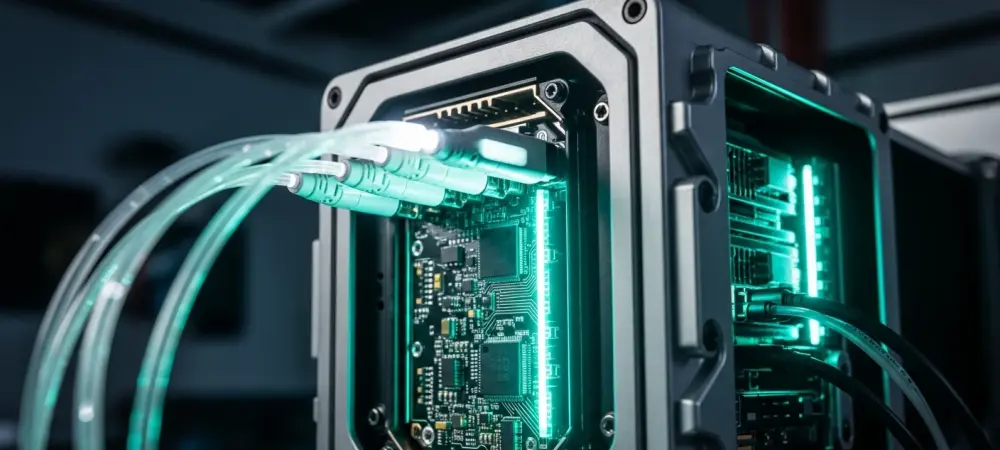
The technical maturation of defense AI requires moving intelligence away from centralized servers and directly onto the “edge”—the drones and vehicles operating in the field. This engineering challenge demands systems that are reliable in “contested environments” where communications are jammed and GPS is denied. Unlike consumer software, military AI must be traceable and auditable; commanders must understand exactly how a change in code results in a specific battlefield outcome.
Engineering teams are now focused on creating “hardened” AI that can function without a constant link to a home base. This necessitates incredible breakthroughs in localized computing power and power efficiency. The focus has shifted from experimental features to rigorous aerospace-grade redundancy, ensuring that autonomous systems “just work” in the harshest physical realities of combat. When a drone enters a signal-denied zone, its internal logic must be robust enough to navigate obstacles and complete its mission without human intervention.
Expert Perspectives on the Philosophical Weight of Automated War
Industry leaders emphasize that while AI can operate at “machine speed,” the decision to employ lethal force must remain a human responsibility. Expert consensus supports the “human on the loop” framework to maintain accountability and judgment. However, practitioners like Tucker Hamilton warn of the “weight of warfare”—the risk that by distancing society from the visceral reality of combat through automation, we may lose our grasp on the gravity of war itself.
There is an inherent tension between using technology to preserve human life and the moral necessity of remaining connected to the sacred value of that life during conflict. As we automate the mechanics of killing, the psychological distance between the decision-maker and the target increases. Ethical frameworks must be developed in tandem with the technology to ensure that the speed of the machine does not outpace the conscience of the commander, preserving the human element in an increasingly cold and calculated battlespace.
Strategic Frameworks for an AI-First Defense Posture
To navigate the transition into the coming decade, defense departments had to implement a software-centric budgetary framework, reallocating funds from heavy-metal procurement to drone fleets and digital infrastructure. National security now depended on “innovation at scale,” which required revitalizing the domestic manufacturing base to produce mass quantities of inexpensive, intelligent systems. Leaders successfully transitioned personnel from direct operators to supervisors of autonomous swarms, ensuring that human-AI collaboration remained the standard. This strategy prioritized industrial capacity as a primary form of deterrence, ensuring that the ability to out-produce and out-code an adversary became the ultimate preventative measure against global conflict. Moving forward, the focus shifted toward establishing international norms for autonomous behavior to prevent accidental escalation. By investing in resilient, distributed networks rather than vulnerable, centralized hubs, nations secured a future where the cost of aggression far outweighed any potential gain, effectively using silicon as a shield for peace.