

A New Benchmark for Physical AI in Shipbuilding
Backlogged yards racing to deliver complex warships faced a stubborn truth: the hardest hours sat inside welding arcs, blasting booths, and inspection gates where variability punished rigid automation and delays multiplied across billion‑dollar programs. That pressure created space for High‑Yield Production Robotics (HYPR), Huntington Ingalls Industries’ integrated line that fuses adaptive welding from Path Robotics, surface operations from GrayMatter Robotics, and in‑process inspection and movement into a coordinated “physical AI” system tuned for naval fabrication.
HYPR arrived as a response to two intertwined constraints—labor scarcity and uncompromising quality. Rather than sprinkling point tools across the yard, the program concentrated on bottlenecks that set schedule risk and rework cost. The novelty was not a single breakthrough robot; it was a production architecture that treats welding as the nucleus, surfaces as the stabilizer, and inspection as the arbiter, all orchestrated through shared data and job routing. That stack mattered because end‑to‑end coherence, not gadget count, determines whether cycle time and first‑pass yield actually move.
How HYPR Works: From Perception to Orchestration
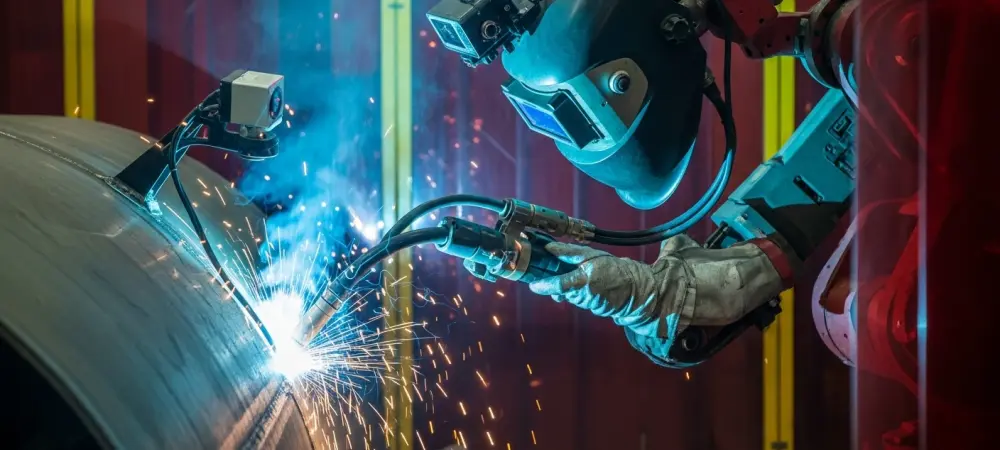
At HYPR’s core sits Path Robotics’ Obsidian AI, which senses joint geometry, fits parametric models to imperfect parts, and plans bead sequences that balance deposition with heat input. The system does not assume perfect fixturing; it measures edge location, gap, and misalignment, then adapts travel speed, oscillation, and torch angle in real time. The practical effect is fewer cold laps and burn‑throughs on long seams and fillets, which, in ship steel, translates into fewer destructive tests and cut‑outs. Path’s Rove extends that capability by mounting the welder on a quadruped so the process walks to the work. That mobility cuts the need for heavy fixtures and rollovers on large modules, shrinking non‑value‑added time tied to craning and staging.
GrayMatter’s Factory SuperIntelligence complements welding with autonomous blasting, grinding, sanding, and coating. The system maps large, irregular surfaces, predicts removal rates based on media, pressure, and standoff, and tunes passes to hit a target profile or coating thickness. Feedback from on‑torch or on‑head sensors closes the loop: if roughness drifts or contamination spikes, the path adjusts before quality escapes upstream. This pairing matters because stable surface prep narrows the window of variation that welding must absorb, which in turn lifts deposition without inviting defects.
Inspection binds the cell. Vision, thermal, and acoustic sensors flag porosity risk, lack‑of‑fusion indicators, and undercut as work progresses, not days later at a reinspection bay. Those signals feed back into the next passes—reduce heat input here, slow there, add a weave on the next layer—so the system learns within a job, not just across jobs. Material movement keeps stations fed: coordinated carts and mobile platforms shuttle subassemblies and consumables, prioritizing routes based on job urgency and robot availability to tame idle time that normally hides between islands of automation.
What Performance Looks Like—and Why It Matters
Shipyards track output in linear feet of weld, hours per module, and rework percentage. HYPR targets those directly. Higher effective deposition with guarded heat input shortens arc‑on time without ballooning distortion, while early defect capture prevents full‑panel rework. Surface systems that hold roughness and thickness within tighter bands cut downstream grinding and repaint, which often stall outfitting. Line‑level gains show up as compressed cycle time, steadier WIP, and higher first‑pass yield. Interpreted for a program manager, that means better schedule confidence, not just prettier process charts.
The data layer is essential. HYPR records weld parameters, surface metrics, and inspection results as traceable records. In naval environments, that trace provides both a qualification pathway and a lever for continuous improvement. If a yard observes that porosity clusters against certain gaps or ambient conditions, it can tweak fit‑up or prep standards with evidence rather than anecdote. Cyber and export controls shape that flow; HYPR’s design keeps sensitive models and data within assured boundaries while still enabling cross‑cell optimization.
Why This and Not Competitors
Many vendors offer stellar single‑task robots: fast cobot welders, rugged blasters, clever visual inspectors. HYPR’s edge is integration against real shipyard constraints owned by HII, the prime that sets requirements and controls qualification. Path’s Rove is also a differentiator; mobile, on‑part welding addresses ship‑scale geometry where gantries struggle and part travel is costly. GrayMatter’s large‑area path planning and closed‑loop coating extend beyond cosmetic work into process‑critical surfaces. Competitors can match pieces, but matching the combined line—validated on naval tasks, with shared incentives to iterate in production—is harder than selling a cell in a demo booth.
There is also a cultural difference. HYPR treats welding and surfaces as the keystone, not an afterthought to cutting or kitting. That choice acknowledges where money and schedule slip in heavy steel: heat, distortion, and finish, not barcode scans. The program’s staged proof‑of‑concept and pilot created a rhythm for qualification that pure startups often underestimate and primes alone rarely accelerate.
Limits, Risks, and the Path to Adoption
HYPR still contends with variability that can outstrip sensors: plate flatness swings, out‑of‑tolerance fit‑ups, and heat‑induced movement on ship‑sized seams. Sensor heads must survive grit, vibration, and electromagnetic noise. Integration across welding, finishing, inspection, and movement means orchestration software must handle exceptions gracefully—when a robot times out or a measurement conflicts, the system needs recovery without trapping work in limbo. Training technicians to interpret AI decisions and intervene safely is another adoption hurdle.
Mitigations are built into the plan. Closed‑loop inspection reduces the cost of misses, while mobile platforms shrink fixture dependency. Digital work instructions and job routing steer parts away from blocked stations. Qualification aligned with naval standards ensures repeatability documents keep pace with capability. None of this eliminates risk, but it converts unknowns into bounded engineering problems the yard can schedule and staff.
Strategic Impact and Market Signal
For defense stakeholders, HYPR signals a shift from heroics to systems thinking. End‑to‑end automation that handles large, variable workpieces breaks the belief that only automotive‑style lines deserve full orchestration. If the pilot sustains throughput gains and defect cuts, the implications extend beyond one yard: standard interfaces and shared data models could let multiple U.S. shipyards replicate the template, raising baseline capacity without waiting on greenfield facilities.
Commercial heavy industry should pay attention. Modules for offshore energy, rail, and heavy equipment share the same enemy—variability at scale. A mobile‑first, inspection‑in‑the‑loop approach changes the ROI math where part travel dominates costs. The differentiator will remain domain fit: whoever owns the qualification path and the pain points will translate “AI” into hours saved and penalties avoided.
Verdict
HYPR proved more than a collection of clever robots; it operated as a production contract between welding physics, surface science, and data discipline. The program’s integration depth, HII’s domain authority, and the mobility of Path’s Rove set it apart from cell‑centric offerings, while GrayMatter’s surface control stabilized the upstream‑downstream handshake that typically undermined weld automation. Risks around variability, sensor robustness, and exception handling remained, but the staged validation and traceable data architecture created credible off‑ramps when things went sideways. For shipbuilders under backlog pressure, HYPR read as a pragmatic bet: measurable throughput, earlier defect capture, and tighter schedule risk in exchange for organizational change and disciplined orchestration. The next step lay in scaling templates across yards, codifying interfaces, and extending physical AI into fit‑up and machining, because the real win came when a line, not a robot, delivered the ship.