

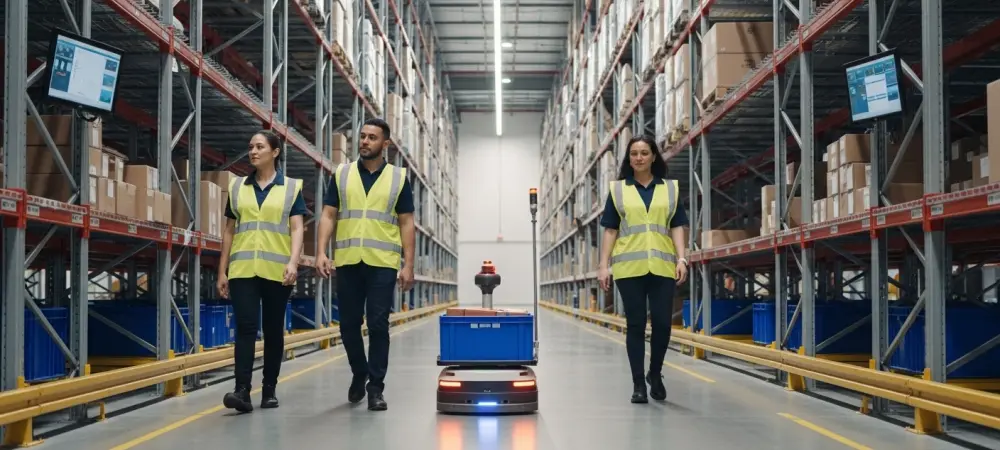
Factories that once froze during supply shocks now test robots that learn, adapt, and act on their own at the network edge across shifts and sites, and that shift signals a turning point for how autonomy converts into real productivity. Physical AI—the fusion of modern AI with embodied machines—has moved from demos to deployments in fields that prize throughput and safety. Warehouse fleets route bins around people using perception-rich mobile platforms, orchards trial robotic harvesters that navigate irregular rows, and insurers send drones to triage storm damage within hours. The pull is clear: tighter labor markets, reindustrialization targets in the U.S. and Europe, and pressure to reconfigure operations fast. The promise is not just lower unit cost, but faster changeovers, safer work in confined spaces, and field-grade decision-making where cloud links are spotty or slow.
From Breakthroughs to Operations: What Makes It Work
The technical stack matured in ways that mattered to executives tasked with uptime. Vision-language and action models improved scene understanding, enabling robots to generalize from sparse data rather than memorize narrow routines. Scaled simulation with platforms like NVIDIA Isaac Sim and MuJoCo let teams train policies on digital twins, then validate them against edge cases—poor lighting, occlusions, or pallet overhangs—before a wheel touched concrete. An AI-robot-data loop tightened: after-action logs, camera frames, and force-torque traces fed back into model updates, shortening iteration cycles. On-device compute such as NVIDIA Jetson Orin and Qualcomm RB5 pushed perception and planning to the edge, cutting latency and operating even when the backhaul dropped. Business models adapted too: Robotics-as-a-Service from Locus Robotics or Zebra’s Fetch reduced capex, while safety standards like ISO 10218 and ISO/TS 15066 guided human-robot collaboration on mixed floors.
This foundation showed its worth in concrete use cases. In e-commerce fulfillment, Amazon’s Sparrow system advanced item handling and worked alongside mobile robots, while 3PLs scaled LocusBots to absorb peak seasons without permanent headcount spikes. In agriculture, John Deere’s autonomous tractors and See & Spray used computer vision to cut input waste and operate during labor gaps. Inspection and disaster assessment leaned on Skydio-class drones that ran inference on-board, helping carriers prioritize claims and dispatch adjusters where impact was highest. Manufacturers piloted adaptive assembly with trajectory transformers that re-planned grasps when fixtures drifted. Even humanoid pilots drew attention—Agility Robotics’ Digit in Amazon trials and announcements from Figure and Tesla—but managers treated them as longer-horizon bets given gait robustness, dexterous manipulation, and cost-of-train hurdles. The near-term value clustered around task-specific systems that combined simulation-trained policies with edge deployment and tight MHE and MES integrations.
Getting to Scale: Value, Timelines, and Guardrails
Enthusiasm alone did not scale fleets; disciplined execution did. Brownfield integration required mapping AI agents into existing PLC logic, WES/WMS flows, and quality gates, with change-control baked in. Procurement teams shifted to outcome-based contracts and RaaS to align incentives on uptime and picks-per-hour. Workforce planning got specific: technicians trained to label sensor anomalies, operators learned exception handling, and safety officers used risk assessments that paired ISO guidance with site telemetry. Regional strategy mattered. U.S. and EU reindustrialization goals made Physical AI a lever for onshoring, while Japan’s demographic squeeze accelerated adoption in retail restocking and automotive sub-assembly. Public confidence varied by country, so leaders phased rollouts: start in closed facilities, add cobot cells with clear e-stops and light curtains, then extend into semi-public settings only after incident-free hours and third-party audits accumulated.
Actionable next steps had been clear for teams aiming to convert promise into margin and resilience. Organizations that succeeded started a portfolio with three tracks: a quick-win pilot for a hazardous task, a simulation-first cell in a core line, and a field operation where edge inference cut delays. Vendor choices had been stress-tested on four metrics—mean time between failures, cycle-time variance under perturbations, recovery from out-of-distribution events, and integration effort into MES/ERP. Governance frameworks had been codified early: data retention for robot logs, human-in-the-loop policies, and red teaming for unsafe behavior. A two-year roadmap from 2026 to 2028 sequenced scale: site A validated autonomy under supervision, site B added fleet orchestration across shifts, and site C localized models for new SKUs. By treating humanoids as a research hedge, doubling down on task-focused systems, and engaging regulators and workers upfront, Physical AI translated breakthroughs into dependable business value.