

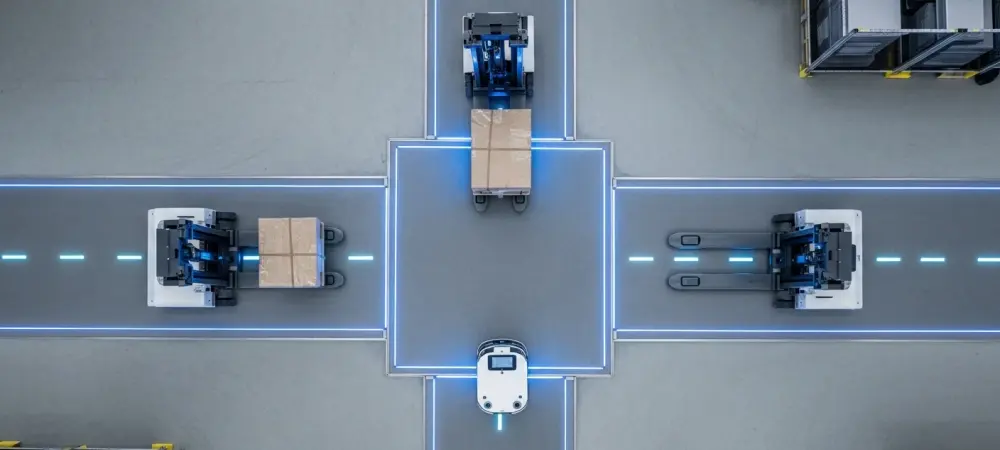
The industrial manufacturing floor is no longer a monolith of single-brand machinery but a complex ecosystem where the success of automation hinges entirely on how well disparate machines speak a common language to each other. Historically, facilities operated in a state of fragmentation, where one vendor’s automated guided vehicles (AGVs) occupied a specific zone while another’s autonomous mobile robots (AMRs) lived in another. This operational segregation created “automation silos,” leading to inefficient floor space usage and redundant infrastructure. The shift toward interoperability represents the dismantling of these walls, favoring a unified approach where different hardware types coexist within a single, orchestrated workflow.
By integrating AMRs and AGVs into a cohesive fleet, companies are moving toward collaborative industrial ecosystems. This evolution is not merely a matter of convenience; it is a strategic response to the increasing complexity of modern supply chains. As manufacturers demand more agility, the reliance on proprietary, closed-loop systems has become a liability. True orchestration requires a framework that transcends the specific hardware capabilities of an individual robot, focusing instead on the holistic movement of goods across a facility regardless of the brand name on the chassis.
The Foundation of Multi-Vendor Robot Orchestration
Modern orchestration relies on the fundamental principle of unified communication, which serves as the nervous system for a heterogeneous fleet. Instead of each robot operating on its own internal map and logic, the integrated approach utilizes a shared data layer to coordinate movements. This integration allows high-agility AMRs, which navigate dynamically around obstacles, to work alongside traditional AGVs that excel at high-capacity, fixed-path transportation. The goal is to move past simple coexistence toward a state of active synergy where robots from different manufacturers share the same environment without conflict.
The relevance of this shift cannot be overstated in the current technological landscape. As industries move toward smaller batch sizes and more frequent line changes, the rigidity of isolated systems becomes a bottleneck. Open industrial ecosystems allow for a “best-of-breed” procurement strategy. Rather than being forced to buy every robot from a single vendor to ensure they can talk to one another, manufacturers can now select specific hardware that meets a unique functional requirement, trusting that the underlying communication architecture will handle the integration.
Technical Frameworks Enabling Fleet Integration
The VDA 5050 Communication Protocol
The VDA 5050 standard has emerged as the primary open-source bridge between mobile robot hardware and master control software. It functions by standardizing the way tasks are assigned and how status reports are transmitted back to a central hub. By using a standardized JSON-based messaging format over MQTT, the protocol ensures that a control system can send a command to a robot from Vendor A or Vendor B using the same syntax. This removes the need for custom drivers for every new piece of equipment, effectively lowering the barrier to entry for complex, multi-brand deployments.
The significance of VDA 5050 lies in its role as a stabilizer for the factory floor. It allows for advanced traffic management, such as intersections where robots from different brands must yield to one another. Without this common protocol, managing a mixed fleet would require a human dispatcher or a prohibitively expensive custom software layer. By providing a clear roadmap for status reporting—including battery levels, position, and error codes—it enables a transparent view of the entire operation within a single interface, which is critical for maintaining uptime.
Centralized Fleet Control and Middleware
Software providers and orchestration tools have evolved to become the “brain” of the operation, sitting above the physical robots to manage job assignment logic. These platforms analyze the entire floor in real time, determining which robot is best positioned to take on a specific task based on its current location, payload capacity, and battery status. This centralized intelligence is what makes synchronized environments possible, as it prevents the gridlock that occurs when independent systems try to claim the same path simultaneously.
Technical performance in these environments is often measured by the latency and reliability of the middleware. In a high-speed manufacturing setting, even a few seconds of communication delay can result in a significant drop in throughput. Orchestration tools must handle complex logic, such as rerouting a fleet when a corridor is blocked or prioritizing a high-value delivery over a routine stock replenishment. The transition from basic connectivity to this level of active management represents the true value of middleware in modern intralogistics.
Current Shifts and Strategic Developments
A major development in the sector is the move toward open-sourcing connectors and the decline of expensive, proprietary middleware. Industry leaders like OTTO Motors have pioneered this shift by certifying their entire AMR lineup—including the 100, 600, 1200, and 1500 models—with third-party VDA 5050 software providers. This decision to prioritize standardization over lock-in signals a maturation of the market. When major players open-source their connection logic, it forces the entire industry toward a more transparent and accessible model, reducing the technical debt for the end-user.
This strategic pivot is also driven by the arrival of standardized certifications that guarantee interoperability. In the past, claiming “compatibility” was often a marketing tactic that required significant engineering work to realize. Today, rigorous testing with software providers like SYNAOS or Idealworks ensures that a robot is truly “plug-and-play.” This development allows manufacturers to scale their automation footprints rapidly, as adding a new robot to the fleet no longer requires starting the integration process from scratch.
Industrial Use Cases and Operational Gains
The automotive and electronics sectors have been the primary beneficiaries of mixed fleet deployments. In automotive plants, AGVs are often utilized for heavy-duty tasks like moving chassis through a predictable assembly line, while AMRs handle the delivery of smaller components to specific workstations. By using a standardized protocol to manage both, these facilities have seen measurable improvements in throughput. Some implementations have reported efficiency gains of up to 51 percent compared to configurations where AGVs operated in isolation.
These gains are largely attributed to the optimization of floor space and the elimination of redundant travel. When robots can share the same lanes and understand each other’s intentions, the “silo” effect is eliminated. This synergy reduces traffic congestion and allows for a more compact facility layout. In electronics manufacturing, where product lifecycles are short and layouts change frequently, the ability to reconfigure a mixed fleet without rewriting the entire control system provides a significant competitive advantage in terms of operational flexibility.
Persistent Challenges in Heterogeneous Environments
Despite the progress, technical hurdles remain in highly volatile settings where layouts shift daily or even hourly. Current standards like VDA 5050 are highly effective for repeatable workflows, but they can struggle in environments that require high levels of non-scripted autonomy. When a robot must navigate an entirely unmapped area or handle a unique, one-off task, the basic communication protocols may not provide enough context for the master control system to make an informed decision.
There is also a continued need for advanced orchestration software to complement basic protocols. While VDA 5050 provides the language, it does not provide the “wisdom” to manage complex logistics. Ongoing development efforts are focused on bridging this gap, integrating artificial intelligence to predict traffic patterns and optimize energy usage across the fleet. The challenge lies in maintaining the simplicity of an open standard while adding the sophisticated layers of logic required for truly autonomous, large-scale industrial operations.
The Evolution Toward Plug-and-Play Automation
The future of the industry is clearly trending toward a “plug-and-play” model where hardware becomes increasingly commoditized, and value is driven by the intelligence of the orchestration layer. We are seeing a shift from basic connectivity toward high-level task optimization, where the system doesn’t just tell a robot where to go, but understands the most efficient way to balance the workload of the entire factory. This reduction in technical debt will be the primary driver for global manufacturing scalability over the coming years.
Breakthroughs in compatibility will likely lead to a world where a manufacturer can unbox a robot, scan a code, and have it integrated into the existing fleet within minutes. This level of accessibility will allow mid-sized and smaller industrial sectors to adopt advanced robotics, as they will no longer need a dedicated team of software engineers to maintain the system. The focus is shifting from “how do we make these robots talk” to “how do we make this fleet move as efficiently as possible.”
Final Evaluation of Interoperability Standards
The transition toward interoperable standards marked a definitive turning point in how industrial engineers approached floor scalability. By moving away from restrictive, vendor-locked architectures, organizations gained the ability to prioritize hardware based on specialized performance rather than software compatibility. The focus shifted toward long-term technical health, where reducing integration debt became as important as immediate cycle times. This shift ensured that automation investments remained viable even as facility needs evolved.
Ultimately, the breakdown of automation silos democratized access to high-level robotics for various industrial sectors. It allowed for a more modular approach to growth, where companies added capacity in increments without fearing a total system overhaul. The commitment to open protocols and standardized certifications created a more resilient manufacturing landscape. Decisions made during this era established the groundwork for a more accessible, efficient, and interconnected future in global intralogistics.