

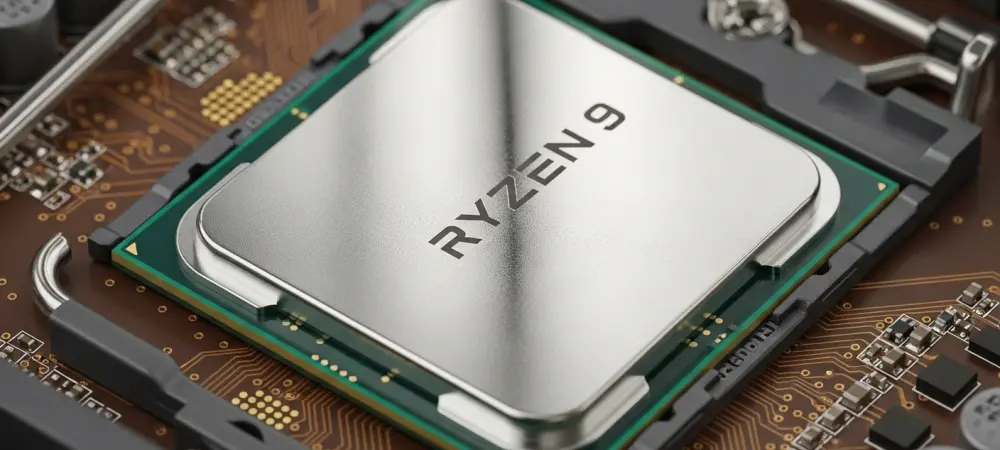
The hardware landscape has undergone a radical transformation with the official launch of the AMD Ryzen 9 9950X3D2 Dual Edition, a processor that fundamentally shifts the technological boundaries for consumer and professional-grade silicon. This release represents the ultimate culmination of intensive technological prototyping and years of speculation, effectively moving the dual-stacked 3D V-Cache architecture from a niche engineering concept into a commercially available reality for the global market. Positioned as the undisputed flagship of the Zen 5 lineup, the 9950X3D2 Dual Edition was meticulously engineered to redefine performance expectations for developers, content creators, and AI researchers who demand immense throughput and extremely low-latency data access. By prioritizing a massive memory pool over raw clock speed increments, AMD has signaled a shift in how high-end computing power is measured, moving away from frequency-centric benchmarks toward a more holistic view of system efficiency and data processing capabilities.
Dual 3D V-Cache Architecture: Expanding the On-Chip Horizon
For the first time in the history of desktop processors, the implementation of a dual 3D V-Cache architecture has broken the long-standing tradition of enhancing only a single Core Complex Die (CCD) within the processor housing. Historically, the strategy involved stacking additional L3 cache on just one of the two CCDs to manage thermal output and maintain high boost clocks on the standard die, but the Ryzen 9 9950X3D2 disrupts this paradigm by equipping both 8-core CCDs with the specialized X3D enhancement. This structural evolution results in a staggering 208 MB total cache pool, a figure that significantly dwarfs previous consumer-level offerings and positions this specific chip as a critical bridge between traditional high-end desktops and enterprise-level workstations. The decision to double the vertical cache suggests that the manufacturing process has reached a level of maturity where thermal density can finally be managed across the entire surface of the silicon package. This unprecedented amount of on-chip memory effectively addresses the “memory wall” that has plagued modern computing, allowing the processor to store and retrieve massive datasets without frequently relying on the much slower system RAM. When both CCDs are accounted for, the L3 cache alone totals 192 MB, which, when combined with the 16 MB of L2 cache, provides a total of 208 MB of high-speed memory directly accessible to the 16 physical cores. Such a vast “on-chip” memory pool is specifically designed to minimize the time a CPU spends waiting for data, which remains a critical bottleneck in complex computational tasks like large-scale simulation or real-time data analysis. By ensuring that both 8-core clusters have equal access to expanded cache, AMD has eliminated the scheduling complexities that previously forced operating systems to prioritize specific cores for gaming or background tasks, creating a more uniform and predictable performance profile across the entire thread count.
Balancing Power and Thermal Management: The Engineering Trade-offs
To successfully accommodate this massive memory hierarchy within the existing AM5 socket constraints, the 9950X3D2 features specific technical adjustments that differentiate it from its standard Ryzen 9 predecessors. While it maintains the familiar 16-core, 32-thread configuration, the processor now operates with a thermal design power (TDP) of 200W, which stands as the highest out-of-the-box rating for any processor on the AM5 platform to date. This 30W increase over single-stack counterparts was a necessary compromise to power the additional transistors required for the dual-cache layout, necessitating high-end cooling solutions for stable long-term operation. Furthermore, the boost clock has been strategically set at 5.6 GHz, which is approximately 100 MHz lower than the standard non-dual variant, reflecting a conservative approach to maintaining silicon longevity under the increased thermal pressure of two stacked vertical dies.
Managing the heat generated by these dual stacks required a refined approach to the 2nd Generation 3D V-Cache technology, which offers improved thermal conductivity compared to earlier iterations of the stacking process. Because the cache is placed directly on top of the logic gates, it acts as an insulator, making it difficult for heat to escape the core complex dies; however, advancements in thinning the silicon and the use of better structural materials have mitigated this risk. This strategic balance ensures that the 192 MB of L3 cache can function efficiently at high utilization rates without triggering thermal throttling that would otherwise negate the performance benefits of the expanded memory. The engineering focus here was not on achieving the highest possible peak frequency, but rather on maintaining a sustained, high-performance state where the processor can leverage its massive cache to process more instructions per clock cycle than was previously possible.
Market Positioning and the Rise of AI Workstations
With a manufacturer’s suggested retail price of $899, the Ryzen 9 9950X3D2 is positioned as a specialized professional tool rather than a general-purpose component for the average home user or hobbyist. While gamers have long enjoyed the benefits of 3D V-Cache, the dual-stack configuration is specifically optimized for workstation-tier tasks such as complex 3D rendering, large-scale software compilation, and financial modeling. It is particularly valuable for the rapidly expanding field of local Artificial Intelligence applications, specifically Retrieval-Augmented Generation (RAG) models, where the ability to access and manipulate large datasets rapidly within the cache is a primary performance bottleneck. By providing this level of specification on a consumer platform, AMD allows researchers to run complex local models that previously required significantly more expensive enterprise hardware with specialized interconnects.
This launch also serves as a preemptive move against competing architectures, asserting dominance in the “prosumer” sector by offering specifications that were previously only available in the more expensive Threadripper or EPYC product lines. Despite the sophisticated internal architecture, the 9950X3D2 remains highly accessible through its “drop-in” compatibility with existing AM5 motherboards, requiring only a BIOS update rather than a total system overhaul. This allows professionals who are already invested in the AM5 ecosystem to upgrade their performance significantly without the overhead of purchasing new memory kits or specialized cooling mounting brackets. By maintaining this compatibility, the processor secures its place as the top-tier choice for users who need enterprise-level throughput but prefer the smaller footprint and lower cost of a standard desktop workstation environment.
Actionable Insights for the Next ErLooking Forward
The arrival of the dual-stack architecture proved that modular, vertically integrated silicon was the most viable path forward for the high-end computing market. Professionals who integrated the 9950X3D2 into their workflows found that the investment paid for itself through drastically reduced compile times and smoother handling of massive datasets in real-time. For organizations planning hardware refreshes, the transition to dual-cache systems offered a way to extend the lifespan of the AM5 platform while gaining performance metrics that rivaled traditional entry-level server hardware. It became clear that the future of desktop performance was no longer tied solely to the number of cores or the frequency of the clock, but rather to the efficiency of the data path and the proximity of high-speed memory to the processing units themselves.
Moving into the next phase of computing, the success of this processor suggested that software developers would need to optimize their applications to better utilize these massive on-chip memory pools. The industry began to see a shift toward cache-aware programming, where algorithms were specifically tuned to fit within the 208 MB envelope to maximize execution speed. For the individual user, the practical takeaway was the importance of matching this high-throughput CPU with equally capable storage and networking solutions to prevent external bottlenecks from limiting the system’s potential. As the market adapted, the 9950X3D2 served as the blueprint for a new generation of “intelligent” hardware that prioritized data movement efficiency, ultimately setting the standard for what a professional-grade desktop should be capable of achieving in a modern digital environment.