

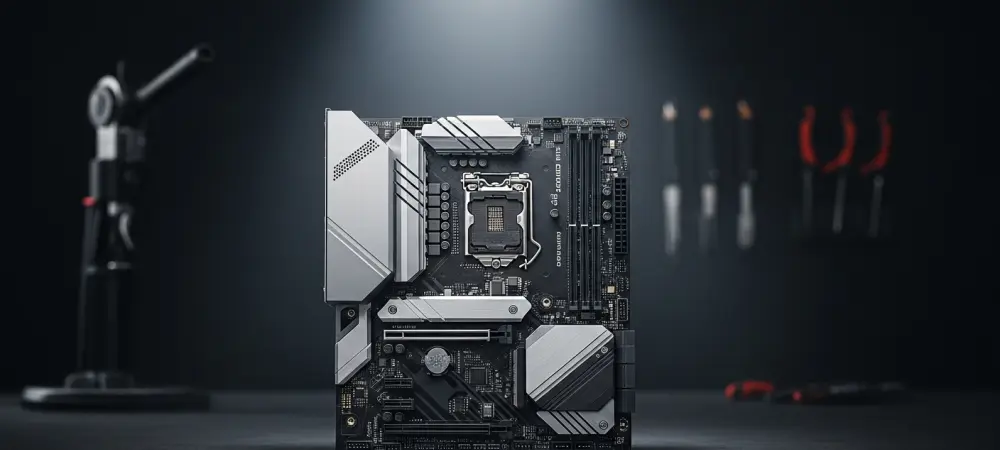
The evolution of modern desktop computing has moved beyond mere speed and entered a phase where the architectural elegance of a system is as significant as its benchmark scores. The B850M Aorus Stealth is a primary example of this shift, as it attempts to solve the persistent issue of cable clutter by moving all essential power and data connectors to the reverse side of the PCB. This design allows for an entirely clean front chamber, which not only enhances the visual appeal of a build but also significantly improves internal airflow patterns. Traditional motherboard layouts often force builders to route bulky cables across the surface of the board, obstructing the view of high-end components and trapping heat in stagnant air pockets. By adopting the back-connect standard, this motherboard enables a more streamlined assembly process that emphasizes the clean lines of the hardware while preparing systems for the demands of high-performance tasks in modern computing environments.
Structural Innovation: The Back-Connect Design
Relocating the 24-pin ATX, CPU power, and fan headers to the rear of the motherboard facilitates a more direct connection to the power supply, reducing the physical strain on the PCB and simplifying the cable management process. This structural change requires a compatible chassis designed with specific cutouts to accommodate the rear-facing ports, ensuring that the connectors are easily accessible from the cable management side of the case. For builders, this means that the front of the machine remains a pristine showcase for the CPU cooler, memory modules, and graphics card, without the distraction of protruding plastic connectors or braided cables. Engineering a board with connectors on the reverse side also necessitates a high degree of precision in the manufacturing process to ensure that the mechanical stability of the board is not compromised. The result is a robust platform that effectively merges the motherboard and the case into a single cohesive unit for superior build quality and performance. Beyond the aesthetic benefits, the Stealth configuration plays a critical role in the thermal management of the entire system by removing physical obstacles that usually hinder the movement of cool air. In a standard mid-tower configuration, cables can act as barriers that disrupt the laminar flow of air from intake fans, often leading to higher temperatures for sensitive components like the VRM and NVMe drives. With the B850M Aorus Stealth, the path from the front intake to the rear exhaust is completely unobstructed, allowing for more efficient heat dissipation even at lower fan speeds. This silence-to-performance ratio is a key consideration for professionals who require a quiet working environment without sacrificing the reliability of their hardware under sustained loads. Additionally, the inclusion of DIY-friendly features like the EZ-Latch ensures that the lack of front-facing wires does not make hardware installation difficult. These refinements represent a thoughtful approach where every design choice serves a purpose.
Technical Performance: Future-Ready Features
The B850M Aorus Stealth is built upon the AMD B850 chipset, providing a high-performance foundation that supports the latest Ryzen processors and offers full compatibility with PCIe 5.0 storage devices. This ensures that the system is ready for the next generation of ultra-fast NVMe SSDs, which are essential for tasks ranging from high-resolution video production to complex scientific simulations. Memory stability is another priority, with the board utilizing a sophisticated trace routing design that allows for high-frequency DDR5 memory modules to operate at their full potential through optimized EXPO profiles. From 2026 to 2028, the AM5 platform is expected to serve as the benchmark for desktop versatility, and this motherboard secures that longevity through a robust VRM phase design that provides clean power to the CPU. The inclusion of Wi-Fi 7 and 2.5GbE LAN ensures that external data transfers are as fast as internal bus speeds, making it an ideal choice for users who depend on high-speed internet for cloud-based professional workflows.
Builders who prioritized a clean workspace found that the B850M Aorus Stealth provided a superior path toward a truly cable-free environment that did not compromise on technical specifications. It was recommended that users verify chassis compatibility prior to assembly to ensure a seamless fit for the rear-mounted connectors, as this remains a critical step in the specialized build process. Those who successfully integrated this motherboard into their systems achieved a level of visual clarity that redefined their expectations for modern PC aesthetics. Looking ahead, the expansion of the back-connect ecosystem will likely drive even more innovation in case design and peripheral connectivity, further simplifying the assembly process for future users. Professionals emphasized that focusing on thermal headroom and high-speed storage compatibility would maximize the long-term value of these systems. Ultimately, the adoption of this platform demonstrated that concealment of internal wiring was a vital step in highlighting the true potential of the hardware.