

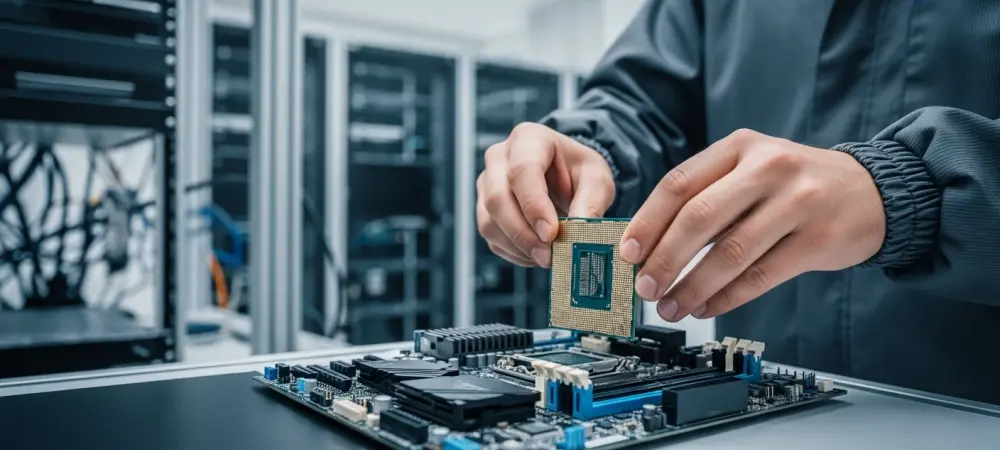
The global transition toward massive artificial intelligence workloads and cloud-native environments has pushed server hardware requirements to unprecedented levels, forcing a radical departure from traditional silicon design philosophies. As enterprise users demand higher throughput for large language models and real-time data processing, the focus has shifted toward extreme core density within a single socket. The upcoming Zen 6 Venice platform represents a significant milestone in this evolution, introducing 256 physical cores to the Epyc product line through refined chiplet interconnects. This architectural shift utilizes the advanced SP7 socket, which accommodates the increased thermal design power and signaling requirements of next-generation silicon. By leveraging a sophisticated fabrication process, the platform achieves higher energy efficiency while maintaining the clock speeds necessary for diverse compute tasks. This balance ensures that massive data centers scale.
Venice Architecture
Building on this foundation, the Venice lineup utilizes a highly modular chiplet design that separates compute dies from specialized input-output functions more effectively than previous iterations. The integration of 256 cores suggests a configuration of multiple core complex dies, each featuring optimized Zen 6 instruction sets that enhance per-clock performance across floating-point and integer operations. Memory subsystems have also seen a major overhaul, with support for advanced DDR5-6400 and MRDIMM technologies providing the bandwidth necessary to feed such a high number of active cores simultaneously. This design prevents the bottlenecks common in high-density chips where data starvation often limits the utility of additional units. Furthermore, the expansion of PCIe Gen6 lanes enables faster communication with high-speed storage and accelerators, which is critical for heterogeneous computing. Such advancements allow processors to handle complex multitenant workloads efficiently.
Deployment Strategy
Integrating these high-density processors required a comprehensive rethink of existing infrastructure, as organizations evaluated their power delivery systems to support the increased demands of 256-core architectures. System administrators focused on liquid cooling solutions and modular rack designs to manage the thermal output effectively while maximizing rack density. The shift toward the Zen 6 Venice platform encouraged a more granular approach to virtualization, where single sockets handled hundreds of isolated containers without performance degradation. Technical teams prioritized firmware updates and BIOS optimizations to ensure compatibility with the new SP7 interface and the expanded memory channels. Looking ahead, the focus shifted to optimizing software stacks to utilize the massive thread counts provided by this generation of silicon. These developments provided a roadmap for future-proofing data centers against rising complexity. This ensured stability for early adopters.