

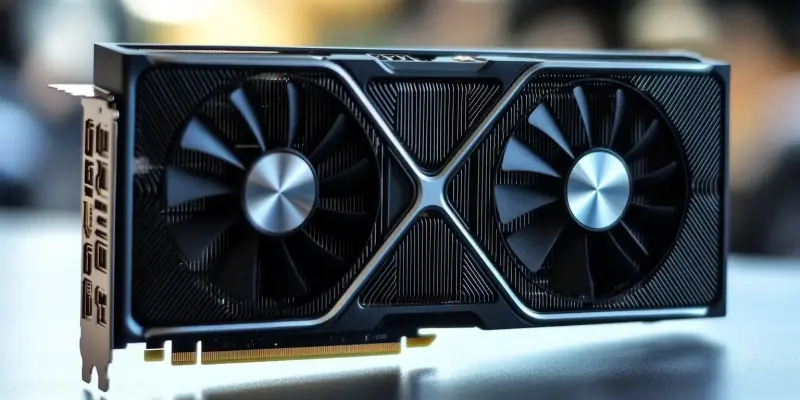
According to PassMark’s G3D Mark tests, the RTX 4090 has narrowly outpaced the RTX 5090, securing an average score of 38,430 points—just 23 points higher than its successor. The RTX 4090’s slight lead in PassMark’s G3D Mark tests can primarily be attributed to its established position in the market, allowing it to garner a more substantial number of tests and data points. Unlike the RTX 5090, which has relatively fewer samples due to its recent release, the RTX 4090’s broader test base has skewed its average performance score in its favor.
Notably absent in these tests is a focus on ray tracing performance, a critical factor in real-world gaming scenarios where the RTX 5090 is expected to shine. Technical specifications and synthetic benchmarks have long been the cornerstone of assessing GPU prowess. However, their real-world applicability to user experiences can sometimes diverge. While the RTX 4090 shows higher G3D Mark scores, gaming enthusiasts might not feel the difference in actual gameplay, especially in games that make extensive use of ray tracing. The RTX 5090, despite its lower composite score, demonstrates superior performance in such demanding, real-world gaming environments.
Despite its apparent advantages in real-world gaming performance, the RTX 5090 faces several hurdles that affect its market readiness and adoption. One of the primary obstacles is its limited availability, which has driven prices higher than anticipated. Supply chain issues and production bottlenecks have contributed to this scarcity, making it difficult for gamers to get their hands on the latest hardware. Furthermore, the RTX 5090 is plagued by a range of technical issues that have been widely reported. These include missing Render Output Units (ROPs), black screen issues, and problematic melting connectors.
These technical challenges not only hamper the user experience but also have a direct impact on the GPU’s performance metrics. Missing ROPs, for instance, result in less efficient data processing, while black screen issues disrupt gameplay continuity. Melting connectors are a more severe problem, posing potential safety risks and necessitating immediate attention from NVIDIA. Resolving these issues is critical not only for improving the RTX 5090’s user experience but also for ensuring that its performance scores catch up to its real-world potential.
In a tech landscape where performance metrics and benchmarks are often the gold standard for evaluating new advancements, the latest performance insights on NVIDIA’s GeForce RTX 4090 and the newer RTX 5090 have garnered substantial attention. According to PassMark’s G3D Mark tests, the RTX 4090 has narrowly beaten the RTX 5090, achieving an average score of 38,430 points—just 23 points more than the newer model. These initial results paint a compelling picture, but a deeper dive reveals that raw scores may not fully capture the real-world gaming performance differences between these two high-powered GPUs. While benchmarks offer a snapshot of potential, many factors, including architecture, software optimization, and individual game performance, can influence the actual experience of using these cards. Thus, while the RTX 4090 currently boasts a slight edge in benchmark scores, discerning gamers and tech enthusiasts might want to consider a broader range of criteria before determining which GPU truly delivers better gameplay and overall value.