

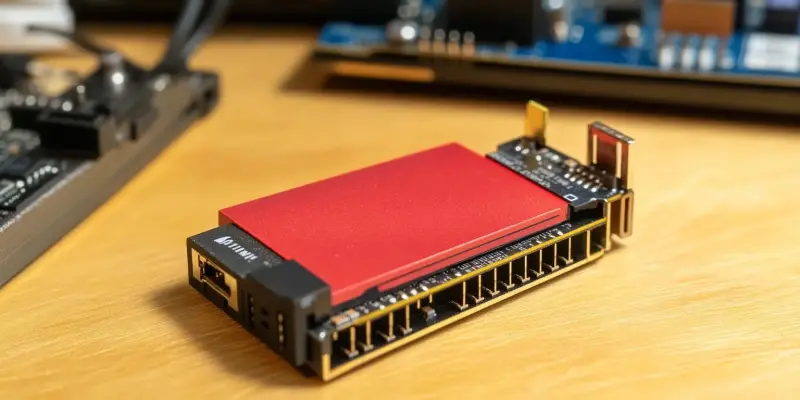
In recent tech developments, the Raspberry Pi community has made significant strides in enhancing the new Raspberry Pi 500 by integrating NVMe storage capabilities into the compact keyboard PC. Originally, the Raspberry Pi 500, which combines the Raspberry Pi 5 into a neat, keyboard-centric design, was targeted as a budget-friendly device for casual browsing and light productivity tasks, with an accessible price tag of just $90. The system comes pre-equipped with a 32GB Class A2 microSD card to handle basic storage requirements. However, in order to keep manufacturing costs low, it lacks support for the faster NVMe M.2 storage.
Initiating the Modding Effort
An anonymous enthusiast laid the groundwork for this modding effort by reaching out to developer and YouTuber Jeff Geerling, providing him with detailed instructions to unlock the potential of an unused PCB header for NVMe storage. On December 13, Geerling shared the comprehensive process on his blog. The detailed modification entails soldering mini capacitors onto the PCIe lines, which appear to lead to an M.2 slot. This intricate process demands advanced skills in surface-mount soldering and the utilization of a high-quality microscope to ensure accuracy. Following the precise placement of the capacitors, the installation of the M.2 socket itself turns out to be relatively straightforward.
Initially, an external bench power supply was employed to energize the M.2 slot and its components, allowing the Raspberry Pi 500 to detect the NVMe storage. However, further experimentation revealed that the existing internal power supply was sufficient. User Samuel Hedrick demonstrated success with this method, showing that the newly integrated NVMe drive could indeed operate on the Raspberry Pi 500’s internal power.
Community Reception and Practicality
The reaction within the Raspberry Pi community has been overwhelmingly positive, with enthusiasts expressing excitement over the marked performance improvements this upgrade introduces. Despite the complexity of the modding process, many experienced hobbyists are drawn to the promise of unlocking significantly higher storage efficiency and speed. Geerling’s blog provides a thorough step-by-step guide for those bold enough to embrace the challenge.
The project has sparked a broader conversation around the capabilities of the Raspberry Pi 500. While it was initially designed with the aim of cost-efficiency and basic functionality, this upgrade highlights the hidden potentials that such compact devices could achieve with a bit of modification. The sentiment among the community underscores a growing belief that the future of budget computing might just reside in the hands of creative and technically gifted hobbyists.
The Future of Raspberry Pi 500
In summary, the addition of NVMe storage to the Raspberry Pi 500 through intricate modding procedures has garnered an enthusiastic response from the user community and stands as a testament to collective ingenuity. This upgrade could potentially revolutionize the inherent capabilities of the keyboard PC, lifting it beyond its initial design constraints centered around affordability.
Although this process is not for the faint of heart and requires a higher level of technical aptitude, it represents an inspiring example of how dedicated enthusiasts can breathe new life and functionality into existing technology platforms. Looking ahead, it is apparent that such efforts may continue to drive innovation within the realm of affordable computing, and the Raspberry Pi 500 might just be the beginning of a new wave of enhanced, low-cost devices.