

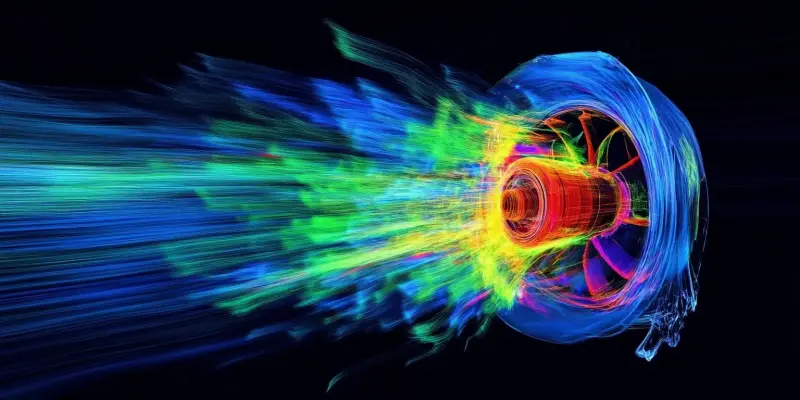
The intersection of computational fluid dynamics (CFD) and advanced computing hardware has opened a new chapter in engineering simulations. In a groundbreaking collaboration, Ansys, Baker Hughes, and Oak Ridge National Laboratory’s Frontier supercomputer demonstrated the potential of AMD’s Instinct GPUs, specifically the MI250X, to transform the landscape of CFD. This initiative showcased that leveraging GPU technology can drastically reduce the time required for complex CFD simulations, achieving unprecedented efficiency and accuracy. Initially, simulations relying on traditional CPU setups took significantly longer, exemplified by a 38.5-hour process on thousands of CPU cores. With the introduction of 1,024 AMD Instinct GPUs, the same task was completed in just 1.5 hours, marking a 96% time reduction and setting new benchmarks for CFD applications.
Implications and Further Applications
The implications of this technological advancement are profound and multifaceted. The speed at which CFD simulations can now be conducted allows for more rapid design iterations, which is crucial for industries focused on advanced engineering and performance forecasting. For instance, the development of next-generation gas turbines and turbomachinery stands to benefit significantly from this innovation. The efficiency in energy conversion and the accuracy of performance predictions are vastly improved, facilitating more refined engineering processes. The advantages are not limited to large enterprises; small and mid-sized businesses can also harness these advancements, potentially leveling the playing field in industrial applications. Even without access to massive high-performance computing systems like Frontier, smaller companies can adopt GPU-based setups to enhance their computational efficiency and accelerate their workloads.
Another noteworthy aspect is the scalability of the solution. The collaboration between Ansys and Baker Hughes indicates that GPU technology can be effectively scaled up to handle large-scale simulations, transforming the approach to industrial CFD analysis. This scalability ensures broad applicability across various sectors, enabling complex problem-solving with greater speed and reliability. Furthermore, the democratization of high-performance CFD simulations suggests a future where advanced engineering tools are accessible to a wider range of companies. The ability to conduct fast, accurate simulations without the need for extensive infrastructure opens up new possibilities for innovation and competition within the industry. The practical benefits of this development extend beyond time savings. With quicker simulation times, engineers can conduct more comprehensive studies within shorter project timelines. This efficiency leads to cost savings, improved resource management, and the ability to tackle more ambitious projects. Enhanced performance forecasting also leads to better-informed decisions, ensuring that designs are optimized before they are brought to production. This capability is indispensable for industries where precision and reliability are paramount, such as aerospace, automotive, and energy. This achievement is a testament to the continuous evolution of computational tools and the role of collaboration in driving technological progress. By merging expertise and leveraging state-of-the-art hardware, Ansys, Baker Hughes, and Oak Ridge National Laboratory have demonstrated the transformative power of GPUs in CFD simulations. While the Frontier supercomputer provided a platform for this breakthrough, the underlying principles and technologies can be adapted for use in other computational environments, further broadening the impact of this advancement.
In conclusion, the integration of AMD’s Instinct GPUs into CFD simulations has set a new standard for efficiency and scalability. This development not only highlights the potential for significant time reductions in complex simulations but also opens doors for smaller enterprises to benefit from high-performance computing. The collaborative efforts have paved the way for more accessible and advanced engineering tools, promising a future where the agility and precision of CFD analyses are within reach for a broader spectrum of industries. As technological advancements continue to unfold, the role of GPUs in transforming computational simulations will likely expand, driving innovation and fostering competitive excellence.