

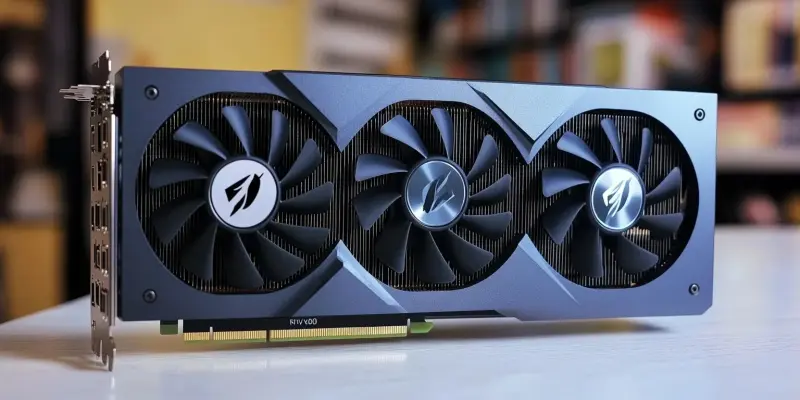
The unveiling of Nvidia’s RTX 5000 series has sent ripples through the GPU market, creating a challenging scenario for AMD as it prepares to launch its own RX 9070 graphics cards. In a market where performance and price are constantly scrutinized, Nvidia’s aggressive pricing strategy for its Blackwell graphics cards has created a significant hurdle for AMD. Initially, AMD’s planned prices for the RX 9070 models were likely higher than those announced by Nvidia, complicating AMD’s position. This unexpected development requires AMD to reassess its pricing strategy urgently to remain competitive and retain its market share. The complexity of this situation is compounded by the current lack of official pricing information from AMD, leading to a state of uncertainty and speculation.
AMD’s Pricing Dilemma
The situation is exacerbated by the perception that AMD was unprepared for Nvidia’s aggressive pricing, disrupting its launch strategy. With the RX 9070 series launch at CES 2025 being notably brief and lacking in detail, it is clear that AMD may have initially intended to gauge Nvidia’s pricing tactics before finalizing its own. Such an approach, while cautious, has left AMD in a state of “launch limbo,” with products reportedly already reaching retailers but no official Manufacturer’s Suggested Retail Price (MSRP) announced. This delay in pricing transparency could potentially harm AMD’s competitive edge as the market eagerly awaits more information.
The internal complications faced by AMD, including the need to renegotiate retail partner agreements and align with revised pricing strategies, add another layer of complexity. Retail partners who had previously agreed to certain price points may now be involved in reassessing and recalibrating these agreements to match the competitive landscape reshaped by Nvidia’s new offerings. This process is not only time-consuming but also fraught with strategic challenges, as it directly impacts AMD’s ability to launch its products effectively. Delays in releasing transparent pricing information could frustrate potential buyers and diminish interest in the RX 9070 series at a critical juncture.
Speculative Pricing and Competitive Positioning
Industry commentators, such as Moore’s Law is Dead, suggest that the lack of definitive pricing information only adds to the confusion surrounding AMD’s launch strategy. Among the speculation, some potential price points are being floated, such as $499 for the RX 9070 and $599 for the RX 9070 XT. These figures, if accurate, could place AMD’s offerings in a competitive position against Nvidia’s RTX 5070 and 5070 Ti. However, this assumes that AMD’s performance metrics for the RX 9070 series align closely with those of Nvidia’s new models. The absence of concrete data leaves room for uncertainty, which is never ideal in a market driven by performance benchmarks and price comparisons.
As the clock ticks down to the anticipated detailed launch around January 23 or 24, 2025, AMD faces increasing pressure to clarify its stance and unveil its pricing structure. The need for clear, competitive pricing is paramount to avoid slipping behind Nvidia, who appears to have gained the upper hand with its aggressive pricing strategy. AMD’s predicament is further highlighted by the urgent necessity to stabilize its position in the market through strategic action. Immediate and authoritative communication regarding pricing could provide the much-needed stabilizing effect, reassuring both retailers and consumers of AMD’s commitment to competitiveness.
The Path Forward for AMD
The unveiling of Nvidia’s RTX 5000 series has caused significant waves in the GPU market, presenting a daunting challenge for AMD as it gets ready to introduce its own RX 9070 graphics cards. With performance and pricing under constant scrutiny, Nvidia’s aggressive pricing strategy for its Blackwell graphics cards has put AMD in a difficult position. Originally, AMD had likely planned to set higher prices for the RX 9070 models compared to Nvidia’s announcements, complicating AMD’s market stance considerably. Now, this unexpected development forces AMD to urgently revisit and potentially revise its pricing strategy to stay competitive and maintain its market share. The situation’s complexity is further heightened by the absence of official pricing details from AMD, leading to a climate of uncertainty and speculation. This lack of information leaves both competitors and consumers guessing, thereby intensifying the pressure on AMD to make strategic decisions quickly to navigate this competitive landscape effectively.