

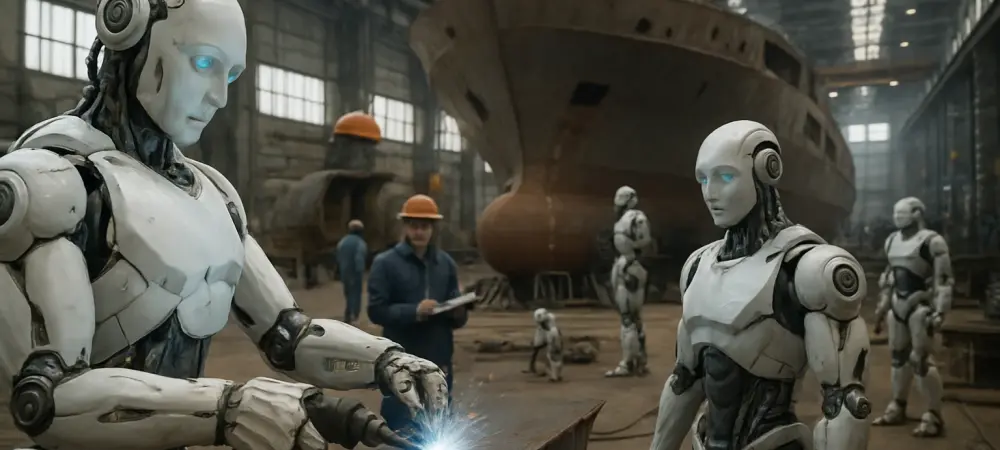
A New Wave in Ship Construction
In the evolving narrative of industrial automation, a groundbreaking partnership between NEURA Robotics and HD Hyundai brings a transformative shift to shipbuilding. This shift raises a provocative question: Can these AI-powered robots truly redefine an industry known for its tradition and manual labor?
Navigating Industry Challenges
Shipbuilding has long faced critical operational hurdles, primarily due to acute labor shortages and persistent safety risks. These challenges are compounded by the complex environments in which ships are constructed, typically exposing workers to demanding conditions. Such obstacles not only threaten productivity but also pose significant safety concerns, underscoring an urgent need for innovative solutions.
Intelligent Robotics Find a Foothold
NEURA Robotics, a leader in cognitive robotics, and HD Hyundai have embarked on an ambitious project to revolutionize shipyard operations. They have developed advanced humanoid and quadruped robots equipped to handle tasks traditionally fraught with risk and complexity. These robots exhibit human-like dexterity and cognitive capabilities, enabling them to perform intricate tasks such as welding and managing logistics across uneven terrains. Early implementations of this technology have already demonstrated marked increases in both efficiency and worker safety.
Insights from Industry Pioneers
David Reger, CEO of NEURA Robotics, emphasizes the expansive potential of cognitive robots to reshape industrial environments. Executive Director Sanghun Ryu from HD Hyundai Samho highlights the development of welding robots specifically tailored to shipbuilding’s rigorous demands. Meanwhile, Younghoon Sang of HD Hyundai Robotics points to the alliance’s pivotal role in enhancing innovation and securing a leadership position in automation technology.
The Path Forward
Implementing such advanced robotics requires strategic planning to reshape current shipyard operations. Training programs and workforce adaptations are necessary to facilitate this transition smoothly. As robotics technology continues to evolve, it is expected to penetrate further into other labor-intensive sectors, offering fresh avenues for operational excellence.
In closing, this collaboration between NEURA Robotics and HD Hyundai signifies a notable milestone in the evolution of automation within shipbuilding. As these cognitive robots take on a more central role, the industry witnesses not just a technological advancement but a paradigm shift toward smarter, safer operations. The success of this initiative paves the way for broader applications of AI-powered robotics, setting a precedent for innovation across diverse fields.