

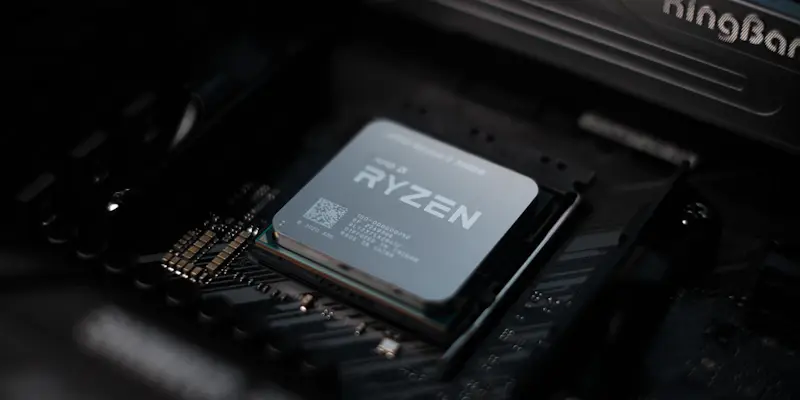
In the world of competitive technology, the fine line between cost-cutting measures and product performance is often explored. Recently, AMD’s Ryzen 5 7400F, a budget six-core Zen 4 CPU, has garnered attention for its overheating issues. Launched in January and primarily targeted at the Chinese market, this CPU aimed to provide an alternative to the more expensive Zen 5, Ryzen 9000 series. However, reviews have revealed significant thermal performance pitfalls which can be largely attributed to its construction.
The Cost-Cutting Measure
Thermal Paste vs. Solder
One primary factor contributing to the Ryzen 5 7400F’s overheating problem is AMD’s decision to use thermal paste instead of solder between the CPU die and the Integrated Heat Spreader (IHS). This decision is peculiar given that it’s uncommon for AMD’s Ryzen series, with exceptions usually seen only in G-series CPUs. The investigation into the CPU’s performance by Bilibili underscored how detrimental this choice has been for the system’s ability to manage heat.
Thermal paste, while economically viable, has inferior conductivity compared to solder. This means it is less efficient at transferring heat away from the CPU die, causing it to retain more heat. As performance tests such as Cinebench R23 revealed, the Ryzen 5 7400F reaches its thermal limit of 95°C and experiences spikes to 105°C under certain conditions. This overheating not only impacts the CPU’s longevity but also leads to throttling, where the CPU reduces its speed to cool down, negatively affecting overall performance.
Why Avoid Solder?
A plausible rationale for avoiding solder could be cost reduction; however, this might not be the sole reasoning. Soldering could potentially increase the risk of CPU die cracking due to thermal expansion and contraction cycles. Nevertheless, this is usually a concern for high-power CPUs, rather than budget options like the Ryzen 5 7400F. The budget CPU’s low power consumption should theoretically negate these concerns, suggesting that the choice was indeed a budgetary measure.
The issue is further exacerbated by the fact that even high-performing cooling systems struggle to compensate for the heat retention caused by thermal paste. For instance, a high-performance 360 mm DeepCool AIO cooler used during tests was unable to curb the thermostat from reaching its peak temperatures. This scenario underscores the stark impact of using thermal paste over solder, particularly in practical, performance-heavy environments.
Performance Concerns
Impact on Daily Usage
The implications of this overheating go beyond synthetic benchmarks and into real-world usage. Users of the Ryzen 5 7400F may experience reduced performance in processor-intensive applications such as gaming, video editing, and software development. The throttling mechanism designed to protect the CPU can kick in during prolonged or intensive sessions, leading to frustrating slowdowns and potentially even system instability.
This is particularly concerning for users who selected the Ryzen 5 7400F expecting reliable performance from a product carrying AMD’s reputable Zen 4 architecture. The discrepancy between expected and actual performance can lead to dissatisfaction and trust issues among consumers, who might feel short-changed by these cost-cutting measures. The market’s response to this issue has been definitive, with many turning to more reliable alternatives or demanding explanations and solutions from AMD.
Alternatives and the Future
In today’s competitive tech industry, balancing cost-cutting measures with product performance is often a challenging task. This delicate act has come under scrutiny with AMD’s recent release of the Ryzen 5 7400F, a budget-friendly six-core CPU based on the Zen 4 architecture. Introduced in January and primarily targeting the Chinese market, this processor was designed as an affordable alternative to the pricier Zen 5, Ryzen 9000 series. However, the Ryzen 5 7400F has been met with criticism due to notable overheating problems.
Reviews have highlighted considerable thermal performance issues, which have dampened the enthusiasm surrounding this CPU. The primary cause for these issues appears to be related to the CPU’s construction and design choices that prioritized cost-saving over thermal efficiency. While it aimed to deliver robust performance at a more accessible price point, the trade-offs have led to significant thermal management concerns. Despite its promising specs, potential buyers should weigh these thermal issues against their needs and consider the overall impact on system performance and longevity.