

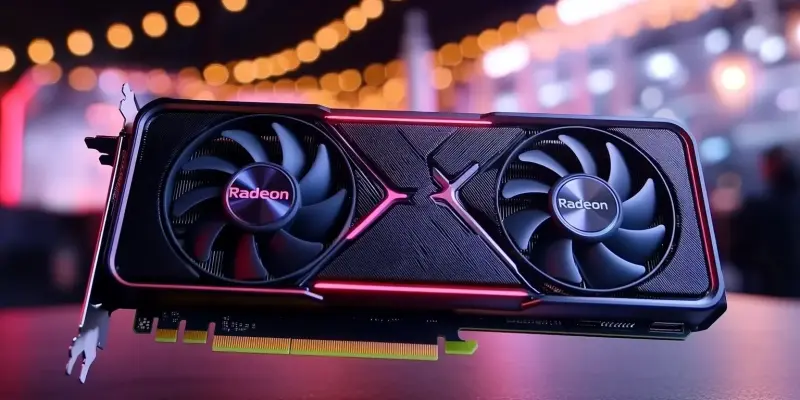
AMD’s Strategic Move in the GPU Market
Targeting Mainstream Gamers
Lisa Su’s confirmation highlights AMD’s strategic intent to capture the “highest volume portion of the enthusiast gaming market,” indicating a blend of performance and affordability. With the gaming community always on the lookout for powerful yet reasonably priced hardware, the Radeon RX 9070’s release could significantly impact market dynamics.
Building Anticipation
Lisa Su’s remarks at the subsequent announcement hinted at a strategic move by AMD, aiming to exert considerable pressure on Nvidia. The delay built a sense of suspense, potentially making the actual reveal even more impactful as the community looks forward to understanding just how AMD’s latest offering stacks up against Nvidia’s established models.
Performance and Pricing
Mid-Range Menace
The Radeon RX 9070 aims to be a “mid-range menace,” riding high on the promise of exceptional performance at a competitive price point. AMD’s approach to native performance presents a compelling proposition as it seeks to challenge Nvidia’s tech advantages head-on. As the gaming community scrutinizes AMD’s claims, the real-world performance of the RX 9070 will be crucial in establishing its reputation as a formidable mid-range option.
Competitive Pricing Strategy
AMD’s marketing head Frank Azos clarified that this was never the pricing strategy. Instead, AMD aims to match Nvidia’s RTX 5070’s MSRP of $549 while striving to outperform it in native performance. Pricing is a critical factor in the competitive landscape of gaming GPUs. With the gaming community highly price-sensitive and performance-focused, this pricing strategy could tip the scales in AMD’s favor.
Market Implications
Skepticism Towards AI Enhancements
The market has shown increasing skepticism towards AI-powered performance enhancements, suggesting a shift towards preferring unassisted performance metrics. As AMD positions itself to capitalize on this skepticism, the RX 9070’s success will likely hinge on its ability to deliver substantial native performance.
Catering to Everyday Gamers
By offering an affordable, high-performance GPU, AMD seeks to capture a significant market share and exert pressure on Nvidia’s mid-range options. AMD’s strategic focus on addressing the needs of everyday gamers highlights a market-savvy approach. This strategy not only caters to budget-conscious gamers but also positions AMD as a champion of democratizing access to top-tier gaming technology, potentially reshaping market dynamics in favor of more accessible, high-performance gaming experiences.
Broader Trends in Gaming Technology
Democratizing High-Performance Gaming
From a marketing perspective, AMD’s commitment to affordable, high-quality 4K gaming aligns seamlessly with the growing trend of democratizing high-performance gaming technology. By tapping into this broader trend, AMD’s Radeon RX 9070 is poised to make a significant impact in the market.
Balancing Performance and Cost
This strategic launch is particularly noteworthy given the current competitive environment, with AMD directly challenging Nvidia’s dominance. AMD’s commitment to pushing technological boundaries is evident, and the Radeon RX 9070 is expected to elevate the standard for graphics processing units. The upcoming months will undoubtedly be critical as the tech community watches to see how the Radeon RX 9070 will perform against Nvidia’s offerings, potentially reshaping the market.