

The strategic alliance between San Francisco-based Foundation Future Industries and AMD marked a decisive pivot in the competitive landscape of humanoid robotics. This partnership challenged the long-standing dominance of Nvidia by introducing hardware specifically optimized for the rugged demands of heavy industry and defense.
The primary objective of this review is to dissect how this integrated silicon approach impacts robotic autonomy. By examining the Phantom MK-2, one can see the shift from experimental AI to commercially viable, durable hardware solutions designed for the current market.
Evolution of AMD Hardware: The Strategic Pivot
The transition toward AMD-powered systems signaled a move away from traditional GPU-centric computing. Foundation Future Industries recognized that general-purpose chips often struggled with the specialized low-latency requirements of a 23-degree-of-freedom humanoid machine.
This partnership prioritized the development of the Phantom MK-2, a robot designed for dual-use applications. This strategic shift positioned AMD as a direct challenger to the Jetson ecosystem, offering a “full-stack” alternative that merged traditional processing with adaptive AI capabilities.
Technical Architecture: Processing and Adaptive Computing
The architectural foundation of these robots relied on a multi-layered compute strategy. This design allowed the robot to process high-level cognitive tasks and low-level motor functions simultaneously without the lag common in older robotic platforms. By integrating disparate computing elements into a unified framework, the Phantom series achieved a more efficient data pipeline. This architecture ensured that every sensor input translated into a physical action with minimal computational overhead.
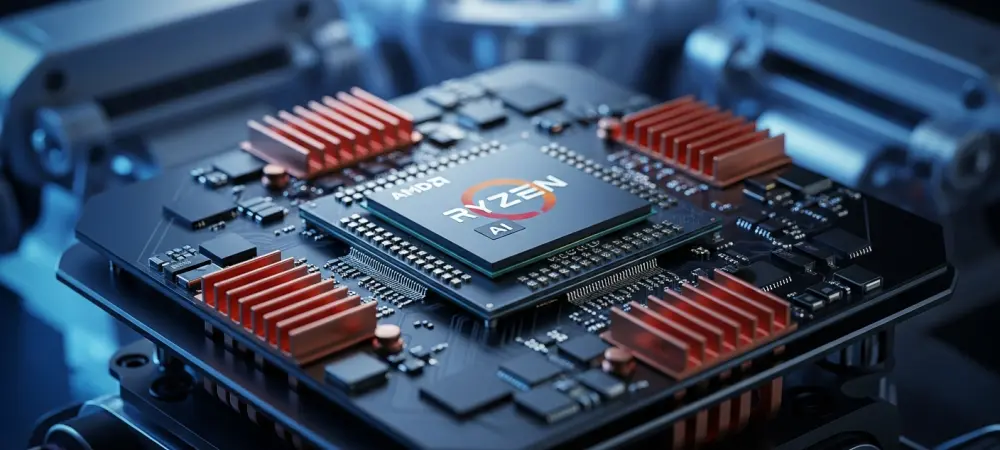
Ryzen AI Embedded X100 Series Processors
The Ryzen AI Embedded X100 Series served as the primary engine for high-level decision-making. These chips provided the necessary inference speeds to handle complex environmental mapping and autonomous labor tasks in real time.
AMD claimed these processors delivered significant performance gains over previous industry standards. This improvement meant the Phantom MK-2 could operate with greater independence, reducing its reliance on external servers for complex spatial reasoning.
FPGA Integration: The Key to Precision
Field Programmable Gate Arrays, or FPGAs, played a vital role in managing the intricate movements of the robot’s tendon-actuated hands. These components provided deterministic control loops, which are essential for maintaining stable tactile feedback during delicate operations.
Unlike standard CPUs, FPGAs allowed the hardware to be reprogrammed for specific physical tasks. This adaptability ensured that the robot could refine its grip and manipulation techniques as new operational requirements emerged in the field.
Emerging Trends: The Full-Stack Hardware Shift
Modern robotics trended toward specialized hardware that prioritized thermal efficiency and low latency. The industry moved away from general processors, favoring integrated solutions that handled the entire robotics pipeline within a single ruggedized unit. Hardware reliability became as critical as software intelligence in this new era. As machines took on more roles in volatile environments, the ability to maintain peak performance under stress became the primary differentiator for successful platforms.
Industrial and Defense Applications: Real-World Deployment
The Phantom MK-2 found immediate utility in automotive manufacturing, where it operated across three consecutive shifts. Its ability to maintain a 24/5 work cycle demonstrated a level of endurance that experimental prototypes had previously failed to reach.
In defense contexts, the ruggedized specifications of the hardware allowed for deployment in hazardous zones. Features like 360-degree vision and IP67 ratings ensured the robot remained operational despite extreme weather or heavy vibrations.
Technical Hurdles: Thermal and Operational Constraints
Managing heat during continuous high-torque operation remained a significant challenge. While low-friction actuators helped, the energy demands of complex humanoid movement often tested the limits of current cooling technologies.
Regulatory obstacles also complicated the deployment of these machines in sensitive areas. Ensuring that hardware-level security prevented unauthorized interference was a top priority for developers working within the defense sector.
Future Outlook: The Road Toward 2035
As the industry moves from 2026 toward 2035, the humanoid market is expected to reach an annual valuation of $50 billion. Future developments will likely focus on enhancing tactile sensing to achieve true human-level dexterity in logistics.
The continued integration of AI and adaptive computing will refine how these machines interact with their surroundings. This trajectory suggests a future where autonomous labor becomes a foundational element of the global supply chain.
Final Assessment: A Shift in Robotics Dominance
The evaluation of AMD’s robotics strategy confirmed that the integration of Ryzen AI and FPGA technology provided a substantial competitive advantage. The hardware successfully bridged the gap between experimental designs and real-world industrial utility.
This review found that the focus on durability and low-latency processing established a new standard for the industry. The success of the Phantom MK-2 proved that hardware diversity was essential for the continued resilience of the robotics sector.