

The global semiconductor landscape has undergone a tectonic shift where success is no longer measured by the peak performance of an individual chip but by the seamless orchestration of liquid-cooled racks that behave as a singular, unified computer. As the silicon industry moves toward massive, integrated clusters, the competition for artificial intelligence supremacy is gravitating toward complete infrastructure orchestration. This paradigm shift signifies that hardware is no longer a collection of discrete parts; instead, it is a living ecosystem where networking, memory, and compute density must be perfectly balanced to sustain the demands of frontier models. This transition from a chip manufacturer to a rack-scale systems provider represents a critical challenge to the existing monopoly, offering hyperscalers a modular, open-standard alternative to proprietary ecosystems. In the current environment, the ability to deliver a fully integrated stack determines which companies can move from experimental pilots to production-scale intelligence. By positioning itself as a provider of the “entire rack,” AMD is addressing the logistical and technical hurdles that have previously slowed down the deployment of massive AI clusters across the globe.
This analysis explores the technical architecture of the Helios platform, the impact of the Instinct MI455X on memory bottlenecks, and the role of Venice CPUs in facilitating agentic AI. Furthermore, it examines the market trajectory of AMD’s integrated software stack, looking at how vertical integration and strategic partnerships are reshaping the power dynamics within data centers. The focus remains on how these technologies collectively solve the “memory wall” and provide the bandwidth necessary for the next generation of reasoning-capable autonomous agents.
The Momentum of AMD’s Shift to Systems Architecture
Growth Statistics and Hyperscale Adoption
The recent trajectory of AMD in the enterprise space is marked by an unprecedented level of commitment from the world’s largest technology companies. Multi-generation agreements with industry leaders such as Meta and OpenAI have solidified the company’s standing, encompassing up to 6GW of compute capacity across their global data center footprints. These partnerships are not merely transactional; they represent a fundamental shift in how hyperscalers diversify their infrastructure to avoid single-vendor dependencies while pursuing the highest levels of computational efficiency.
Beyond these foundational agreements, the deployment scale observed in the public cloud sector is equally telling. Oracle has recently committed to a 50,000-GPU public cloud cluster based on AMD architecture, while Microsoft continues to integrate the Helios platform into its Azure AI services to handle high-concurrency inference tasks. Such large-scale implementations suggest that the market has moved beyond viewing AMD as a “value alternative.” Instead, the company is now a primary strategic partner for providers who are building the backbone of the global digital economy, signaling a permanent evolution in market share.
This evolution is reflected in the way frontier model providers now prioritize AMD hardware for their internal training and fine-tuning workloads. Data indicates a transition where the Instinct platform is frequently chosen for its superior memory capacity, which is essential for the latest iteration of Mixture-of-Experts models. As these models grow in complexity, the demand for hardware that can handle massive parameter counts without a drop in utilization has driven a surge in adoption, cementing the company’s role in the elite tier of infrastructure providers.
Real-World Deployment and Strategic Alliances
The practical application of the Helios platform reveals the true power of a 72-GPU shared-memory domain. By utilizing this massive pool of resources, developers are now able to run expansive Mixture-of-Experts (MoE) models without the traditional networking penalties associated with multi-node clusters. This architectural shift allows for nearly instantaneous data exchange within the rack, ensuring that the latency between different experts in a model remains negligible. In real-world scenarios, this translates to faster response times for end-users and more efficient utilization of expensive compute time.
Strategic capital injections have also played a pivotal role in securing long-term infrastructure loyalty. The $5 billion partnership with Anthropic, supported by the use of performance-based warrants, ensures that AMD hardware remains the preferred foundation for some of the world’s most advanced reasoning models. These financial and technical alliances create a feedback loop where the hardware is optimized for the specific software requirements of the model providers, while the providers gain early access to the next generation of silicon, creating a symbiotic relationship that is difficult for competitors to disrupt.
Furthermore, the expansion into physical AI and the edge has broadened the impact of this integrated strategy. The Ryzen AI Embedded X100 and Kria platform are increasingly being utilized in autonomous robotics and industrial machine vision systems, where low-latency inference at the point of data collection is critical. These deployments demonstrate that the “Big Iron” strategy in the data center is mirrored by a “Small Iron” strategy at the edge, providing a unified software and hardware environment that spans from the largest cloud clusters to the smallest industrial sensors.
Industry Perspectives on Technical Differentiation
Bridging the Memory Wall with Instinct MI455X
The most persistent bottleneck in modern computing is the “memory wall,” a phenomenon where the speed of the processor significantly outpaces the rate at which data can be moved in and out of memory. To address this, the Instinct MI455X has been engineered with 432GB of HBM4 memory, delivering a staggering 23.3TB/s of peak memory bandwidth. Expert insights suggest that this massive increase in local capacity is the single most important factor in solving the latency issues that plague large-scale reasoning models, as it allows more of the model’s state to reside directly on the accelerator.
In addition to raw capacity, the impact of numerical precision efficiency cannot be overstated. The introduction of MXFP4 and MXFP8 data formats allows for a significant increase in throughput while simultaneously minimizing the memory footprint for models requiring long-context windows. This efficiency is crucial for maintaining the “attention” mechanisms of modern AI, which often require vast amounts of temporary storage for key-value caches. By optimizing how data is represented at the hardware level, AMD has managed to squeeze more performance out of every watt and every gigabyte.
The compute density of the MI455X is further enhanced by the CDNA 5 architecture, which cleverly utilizes a mix of 2nm and 3nm chiplets to maximize matrix performance. This modular approach allows for better yield during manufacturing and enables the inclusion of more specialized compute engines within a single package. Industry analysts have noted that this design philosophy provides a level of flexibility that monolithic chips cannot match, allowing for rapid iterations and the inclusion of dedicated hardware for data movement that can operate in parallel with primary compute tasks.
The Strategic Value of Open-Standard Networking
As clusters grow to the size of entire buildings, the networking fabric that connects them has become just as important as the chips themselves. Hyperscalers are increasingly gravitating toward open standards like UALink over Ethernet (UALoE) to avoid the restrictive vendor lock-in associated with proprietary interconnects. This preference for open architecture allows cloud providers to mix and match hardware from different vendors and maintain control over their own infrastructure roadmaps. By championing UALink, AMD is aligning itself with the broader industry trend toward interoperability and transparency.
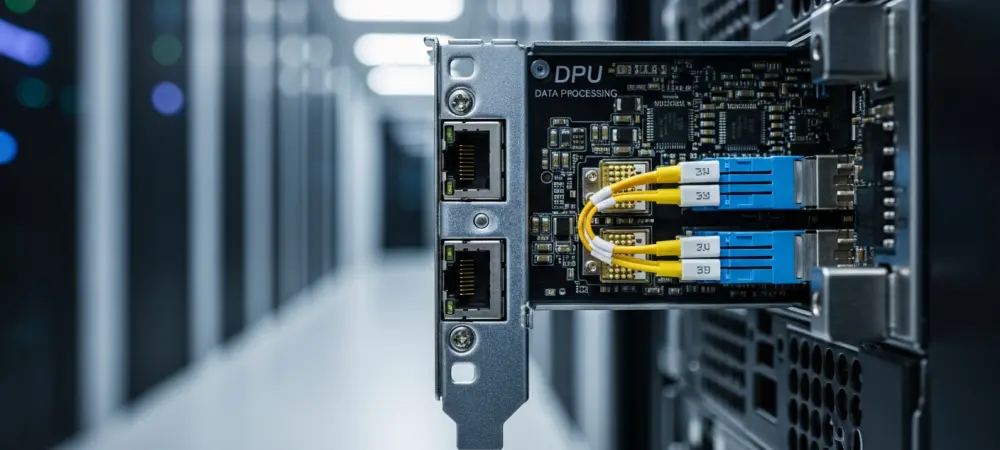
The integration of Pensando technology has been a game-changer for maintaining high utilization rates across massive GPU clusters. With the deployment of 800Gbps NICs and Salina DPUs, the Helios platform can manage data flows with minimal CPU intervention, ensuring that the GPUs are never starved for data. This front-end infrastructure is designed to handle the complex traffic patterns of AI training, where thousands of nodes must synchronize their states simultaneously. Without this level of networking sophistication, the theoretical peak performance of the GPUs would be lost to communication overhead.
Reliability and the total cost of ownership (TCO) are also central themes in the current discourse regarding data center hardware. The industry’s focus has shifted toward “self-healing” infrastructure and virtual rack partitioning, which allow a cluster to continue operating even when individual components fail. These features are essential for hyperscalers who must maintain 99.999% availability while running some of the most demanding workloads in history. By building these protections directly into the hardware and networking layers, AMD has significantly reduced the operational burden on data center administrators.
Future Projections: The Era of Agentic AI and Rack-Scale Computing
Venice CPUs and the Orchestration of Complex Workflows
In the evolving world of agentic AI, the role of the CPU is shifting from a simple host to a sophisticated orchestrator. While the GPU handles the heavy lifting of tensor mathematics, the Venice processors, based on the Zen 6 architecture, are tasked with managing vector searches, security protocols, and tool execution. An AI agent must be able to “think” about which tool to use, verify that the action is safe, and then interpret the results; these are logic-heavy tasks that benefit from the high clock speeds and complex branching capabilities of a modern EPYC processor. The architectural scaling of the Venice platform, featuring up to 256 cores and support for PCIe 6.0, is designed specifically for this orchestration layer. As agents become more autonomous, the volume of metadata and the number of simultaneous requests they generate will grow exponentially. This requires a processor that can handle massive amounts of I/O and maintain high-speed connections to both the GPUs and the storage subsystem. Projections for the Zen 6 architecture indicate that it will provide the necessary bandwidth and core density to prevent the orchestration layer from becoming a new bottleneck in the AI pipeline.
Internal performance benchmarks suggest that these generational improvements in context assembly and gateway processing will be vital for the next phase of AI development. As models move toward “long-context” interactions—where the AI remembers thousands of previous pages of conversation—the ability to quickly retrieve and format that data becomes paramount. The Venice CPUs are being positioned as the central nervous system of the rack, ensuring that every component, from the HBM4 memory to the high-speed networking, is working in perfect harmony to support the agent’s complex decision-making processes.
Long-term Implications for Data Center Sovereignty
One of the most significant challenges facing the expansion of this integrated infrastructure is the maturation of the ROCm.AI software stack. To truly compete with the established developer familiarity of proprietary ecosystems, AMD must continue to refine its software tools and provide a seamless experience for those migrating their workloads. While significant progress has been made, the industry consensus is that software remains the final frontier in achieving total parity. The success of initiatives like Hyperloom will be a bellwether for how quickly developers can adapt to this open-standard environment.
Despite these software challenges, the open-architecture approach offers cloud providers a level of sovereignty that was previously unattainable. By using standard interfaces, these companies can exercise greater control over their internal supply chains and avoid being held hostage by the pricing or availability of a single vendor’s proprietary technology. This sovereignty is particularly important in an era where compute capacity is seen as a strategic national resource. The move toward modular, rack-scale systems allows for a more resilient and adaptable global compute infrastructure.
Looking ahead, the broader impact of this “Big Iron” strategy will be felt in the availability and affordability of large-scale AI inference. As more integrated, high-efficiency racks come online, the cost per token of intelligence is expected to drop, making advanced reasoning models accessible to a wider range of industries. This democratization of compute power is the ultimate goal of the current infrastructure race, and the success of AMD’s integrated approach will be measured by how many new applications and innovations it enables across the global economy.
Navigating the New Frontier of AI Hardware
The transition to rack-scale, liquid-cooled environments marked a decisive moment in the evolution of modern computing. This analysis highlighted how the industry recognized that shattering the memory wall was the prerequisite for the next generation of reasoning agents. By integrating massive HBM4 capacity with sophisticated orchestration through Venice CPUs, the shift provided a necessary alternative to the closed-loop systems that previously defined the market. The emergence of open-standard fabrics like UALink also played a crucial role in ensuring that hyperscalers could scale their operations without sacrificing architectural flexibility.
As the industry progressed, the necessity of high-bandwidth memory and open-standard fabrics became the standard by which all new hardware was judged. The focus moved beyond simple FLOPS toward a more holistic view of system utilization and data movement efficiency. Companies that adopted these integrated systems found themselves better equipped to handle the unpredictable demands of frontier model development, where the ability to pivot between different model architectures is a key competitive advantage. This flexibility proved essential for maintaining a high pace of innovation in an increasingly crowded and competitive landscape.
The period leading into the second half of the decade served as the definitive proving ground for this integrated strategy. The successful execution of the Helios roadmap demonstrated that a modular, open-standard approach could indeed match the performance of more restrictive, vertically integrated competitors. Consequently, the long-term balance of power in the AI data center market became more distributed, favoring those who prioritized interoperability and memory-centric design. This shift ensured that the global demand for AI compute could be met through a diverse and resilient supply chain, paving the way for the next era of computational intelligence.