

The relentless and exponential growth of artificial intelligence workloads is forcing a radical reimagining of the digital backbone of our world, moving beyond conventional data centers to highly specialized, purpose-built ecosystems. This review explores the evolution of this infrastructure, its key features, performance metrics, and the impact it has on various applications, using KDDI’s new Osaka Sakai Data Center as a primary case study. The purpose of this review is to provide a thorough understanding of this critical technology, its current capabilities, and its potential future development.
The Evolution Toward AI Centric Data Centers
The transition from traditional data centers to AI-centric facilities represents a fundamental change in IT architecture. Conventional data centers were designed as general-purpose hubs, capable of handling a diverse range of applications with balanced resource allocation. In contrast, AI-native infrastructure is purpose-built to address the unique, parallel-processing demands of training large language models and executing complex inference tasks, marking a necessary departure from older designs.
This evolution is driven by the sheer scale of modern AI workloads, which require an unprecedented density of computational power. The architectural blueprint for these facilities centers on unique components, such as tightly integrated clusters of high-performance GPUs and advanced, low-latency networking fabrics that allow them to function as a single, cohesive supercomputer. Consequently, this shift establishes a new standard in the technological landscape, where infrastructure is no longer just a utility but a strategic enabler of AI innovation.
Core Components and Technological Innovations
Advanced Acceleration Hardware
Specialized processors are the engines of the AI revolution, with hardware like the NVIDIA GB200 NVL72 serving as a prime example of this technological leap. These accelerators are architected specifically for the massive parallel computations required by deep learning algorithms. Their design allows for the simultaneous processing of immense datasets, drastically reducing the time needed for both the training of new models and the rapid delivery of AI-powered services, making them the cornerstone of modern AI data center design.
The performance of these GPUs is measured not only in raw computational speed but also in their efficiency across different AI workloads. During the training phase, their ability to scale across thousands of units is paramount for developing increasingly sophisticated models. For inference tasks, where responsiveness is key, their architecture ensures low-latency processing. This dual-capability is what defines their critical role, providing the power and flexibility needed to support the entire AI development lifecycle.
High Density Cooling Solutions
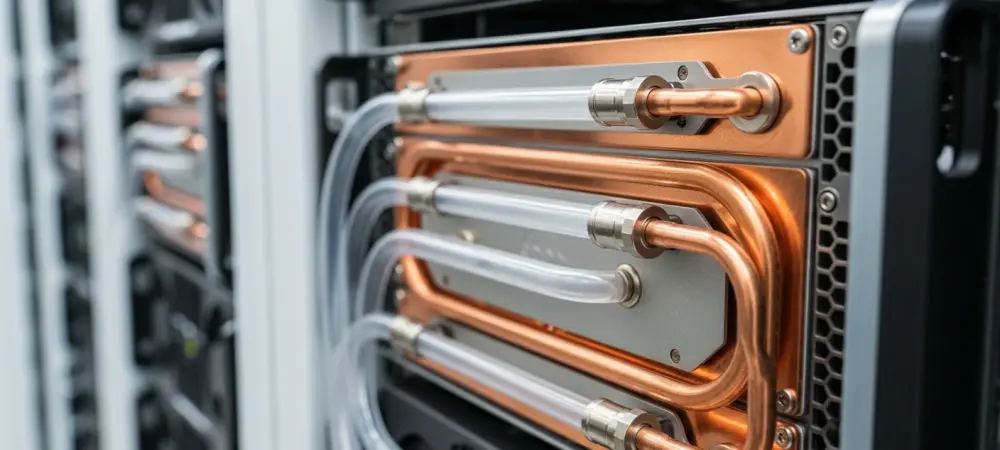
The immense computational density of AI hardware generates an unprecedented thermal load, making advanced cooling a non-negotiable component of modern data center design. Traditional air-cooling methods are insufficient to manage the heat produced by tightly packed GPU clusters operating at peak capacity. To address this, operators are turning to innovative hybrid systems that combine air cooling with more efficient direct liquid cooling technologies.
These advanced cooling solutions are critical for enabling the high-density deployments that AI requires. By circulating liquid directly to the hottest components, these systems dissipate heat far more effectively than air, allowing for greater computational density within the same physical footprint. This not only ensures hardware reliability and peak performance but also contributes significantly to the overall energy efficiency of the facility, a key consideration in sustainable operations.
Sustainable and Efficient Power Infrastructure
As the energy consumption of AI data centers grows, sustainability has transitioned from a corporate ideal to a critical operational imperative. Operators are increasingly integrating renewable energy sources to mitigate their environmental footprint. KDDI’s commitment to offsetting 100% of its facility’s power with renewables exemplifies this trend, reflecting a broader industry push toward responsible and sustainable large-scale computing.
Beyond sourcing clean energy, power efficiency is engineered into the very foundation of these facilities. This involves optimizing everything from power distribution units to the efficiency of the cooling systems. Such design considerations are crucial not only for reducing environmental impact but also for managing the substantial operational costs associated with running these power-intensive sites, making efficiency a key competitive differentiator.
Strategic Site Repurposing and Rapid Deployment
An innovative trend in AI infrastructure development is the strategic conversion of existing industrial sites into state-of-the-art data centers. This approach offers significant advantages over new construction, including drastically accelerated deployment timelines. By leveraging existing structures and utility connections, companies can bring massive computational resources online in a fraction of the time, as demonstrated by the six-month conversion of the former Sharp manufacturing plant for KDDI’s facility.
This strategy of repurposing sites also provides access to robust, pre-existing infrastructure that is well-suited for the demands of a high-density data center. Former manufacturing plants often feature high ceilings, reinforced flooring, and substantial power and water access, which are essential for supporting heavy equipment and advanced cooling systems. This method proves to be a capital-efficient and agile way to meet the urgent demand for AI-ready infrastructure.
Emerging Trends in AI Infrastructure Deployment
The latest developments in AI infrastructure are characterized by strategic initiatives from technology and telecommunications giants to establish sovereign AI capabilities. Companies like KDDI and SoftBank are not merely building data centers; they are creating national assets designed to foster domestic innovation and reduce reliance on foreign cloud providers. This push is reshaping the geopolitical landscape of technology, with nations and corporations racing to secure computational independence.
This strategic drive has given rise to new service models and collaborative ecosystems. The creation of dedicated “GPU Cloud” services offers organizations direct access to high-performance computing without the need for massive capital investment. Furthermore, the co-location of major industry players within the same repurposed industrial parks, as seen in Sakai, is fostering the growth of new technology hubs, where competition and collaboration can accelerate technological progress.
Real World Applications and Industry Impact
The tangible impact of this new generation of AI infrastructure is already being felt across multiple sectors, enabling breakthroughs that were previously computationally prohibitive. The specialized hardware and immense processing power housed in these facilities are powering a diverse range of applications, from scientific research to industrial innovation, demonstrating the transformative potential of purpose-built AI hardware.
At the KDDI facility, for instance, these capabilities are being applied to solve complex, real-world problems. In the pharmaceutical industry, partners are leveraging the platform for AI-driven drug discovery by analyzing vast medical datasets. In manufacturing, it is being used for advanced fluid analysis to optimize product design. Concurrently, the development of domestic AI models on this infrastructure is a strategic move to foster national technological autonomy and create AI tailored to specific cultural and linguistic contexts.
Challenges and Operational Hurdles
Despite their immense potential, the deployment of AI-centric data centers is fraught with significant challenges. On a technical level, managing the extreme power and thermal densities of modern GPU clusters pushes the limits of existing engineering solutions. Ensuring that network performance can keep pace with the blistering speed of computation is another critical hurdle, as bottlenecks can severely diminish the effectiveness of the entire system.
Beyond the technical complexities, market and logistical obstacles present formidable barriers. The immense capital investment required to build and equip these facilities places them out of reach for all but the largest corporations. Moreover, the industry faces severe supply chain constraints for essential high-end components like GPUs and networking hardware. Compounding this is the intense competition for a limited pool of specialized talent capable of designing, building, and operating these sophisticated environments.
Future Outlook and Long Term Trajectory
Looking ahead, the trajectory of AI data center technology points toward greater efficiency, integration, and automation. The standardization of direct liquid cooling is expected to become commonplace, enabling even greater computational densities. The integration of next-generation optical interconnects will be crucial for overcoming data bottlenecks between processors, while advancements in AI-driven management software may pave the way for fully autonomous data center operations that self-optimize for performance and efficiency. The long-term impact of this infrastructure will extend far beyond the technology sector, fundamentally altering the landscape of scientific research, economic competitiveness, and society at large. By providing the computational foundation for breakthroughs in fields like medicine, materials science, and climate modeling, these facilities will become indispensable engines of progress. Their ability to drive national AI strategies will also position them as critical assets in the global economy of the 21st century.
Conclusion The New Foundation for Artificial Intelligence
The emergence of specialized AI data centers represents a pivotal moment in the evolution of information technology. The review of facilities like KDDI’s Osaka Sakai Data Center makes it clear that these are not merely incremental upgrades but a fundamentally new class of infrastructure. They are meticulously engineered ecosystems designed to meet the unique and voracious demands of modern artificial intelligence. Ultimately, these advanced data centers are the new foundation upon which the future of AI is being built. Their core components—from accelerated hardware and liquid cooling to sustainable power solutions—form an integrated system that is essential for driving innovation. As this technology matures, its role in enabling scientific discovery, fostering economic growth, and shaping technological autonomy becomes increasingly central, solidifying its position as a critical enabler of the AI era.