

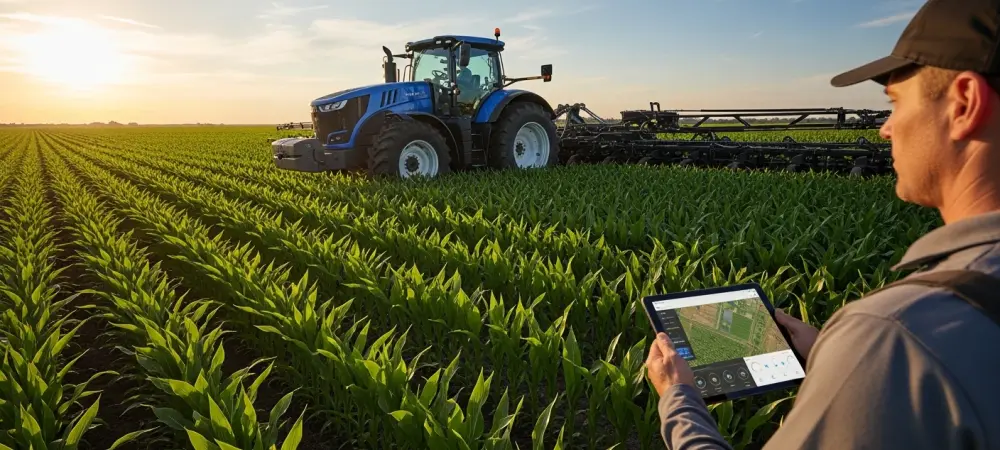
Across the vast, undulating landscapes of the American heartland, a quiet transformation is unfolding as silicon and steel replace the traditional calloused hands of the manual laborer. This metamorphosis is not merely about replacing muscle with machinery; it represents a fundamental pivot toward a data-centric, autonomous production cycle across 1.9 million American farms. As the agricultural sector grapples with the mounting pressures of a growing global population and a dwindling rural workforce, the integration of artificial intelligence (AI) and robotics has moved from the realm of science fiction to a daily operational necessity. This shift is turning the modern farm into a high-tech laboratory where every seed, drop of water, and gram of fertilizer is managed with surgical precision.
The importance of this technological surge cannot be overstated as it represents a survival strategy for the modern food producer. For decades, farming relied on human intuition and generalized applications of resources, but the complexity of today’s market demands a more granular approach. By moving beyond simple pre-programmed software to AI that manages unpredictable real-world variables, farmers are finding ways to stabilize their operations. This transition has propelled agricultural robotics into one of the top five professional service categories globally, signaling a permanent change in how the world’s food is grown, harvested, and managed.
The Silent Workhorse: Why the Most Advanced Robots on Earth Are Now Found in the Field
The shift toward autonomous production is redefining the very identity of the American farmer, moving the focus from physical tasks to the oversight of complex digital systems. This transition is most evident on the nearly two million farms where the traditional tractor is being replaced by intelligent agents capable of navigating the chaos of nature without human intervention. Unlike industrial robots that operate in controlled factory environments, agricultural bots must contend with mud, dust, changing light, and biological variability. AI has finally reached a level of sophistication where it can process these variables in real-time, allowing machines to make decisions that previously required a human in the cab.
The emergence of these machines has effectively turned the field into a testing ground for the most advanced robotics technology available today. The international community has taken note, as agricultural tools now dominate the professional service robotics sector, surpassing many industrial and healthcare applications in total deployment. This rise is driven by the realization that AI-driven hardware can successfully manage the nuance of crop health and soil conditions, providing a level of consistency that manual labor simply cannot match. Consequently, the farm has become a sanctuary for cutting-edge engineering, where autonomous systems work tirelessly to maintain the delicate balance of the ecosystem.
Furthermore, the integration of these “silent workhorses” allows for a continuous production cycle that is no longer limited by the physical endurance of a human workforce. These robots do not experience fatigue, nor do they lose focus during the monotonous hours of tilling or planting. By leveraging machine learning, these systems improve with every acre covered, refining their pathfinding and task execution through constant data ingestion. This creates a feedback loop of efficiency that makes the operation increasingly resilient against external disruptions, ensuring that the heavy lifting of food production continues regardless of labor availability.
The Macro-Economic Drivers: Navigating the Triple Threat of Modern Farming
The drive toward automation is fueled by a convergence of three critical pressures: chronic labor scarcity, increasingly stringent environmental regulations, and razor-thin profit margins. Farmers today are operating in a “triple threat” environment where traditional methods are no longer financially or legally sustainable. In many rural areas, the labor pool has shrunk to the point where finding enough seasonal workers is nearly impossible. This scarcity has forced a reliance on autonomous hardware that can operate 24/7, effectively “closing the control loops” of the farm and ensuring that time-sensitive tasks are completed within narrow weather windows.
Beyond labor, the regulatory landscape is shifting toward a model that demands higher accountability for resource use and environmental impact. Governments and consumers are pushing for a reduction in chemical runoff and a more responsible approach to soil health. Autonomous tools provide a solution by applying inputs only where they are needed, rather than through the wasteful broadcast methods of the past. This precision allows farmers to meet environmental standards without sacrificing productivity, turning a potential regulatory burden into an opportunity for operational refinement and cost reduction.
The economic viability of family-owned operations is the final piece of the puzzle, as these businesses fight to stay profitable in a volatile global market. The adoption of high-tech tools is increasingly seen as the only way to preserve the legacy of the family farm by lowering the cost per bushel or pound of produce. By reducing the overhead associated with chemicals and labor, these technologies allow smaller operations to remain competitive with large corporate entities. Technology is not just an additive cost; it is a defensive investment that protects the long-term sustainability of the agricultural heritage against economic instability.
Precision and Power: Exploring the Autonomous Tools Defining the Future of Food
The actual hardware performing these tasks is a marvel of modern engineering, ranging from massive self-driving tractors to delicate, camera-equipped sensors. High-performance GPUs and AI-driven navigation systems now allow tractors to perform autonomous tillage and planting with centimeter-level accuracy. These machines use sophisticated sensors to detect obstacles and adjust their path instantly, ensuring safety while maximizing the use of every square inch of land. This level of autonomy transforms the grower from a driver into a fleet manager, overseeing multiple machines from a single mobile device.
In the realm of crop protection, “See and Spray” systems are revolutionizing how weeds are managed by leveraging computer vision and machine learning. These systems scan the ground as they move, identifying individual weeds among the crops and applying herbicide only to the target. This approach can reduce chemical usage by up to 50%, representing a massive shift in both environmental stewardship and cost management. For those looking to avoid chemicals altogether, high-energy laser weeders offer an even more futuristic solution, using submillimeter thermal accuracy to neutralize 10,000 weeds per minute without ever touching the soil.
The dairy industry is also benefiting from this AI revolution through non-invasive monitoring systems that track herd health with incredible precision. Deep learning models analyze footage from parlor cameras to identify mobility issues or health declines in individual cows long before a human eye would notice. This allows for early intervention, preventing production losses and improving the overall welfare of the animals. By using AI to monitor the “barn side” of the operation, producers are able to maintain a high standard of care while managing larger herds with fewer staff members, ensuring the health of the business and the livestock.
Field-Tested Success: Quantifying the Financial and Environmental Impact of Ag-Tech
The industry’s transition is perhaps most clearly illustrated by the strategic roadmaps of major equipment manufacturers, such as John Deere, which aims for a fully autonomous production cycle by 2030. This is not a distant dream; it is an active rollout that is already yielding measurable results for early adopters. Growers utilizing precision weeding technology have reported savings of between $500 and $1,000 per acre in labor and chemical costs. These figures represent a transformative change in the balance sheet, turning a struggling operation into a highly profitable enterprise through the reduction of waste.
Real-world evidence from the dairy barn also supports the case for AI, as operations like Triple G Dairy use objective data to catch health issues before they become catastrophic. In these environments, the AI acts as a 24-hour veterinarian assistant, providing a level of surveillance that was previously cost-prohibitive. The financial impact is direct: preventing a single case of severe lameness can save a producer hundreds of dollars in lost milk production and medical costs. This objective data replaces guesswork with certainty, allowing for more predictable outcomes in an inherently unpredictable industry.
Environmental stewardship has seen a similarly significant boost, with millions of gallons of spray mix saved through targeted application technologies. Case studies from large-scale wheat farms in Colorado show a 42% reduction in chemical use, illustrating that precision agriculture is a powerful tool for conservation. By using AI to apply only what is necessary, farmers are reducing the chemical load on the land and protecting local water sources from nitrogen and herbicide runoff. This synthesis of financial gain and environmental responsibility proves that high-tech farming is the only sustainable path forward for a world with limited resources.
Strategic Implementation: A Framework for Adopting Artificial Intelligence on the Farm
The successful integration of these systems required a disciplined investment strategy that prioritized a clear return on investment. It was observed that farmers who focused on the “data sequence of autonomy” were the most successful in scaling their technological capabilities. By first mastering data collection and then moving toward automated action, these operations built a solid foundation for more complex AI tools. This measured approach ensured that each new piece of hardware or software solved a specific, measurable problem rather than just adding complexity to the daily workflow.
The transition from reactive labor management to a proactive, data-driven model was a hallmark of the most profitable farms. These operations moved away from the traditional model of fixing problems as they appeared, choosing instead to use AI-driven analytics to predict and prevent issues before they could impact the harvest. This shift allowed for a more strategic allocation of resources, as land performance and crop health were monitored with granular detail. The use of specialized chipsets and cloud-based analytics became the backbone of these modern farms, providing the processing power needed to turn raw data into actionable insights. Ultimately, the move toward intelligent automation proved to be a welcome relief for an industry under immense pressure. The implementation of specialized hardware helped stabilize the food supply chain and provided a viable future for the next generation of farmers. By embracing the synthesis of computer vision and robotics, growers gained a level of control over their land that was once thought impossible. This evolution demonstrated that the strategic adoption of AI was not just about modernization, but about ensuring that the ancient practice of agriculture could thrive in a modern world.