

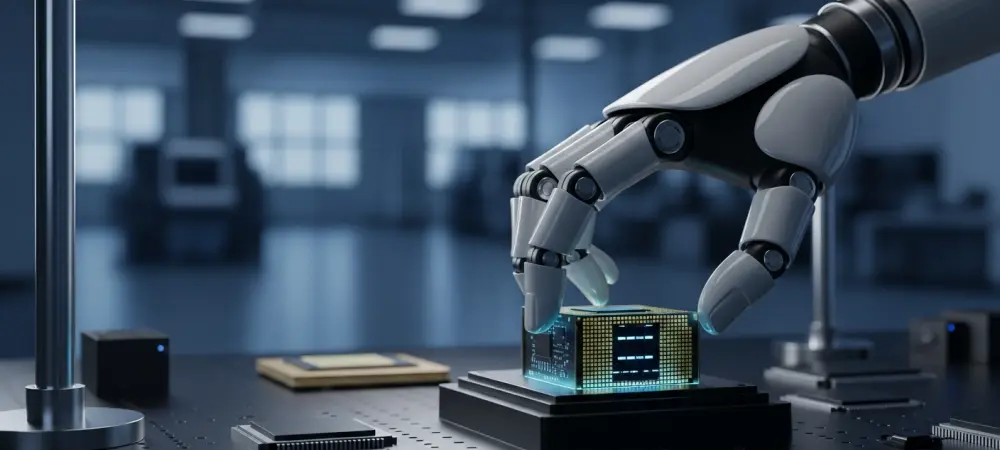
The sight of a robotic arm fluidly adjusting its grip to accommodate a fragile, oddly shaped component marks the end of an age defined by rigid, pre-programmed industrial machinery. While traditional automation relied on thousands of lines of static code to perform a single repetitive motion, a new alliance between Agile Robots and Google DeepMind is introducing a cognitive layer to the factory floor. This collaboration signifies a shift from machines that merely follow a script to systems that perceive, reason, and act within dynamic environments.
The Dawn of the Scalable AI Flywheel in Manufacturing
The industrial sector is currently witnessing the birth of a “scalable AI flywheel,” a concept that transforms every robotic movement into a learning opportunity. By merging Gemini’s advanced reasoning with specialized hardware, the partnership moves beyond the limitations of bolted-down machines. This evolution allows robots to understand their surroundings in real time, making them capable of handling the unpredictability that once required constant human intervention.
Unlike previous automation efforts, this flywheel creates a self-reinforcing cycle of improvement. As these intelligent systems operate, they gather vast amounts of environmental data that refine the underlying neural networks. Consequently, the more these robots work, the smarter and more efficient they become, creating a platform where software intelligence and physical execution are inseparable.
Bridging the Gap Between Neural Networks and Industrial Hardware
For years, a significant wall existed between high-level AI research conducted in digital sandboxes and the gritty, high-stakes reality of global production lines. Agile Robots and Google DeepMind are dismantling this barrier by grounding foundation models in physical reality. With over 20,000 systems already deployed worldwide, Agile Robots provides the necessary scale to prove that advanced machine learning can survive and thrive outside of a laboratory.
The integration focuses on making AI practical rather than theoretical. By applying Gemini’s multimodal capabilities to hardened industrial hardware, the partnership ensures that complex vision and tactile feedback are processed instantly. This bridge allows manufacturers to deploy sophisticated logic across diverse scenarios, from delicate electronics assembly to heavy industrial sorting, without the need for bespoke software for every new task.
Engineering Autonomy Through Gemini Robotics Integration
The technical core of this initiative involves the transition from pre-programmed scripts to truly autonomous production systems. By utilizing Google DeepMind’s Gemini models, these robots gain a cognitive framework that allows them to process visual data and operational feedback simultaneously. This enables the execution of sophisticated tasks that were previously deemed impossible for standard automation due to their high degree of variability.
Furthermore, the collaboration relies on an iterative learning loop where real-world data fuels constant model updates. This data-driven evolution ensures that precision and repeatability are not just maintained but actively improved over time. By combining DeepMind’s software prowess with Agile’s physical ecosystem, the industry is moving toward a future where hardware is simply the vessel for a rapidly evolving digital intelligence.
Perspectives on the Future of Autonomous Production
Leading figures in the field view this synergy as a defining moment for the global workforce. Zhaopeng Chen, CEO of Agile Robots, noted that this integration positions the company at the absolute forefront of the autonomous market. He believes the industry is moving beyond traditional robotics into a realm where machines possess the “common sense” required to navigate complex manufacturing layouts autonomously.
From the perspective of Google DeepMind, leadership emphasizes the importance of moving theoretical breakthroughs into large-scale applications. Carolina Parada highlighted that the partnership serves as a critical vehicle for testing AI resilience in high-pressure environments. Experts now see this interplay between Agile’s hardware and DeepMind’s intelligence as the new benchmark for how mechanics and logic should coexist to drive industrial productivity.
Implementing Flexible Automation in Modern Workflows
To stay competitive, organizations must begin identifying manufacturing processes characterized by high variability, as these are the primary candidates for Gemini-powered systems. Transitioning from rigid workcells to adaptive environments allows for a more efficient use of floor space and operational agility. Companies that prioritize flexible robotics over fixed hardware can pivot their production lines with minimal downtime, responding to market shifts in days rather than months.
Future-proofing these production lines requires the adoption of hardware ecosystems that remain compatible with evolving AI foundation models. By establishing robust protocols for data collection today, manufacturers ensure their “AI flywheel” remains fueled for years to come. This strategy allowed leaders to treat automation as a long-term software investment, where performance enhancements are delivered through digital updates rather than expensive mechanical overhauls.