

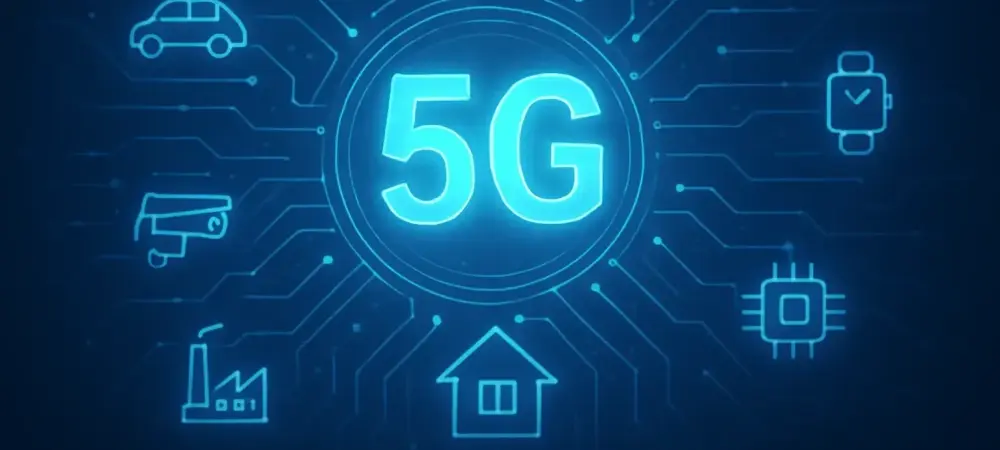
In today’s rapidly evolving digital landscape, the convergence of 5G technology and the Internet of Things (IoT) stands as a pivotal force reshaping industries and economies worldwide, with global IoT connections surpassing billions of devices. The demand for faster, more reliable networks has never been more critical. 5G, with its promise of ultra-low latency and massive device support, emerges as the backbone of this transformation, driving innovations from smart cities to autonomous vehicles. This analysis delves into the market dynamics of 5G-enabled IoT, exploring current trends, data-driven insights, and future projections to uncover how this synergy is redefining connectivity. The purpose is to provide stakeholders with a clear understanding of growth opportunities and strategic imperatives in a hyper-connected world.
Market Dynamics: The Surge of 5G in IoT Ecosystems
The market for 5G-powered IoT solutions is experiencing unprecedented growth, fueled by the technology’s ability to address the limitations of previous cellular generations. Unlike 4G, which supported basic IoT applications through standards like LTE-M and NB-IoT, 5G offers a quantum leap with latency as low as 1 millisecond and capacity for up to 1 million devices per square kilometer. Industry data indicates that global 5G subscriptions have already crossed significant milestones, with projections estimating a compound annual growth rate (CAGR) of over 25% through 2030. This surge is driven by increasing adoption in urban centers where smart infrastructure projects demand robust connectivity for thousands of simultaneous sensor interactions.
Beyond raw numbers, the competitive landscape reveals a race among telecom operators and tech giants to deploy 5G infrastructure tailored for IoT needs. Investments in network slicing—a feature allowing customized virtual networks on a single physical infrastructure—are gaining traction, particularly in sectors like manufacturing and healthcare that require guaranteed bandwidth. Market reports suggest that enterprises investing in private 5G networks for mission-critical operations are seeing operational efficiency gains of up to 20%. However, disparities in rollout pace between developed and emerging markets highlight a challenge: while urban hubs accelerate adoption, rural areas lag due to high infrastructure costs and regulatory hurdles.
Shifting focus to consumer behavior, demand for IoT-enabled devices such as smart home systems and wearable health trackers is pushing telecom providers to prioritize 5G coverage expansion. This trend is evident in the rising sales of 5G-compatible IoT hardware, which have grown by double-digit percentages in key markets over the past year. The interplay of technological advancements and market demand underscores a clear trajectory: 5G is not merely an upgrade but a fundamental enabler of IoT scalability, setting the stage for deeper industry transformations.
Key Trends: Technical Innovations Shaping IoT through 5G
Ultra-Low Latency Driving Real-Time Applications
Among the standout trends in the 5G-IoT market is the impact of ultra-low latency on real-time applications, a feature reducing communication delays to a mere millisecond. This capability is proving indispensable for industries like automotive, where vehicle-to-vehicle and vehicle-to-infrastructure communications rely on instantaneous data exchange to enhance safety and navigation. Market analysis shows that autonomous vehicle projects leveraging 5G are expected to reduce accident rates by a significant margin, with early pilots demonstrating improved reaction times in urban test zones.
This trend extends to other high-stakes sectors such as healthcare, where remote surgeries and telemedicine benefit from near-instant connectivity. The ability to transmit high-definition video and sensor data without lag is creating new revenue streams for medical tech firms, with market forecasts predicting a sharp uptick in 5G-enabled telehealth solutions by 2027. Yet, challenges persist, including the need for uniform 5G coverage to ensure reliability across geographies, a factor that could limit short-term growth in less-developed regions.
Massive Device Capacity Fueling Smart Infrastructure
Another defining trend is 5G’s capacity to support massive device density, accommodating up to 1 million connections per square kilometer, a tenfold increase over 4G. This scalability is a game-changer for smart city initiatives, where municipalities deploy extensive sensor networks to monitor traffic, utilities, and environmental factors. Data from leading smart city projects indicates traffic flow optimizations of up to 20% in areas utilizing 5G networks, driving further investment from local governments and private entities.
The implications for market growth are substantial, as urban planners and tech providers collaborate to integrate IoT solutions at scale. However, high deployment costs and spectrum allocation issues pose barriers, particularly for smaller cities with limited budgets. Despite these hurdles, the trend toward dense IoT ecosystems signals robust demand for 5G infrastructure, with opportunities emerging in crowd management and public safety applications at large-scale events.
Network Customization through Slicing for Sector-Specific Needs
A third critical trend shaping the market is network slicing, which enables tailored connectivity for diverse IoT applications on shared infrastructure. This innovation allows sectors like energy and logistics to secure dedicated bandwidth and reliability for critical operations such as smart grid management and supply chain automation. Industry insights reveal that network slicing could cut downtime in industrial settings by a notable percentage, boosting productivity and attracting investment from enterprise clients.
Market adoption of this feature varies by region, with advanced economies leading due to established 5G frameworks, while others grapple with implementation complexities. Nevertheless, the flexibility of network slicing is fostering new business models, such as subscription-based connectivity services for businesses, adding a layer of revenue potential for telecom operators. This trend highlights a shift toward personalized network solutions, positioning 5G as a versatile tool for IoT-driven market expansion.
Future Projections: Mapping the 5G-IoT Growth Trajectory
Looking ahead, the 5G-IoT market is poised for transformative growth, with projections indicating a significant expansion of connected devices and applications over the next five years. Integration with artificial intelligence and edge computing is expected to redefine IoT capabilities, enabling decentralized data processing for faster, smarter decision-making. Market forecasts suggest that sectors like precision agriculture will see widespread adoption of 5G-enabled drones for crop monitoring, while logistics firms anticipate enhanced automation through private networks.
Geographic disparities will influence growth patterns, as satellite integration promises to extend 5G connectivity to remote areas, unlocking potential in environmental monitoring and rural healthcare. Economic analyses predict that global investments in 5G infrastructure will continue to rise, though regulatory challenges around spectrum licensing could temper the pace in certain markets. Emerging opportunities in mission-critical applications, particularly in manufacturing and energy, are likely to drive demand for bespoke 5G solutions tailored to specific operational needs.
Long-term projections point to a hyper-connected ecosystem where 5G underpins innovations yet to be fully realized. Industry estimates suggest that by 2030, the economic impact of 5G-driven IoT could reach trillions in value across multiple sectors, fueled by advancements in device interoperability and network reliability. This forward-looking perspective emphasizes the need for stakeholders to anticipate evolving market demands and align strategies with technological progress to capitalize on this unprecedented growth wave.
Final Reflections and Strategic Pathways
Reflecting on the analysis, it becomes evident that 5G has established itself as the cornerstone of IoT market evolution, with its technical prowess in latency, device capacity, and customization driving profound industry shifts. The trends of real-time connectivity, massive scalability, and network slicing have reshaped sectors from urban planning to healthcare, while future projections hint at even broader economic impacts through integrations with AI and satellite systems. These findings underscore the transformative power of 5G in meeting modern connectivity demands. For businesses, the next steps involve prioritizing investments in private 5G networks to secure reliable, mission-critical operations, especially in competitive fields like manufacturing. Telecom providers must focus on expanding coverage through partnerships and innovative financing models to bridge gaps in underserved regions. Meanwhile, policymakers are encouraged to streamline spectrum allocation processes to accelerate adoption. By aligning with these strategic pathways, stakeholders can harness the full potential of 5G and IoT, paving the way for sustained market growth and innovation in a connected landscape.