

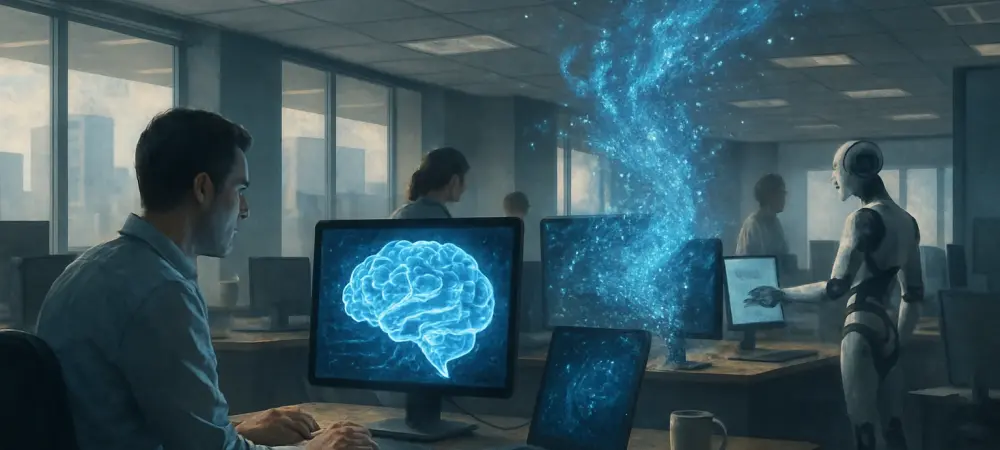
In a world where technology evolves at breakneck speed, a staggering statistic reveals the pace of change: over 50% of organizations now rely on artificial intelligence (AI) to drive daily decision-making, fundamentally altering the fabric of the workplace. This rapid integration of AI is not just a technological advancement but a transformative force reshaping employment landscapes across industries. As a dual-edged sword, AI boosts efficiency while simultaneously disrupting traditional job structures, raising critical questions about workforce readiness and adaptability. This analysis delves into the surge of AI adoption, its tangible impacts on job roles, insights from industry experts, future implications for the labor market, and essential takeaways for navigating this dynamic shift.
The Rise of AI in the Workplace
Adoption Trends and Workforce Preparedness
The adoption of AI is accelerating across diverse sectors, with data from the Data Integrity & AI Readiness Survey, which polled 550 companies, showing that more than half incorporate AI into their routine operations. This trend is particularly pronounced in areas like marketing, sales, and operations, where automation streamlines processes and enhances decision-making capabilities. Reports from leading industry analyses further underscore this momentum, highlighting how businesses are increasingly embedding AI tools to stay competitive in a fast-paced economy.
Despite this widespread integration, a significant gap in workforce preparedness persists. The same survey indicates that only 38% of companies believe their employees are equipped to handle AI effectively, pointing to a disconnect between technological advancement and human capability. This readiness shortfall poses challenges as organizations struggle to align their staff with the demands of AI-driven environments, risking inefficiencies and missed opportunities.
The lag in adaptability is a pressing concern, especially as AI continues to redefine operational norms. Without targeted training and support, employees in customer-facing and backend roles may find their skills outdated, exacerbating the divide between technology and talent. Bridging this gap remains a critical priority for businesses aiming to harness AI’s full potential without leaving their workforce behind.
Real-World Impacts on Job Roles
The tangible effects of AI on employment are evident in high-profile corporate actions across various industries. For instance, Accenture’s decision to lay off 11,000 employees while investing heavily in AI training programs reflects a strategic pivot toward automation and upskilling. Similarly, IBM has replaced certain roles with AI systems, prioritizing efficiency over traditional staffing models in specific functions.
Amazon provides another compelling example, reducing staff in some areas while expanding the use of AI tools to optimize operations like logistics and customer service. These cases illustrate a broader trend of job displacement paired with technological investment, where automation often takes precedence over maintaining existing headcounts. Such shifts highlight the urgent need for employees to adapt to new tools and workflows.
Beyond layoffs, companies are also reshaping job responsibilities to integrate AI, particularly in customer-facing and operational sectors. Roles are being redefined to focus on collaboration with intelligent systems, requiring workers to oversee automation outputs rather than perform manual tasks. This transformation signals a fundamental change in how job functions are conceptualized, pushing the boundaries of traditional employment structures.
Insights from Industry Leaders and Research
Expert opinions shed light on the profound changes AI is bringing to hiring practices and skill requirements. Researchers and educators from prominent institutions emphasize that human-AI fluency—the ability to work seamlessly with intelligent systems—is becoming indispensable. This perspective aligns with findings from industry surveys, which stress the need for adaptability and critical thinking to navigate AI-driven workplaces effectively.
A notable concern among experts is the inconsistent perception of AI tool usage in professional settings. While organizations increasingly rely on AI internally, a mere 27% of recruiters approve of job applicants using similar tools for tasks like resume crafting, as noted in the College Hiring Outlook Survey involving 470 employers. This discrepancy creates confusion for job seekers trying to meet evolving expectations in a tech-centric market.
Cultural elements like trust and reskilling also play a pivotal role in successful AI integration, according to industry analyses. Data reveals that organizations with robust governance and high trust levels achieve nearly double the performance gains compared to those without. Fostering an environment where employees feel safe to experiment and learn with AI is essential, as is investing in reskilling programs that embed learning into practical, real-world projects.
The Future of Work in an AI-Driven Era
Looking ahead, AI is poised to further transform employment by giving rise to hybrid roles that blend technical expertise with human insight. Positions such as “AI translators,” who interpret system outputs for decision-makers, and “digital coaches,” who guide teams in leveraging intelligent tools, are emerging as critical to organizational success. These roles underscore a shift toward valuing skills that bridge the gap between technology and human judgment.
The potential benefits of this evolution are significant, including heightened efficiency and innovation across industries. However, challenges like workforce displacement and the pressing need for updated training programs loom large. As AI reshapes job requirements, there is a risk of widening skill gaps, particularly for those unable to access reskilling opportunities, which could deepen inequalities in the labor market. Broader implications include a reorientation of hiring priorities toward adaptability and digital bilingualism—the capacity to navigate both machine logic and human intuition. Optimistic scenarios envision enhanced collaboration between humans and AI, driving unprecedented productivity. Yet, the risk of exclusion for those unprepared for this shift remains a sobering reality, necessitating proactive efforts to ensure inclusive growth in this new era.
Key Takeaways and Call to Action
Reflecting on the journey of AI’s integration into workplaces, it becomes clear that this technology serves as both a disruptor and an enabler, fundamentally altering job landscapes while offering pathways to innovation. The readiness gap, with only a fraction of companies confident in their employees’ AI skills, highlights a critical challenge that demands urgent attention. Human-AI fluency, trust, and reskilling emerge as vital components in bridging this divide, ensuring that workers can keep pace with rapid advancements.
Moving forward, the emphasis shifts to actionable strategies for staying competitive in an evolving job market. Organizations and individuals alike need to prioritize continuous learning, advocating for innovative training programs that integrate AI into practical contexts. Adaptability stands out as the cornerstone of success, positioning those who embrace change to thrive in the future of work.