

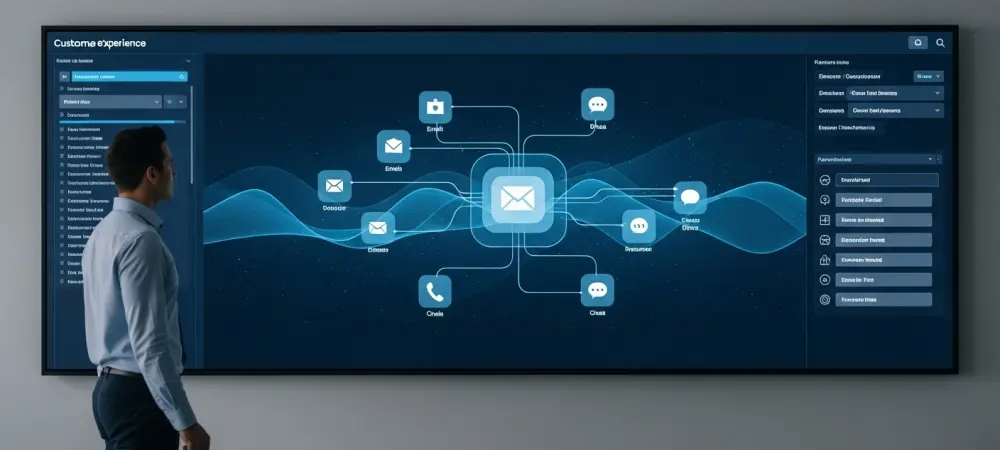
In a world where artificial intelligence is rapidly reshaping customer interactions, the humble phone call remains a critical touchstone for service. We sat down with Aisha Amaira, a MarTech expert whose work at the intersection of CRM technology and customer data platforms gives her a unique perspective on this evolution. She specializes in how businesses can harness innovation not just for efficiency, but to create truly resonant customer experiences. Our conversation explored the delicate balance between human and artificial support, the tangible impact of AI tools on resolving issues the first time, and the strategic shift toward unified platforms that promise a seamless future for customer communication.
Given that many premium customers still see live phone support as a key part of the service they pay for, how should businesses balance investing in new AI channels with perfecting this traditional one? Please share a key metric that demonstrates the ROI of excellent live call handling.
That’s the central tension many leaders are feeling right now, but I believe it’s a false dichotomy. The goal isn’t to replace the human touch but to elevate it. Premium customers, as the research shows, equate that live, personal connection with the value they receive. So, the investment in AI should be seen as a direct investment in your human agents. Instead of deflecting calls, AI should be used to arm your agents with everything they need to create a truly exceptional experience. The ultimate ROI is demonstrated by customer lifetime value. As one expert, Dominic Kent, put it, “Fast, competent, and friendly call handling gives customers a sense of value.” When a customer feels genuinely valued, they don’t just stay; they become advocates. That sense of value is priceless and directly impacts long-term loyalty and spend.
Effective call management aims to boost first-call resolution. Beyond better routing, how do AI agent-assist tools—which offer real-time guidance and customer history—directly contribute to this goal? Could you walk us through a step-by-step example of how this plays out during a difficult call?
AI agent-assist tools are the single biggest lever we can pull to boost first-call resolution, or FCR. It’s about transforming the agent from a researcher into a problem-solver in real time. We know from survey data that a third of businesses are already using these tools because the impact is so immediate.
Imagine a difficult call: a long-time customer is on the line, audibly stressed about a recurring billing error. The moment the call connects, the agent-assist tool populates the agent’s screen. They don’t have to ask for an account number; they see the customer’s entire journey—past interactions, sentiment scores, and a flag on this specific unresolved issue. As the customer explains, the AI is already searching a knowledge base for solutions to similar problems. Instead of placing the customer on a frustrating hold, the agent receives a pop-up with a suggested reply to acknowledge the frustration, along with the three most likely steps to permanently fix the billing cycle. The agent can then confidently walk the customer through the resolution, turning a moment of high tension into one of relief and trust, all within that single interaction.
About a quarter of businesses now use real-time sentiment analysis during calls. What are the key indicators these tools track, and how do they translate that data into practical, on-the-spot suggestions for an agent? Please share an anecdote where this technology helped de-escalate a tough situation.
It’s a fascinating technology that acts as an emotional co-pilot for the agent. The tools are listening for a combination of indicators—not just keywords like “angry” or “unhappy,” but also the acoustic patterns. Is the customer’s speech volume increasing? Is their talking speed accelerating? Are there long, frustrated pauses? These data points are analyzed in milliseconds to create a real-time sentiment score.
I remember a case with a telecommunications company. A customer’s call was flagged as rapidly deteriorating; their tone became sharp and their pace frantic. The sentiment analysis tool triggered an alert on the agent’s screen that said, “Customer stress level is high. Suggestion: Acknowledge the wait time and offer a direct resolution path.” The agent, prompted by this, immediately shifted their approach and said, “I can only imagine how frustrating this has been, and I see you’ve been on the line for a while. Let’s skip the standard script. I am personally going to solve this for you right now.” You could almost hear the tension dissipate from the call. The customer’s tone softened, and what was heading toward a major complaint became a moment of brand recovery, all thanks to a timely, AI-driven nudge.
Many CX leaders want “autopilot” AI systems where human agents can oversee interactions and intervene when needed. What are the most critical signals or moments for a human to jump into an AI-led call, and what training do agents need to manage this transition smoothly?
The “autopilot” model is the future, and over half of CX leaders are already asking for it. The most critical signal for human intervention is ambiguity or high emotional distress. If an AI detects conversational loops—where the customer keeps repeating the same question because the AI isn’t understanding the nuance—that’s a clear trigger. Another is the detection of escalating negative sentiment, like sarcasm or extreme frustration, which an AI might misinterpret. The system should be designed to flag these moments automatically for a human to take over.
Training for this is a complete paradigm shift. Agents are no longer just call handlers; they become supervisors and escalation specialists. The training needs to focus on “intervention management.” This includes teaching them to quickly read an AI-generated transcript to get up to speed in seconds, to master the seamless handoff so the customer doesn’t feel bounced around, and to trust the AI’s data while applying human empathy and judgment to the situation. It’s less about learning scripts and more about developing high-level problem-solving and emotional intelligence skills.
Businesses are moving toward unified platforms to avoid data silos and constant app-switching. What are the first three practical steps a company should take to consolidate its different communication tools into a single UCXM platform, and what common roadblocks should they anticipate during this process?
Unification is absolutely essential. Having your teams toggling between different apps all day is a recipe for inefficiency and lost data. The first step is to conduct a comprehensive audit. Map out every single tool your customer-facing teams use—from the CRM and email platform to social media dashboards and the phone system. You need a clear picture of your current, fragmented ecosystem.
Second, define your ideal, unified customer journey. Don’t think about technology yet; think about the experience. What information should an agent have at their fingertips when a customer calls? How should an interaction on a mobile app inform a follow-up email? This creates your blueprint. Third, start with a pilot program. Don’t try to rip and replace everything overnight. Choose one department or team to migrate to a unified customer experience management (UCXM) platform. This allows you to work out the kinks on a smaller scale.
The biggest roadblock is almost always internal resistance to change and data migration complexities. Teams are comfortable with their old tools, even if they’re inefficient. And moving data from a dozen silos into one cohesive platform without loss or corruption is a major technical hurdle. Proactive change management and a dedicated data integration team are non-negotiable for success.
What is your forecast for the evolution of the contact center agent’s role over the next five years?
The role of the contact center agent is poised for a significant and, I think, exciting transformation. The mundane, repetitive tasks—like password resets or order status lookups—will be almost entirely handled by agentic AI. This frees up human agents to evolve into a more strategic and specialized role. I see them becoming “experience managers” or “brand ambassadors.” Their job will be less about transaction processing and more about relationship building, complex problem-solving, and managing emotionally charged interactions that require true empathy. They’ll be overseeing the AI systems, intervening in critical moments, and handling the most valuable and sensitive customer cases. In short, their work will become more challenging, more skilled, and ultimately, far more rewarding and integral to the business’s success.