

A Lean Catalog With Outsized Reach
Shoppers scrolling a four-SKU furniture site rarely expect to meet a nine-figure business filling store floors down the street, yet that is the wager Transformer Table is placing as it shifts from pure e‑commerce to a retail-forward mix. The Montreal brand built a $150 million online engine on expandable dining sets priced at $3,000–$4,000, then decided the next conversion lift lives in showrooms rather than in checkout flows.
The move reframed what “direct” means in high-consideration categories. Digital still captures attention at scale, but final reassurance often happens when hands touch wood, leaves slide into place, and a salesperson answers the last question.
Why This Story Matters
The pivot came as the DTC playbook met its limits in home goods. Consumers proved comfortable researching online, but many still wanted tactile validation before committing to a centerpiece purchase that sets the tone for a room and a lifestyle.
Moreover, retailers looked for partners that send demand, not just inventory. By owning the top of the funnel and routing nearby shoppers to dealers, the manufacturer inverted the traditional equation and signaled a new contract between brands and stores.
The Strategy Behind The Flip
“Manufacturers have asked retailers to make the market for decades,” said co‑founder and VP Richard Mabley. “We generate the demand upstream and let retailers capture it locally.” The approach put performance media at the front and human trust at the close.
Daily ad spend between $50,000 and $100,000, amplified by hundreds of influencers and celebrity features, fed 2–3 million monthly site visitors.Teams studied non-conversion signals—questions about finish, wobble, seating capacity—and translated those frictions into content, store training, and product tweaks.
Demand At The Top, Trust At The Bottom
High-intent visitors who hovered, saved, or chatted were encouraged to book an in‑store appointment with nearby partners.That redirected a costly closing step to sales floors where consumers could test stability, match finishes, and negotiate delivery windows. In return, dealers received localized leads, merchandising guides, and transparent attribution.Rather than competing with stores, the brand aimed to become a dependable demand utility that filled calendars with ready buyers.
The Product That Rewrote The Brief
“Reclaim living space” emerged as both slogan and thesis.Buyers did not only live in tight studios; typical households surpassed 1,200 square feet. The core appeal was versatility: a room could flex from office to dining to crafts, then reset in minutes.
Farmhouse and Tavelo lines expanded beyond mid-century modern to meet regional tastes without bloating operations. SKU discipline held, but finishes, legs, and silhouettes diversified to draw traditional shoppers who wanted warmth and heft with the same transforming mechanics.
Manufacturing As A Growth Lever
A 200,000‑square‑foot Vietnam facility, Transformer Robotics, with roughly 1,000 employees, anchored vertical integration.An adjacent 15,000‑square‑foot warehouse supported just‑in‑time flow, reducing dwell and enabling faster replenishment on hero items.
Downstream, six U.S. warehouses, three in Canada, one in Australia, and three across Europe and the U.K. built a network for rapid delivery. The spread buffered regional spikes and cut lead times that often kill furniture momentum after the initial impulse.
Headwinds, Pricing, and Resilience
Tariffs on Vietnamese imports forced list price increases, yet management saw little demand erosion—evidence that category differentiation can preserve pricing power.Higher fuel costs and freight volatility still weighed on margins, but conversion strength in core SKUs offset much of the drag.
Operationally, the company tightened forecasting, guarded safety stock on bestsellers, and leaned on vertical control to rework components when inputs shifted. The result signaled resilience rather than whiplash.
High Point As Bellwether
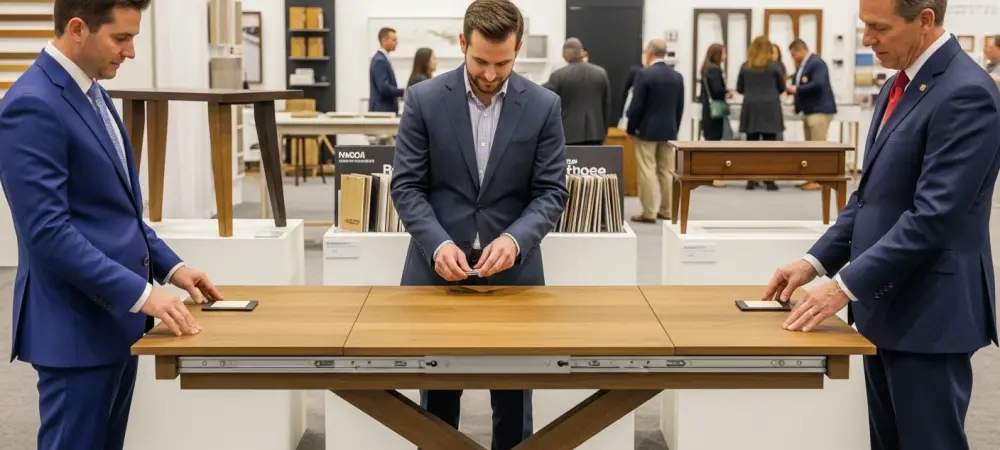
At High Point Market, more than 150 dealers engaged in the prior season, a clear read on retail appetite.Showgoers who had tracked the brand online wanted proof in person: slide the panels, seat a full dinner party, collapse to console. The second showing reinforced a key pattern: digital virality sparks curiosity, but trade events institutionalize it.Commitments coming out of appointments suggested the flip from awareness to distribution was sticking.
Customers Who Defied Expectations
Early believers were thought to be apartment dwellers. Yet purchase data and home tours showed families in larger homes buying for flexibility: homework on weekdays, game nights on Fridays, holiday seating on demand.That insight reshaped creative and sales scripts. Messaging moved from “fit a table in a studio” to “unlock a room for every moment,” broadening addressable demand without abandoning space-conscious buyers.
Internationalization By Local Norms
The global plan followed buying habits, not a template. In the GCC, where in‑store is still the default, distribution partners and licensees took precedence.In the U.K. and Europe, e‑commerce carried more of the load, supported by regional warehouses.
Mexico and Dubai stood on the near horizon, chosen for a mix of urban density, retail infrastructure, and media efficiency. The goal was not ubiquity; it was channel fit with reliable service.
The Origin That Still Guides The Build
The first prototype solved a Montreal condo dilemmone room, two lives, not enough square footage.Founders with aerospace, engineering, finance, and media roots turned that constraint into a Kickstarter launchpad and then into a brand that tested fast and learned faster.
That culture continued to shape operations. Marketing experiments informed product changes; store feedback fed back into online content. The loop kept the line tight and the value proposition sharp.
What Comes Next: A Practitioner’s Playbook
The path forward favored actions others could use: own demand with persistent media; quantify intent by market; route ready buyers to nearby floors; arm retailers with training and attribution; keep SKUs disciplined while widening aesthetics; close the touch gap with appointments and quick delivery; and localize channel mix by region.
Taken together, the strategy had placed a digital-native furniture brand on the cusp of a durable omnichannel posture.The lesson was plain: when a manufacturer made the market, retailers finished the job, and customers gained confidence without friction.