

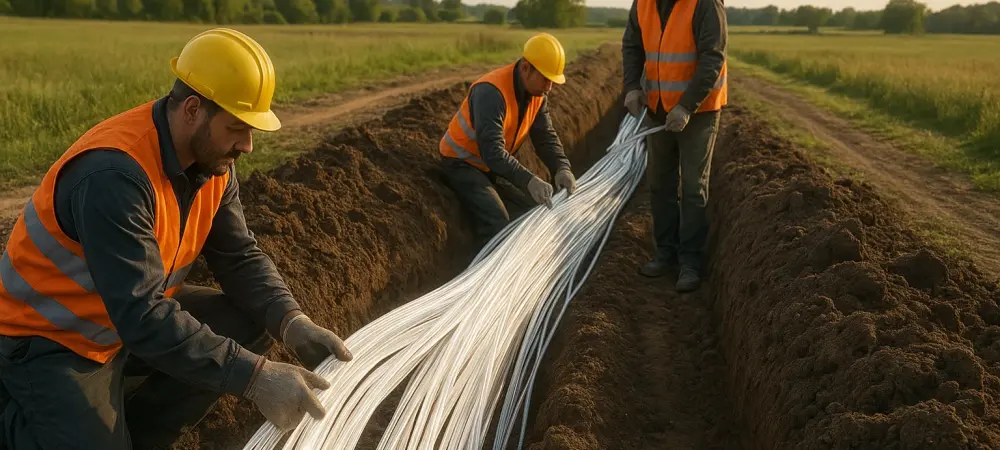
Zayo’s existing footprint of 32 million fiber miles provides a foundation for a new era where AI fundamentally alters how network capacity is consumed. As the digital landscape transitions into a period defined by massive computational needs, the sheer physical scale of the internet has become the ultimate competitive advantage. This infrastructure provider is no longer just managing bandwidth; it is curating the physical pathways that allow generative models to synchronize across vast distances. By 2026, the industry has realized that software innovation is only as fast as the glass that carries its signals. Zayo’s expansive reach of 224,000 route miles across North America and Europe serves as the skeletal system for a global economy that is increasingly reliant on low-latency data transfers. This strategic positioning allows the company to act as a primary enabler for enterprises that are racing to integrate advanced machine learning into their core operations effectively.
Addressing the Impending Infrastructure Bottleneck: Managing the Triple Threat
The telecommunications sector is currently grappling with a convergence of demands that Troy Lupe, Zayo’s Chief Network Officer, characterizes as a significant bottleneck. This pressure stems from a triple threat of intensive infrastructure requirements: the rapid deployment of government-supported broadband expansion, the unrelenting construction of massive hyperscale data centers, and the unique, high-density fiber needs of generative AI. Each of these drivers requires a distinct type of connectivity, yet they all compete for the same finite manufacturing capacity of high-quality optical fiber. As generative AI models become more complex, the density of fiber required to interconnect specialized processing units within and between facilities has skyrocketed. This shift has forced a rethink of how companies approach their supply chains. No longer can a provider wait for a contract to be signed before ordering materials; the lead times for specialized optical cabling have extended.
The complexity of long-haul network development means that projects initiated today may not reach full operational capacity for several years. Because these networks involve intricate design phases, regulatory hurdles, and physical installation across diverse terrains, any delay in material availability can cascade into multi-year setbacks. In the current environment, securing the physical inputs early in the development cycle is no longer a luxury but a strategic necessity. Zayo’s leadership recognizes that the geography of the network is shifting as AI workloads move toward regions with more favorable power costs or cooling climates, often away from traditional tech hubs. This migration necessitates a more flexible and forward-looking approach to inventory management. By locking in a reliable source of fiber now, the company mitigates the risk of being sidelined by global shortages that are expected to intensify as more industries digitize their legacy systems and adopt automation.
Navigating the Physical Requirements: Strategic Insights and Industry Actions
To navigate these logistical hurdles, Zayo has committed to an ambitious expansion plan that includes adding 15,000 new route miles to its network by 2030. A cornerstone of this initiative is the deepening of its long-term partnership with Corning, a move designed to ensure a consistent flow of optical materials regardless of market volatility. This collaboration is essential for high-profile projects, such as the 8,000-mile long-haul fiber route being developed in conjunction with Nvidia. This specific project is tailored to support the massive data throughput requirements of AI training and inference, where traditional network architectures often fall short. By securing a guaranteed supply of Corning’s advanced glass technology, Zayo can execute these massive build-outs with high precision. The partnership ensures that material availability is effectively removed from the list of project risks, allowing engineers to focus on optimizing the path and performance of the system.
The strategy employed by Zayo offered a clear set of actionable steps for an industry facing unprecedented growth. By prioritizing the physical layer, the company ensured that the backbone of the global AI economy remained resilient and scalable. Analysts observed that the primary recommendation for other players in the space was to move away from spot-market purchasing and toward deep, multi-year commitments with trusted manufacturers. This move helped stabilize the entire ecosystem, as it provided suppliers with the predictable demand needed to justify their own capacity expansions. Steve Smith, the chief executive, noted that future infrastructure had to be built with specific workloads in mind rather than general-purpose use. Ultimately, the industry learned that securing the physical components of the internet was just as competitive as developing the software that ran on it. This foresight allowed the company to maintain its momentum and provided a roadmap for future-proofing.