

Dominic Jainy has spent years at the intersection of machine learning and heavy-duty infrastructure, observing as the abstract promises of “AI-native” networks finally hit the pavement. As we navigate the complexities of 2026, the industry is no longer just talking about theoretical throughput; it is pouring billions into the physical layer—undersea cables, massive satellite constellations, and AI-optimized radio access networks. In this discussion, we examine the massive hardware upgrades required to sustain spiraling traffic, the shift toward physical infrastructure ownership by major enterprises, and how the collaborative “tower company” model in space is challenging vertically integrated giants.
Nokia claims its Nvidia-backed platform can improve spectrum efficiency by 20% now and up to 100% by 2028. How do these AI-on-RAN upgrades fundamentally change the financial outlook for legacy telcos, and what specific technical hurdles must be cleared to reach those doubling capacity targets?
The financial outlook shifts from a desperate search for new revenue streams to a massive optimization of existing assets, effectively allowing telcos to “manufacture” more capacity without buying new spectrum. Right now, Nokia is seeing a 20% bump in efficiency through its Nvidia-backed platform, but the real prize is the 50% increase expected by the 2027 launch and the full 100% doubling by 2028. This isn’t just a software patch; it’s a grueling technical journey across Europe, Asia Pacific, North America, and the Middle East where operators are currently putting these systems through the ringer. The primary hurdles are the massive software upgrades required to integrate AI-for-RAN and AI-on-RAN simultaneously, ensuring that the latency added by AI processing doesn’t negate the throughput gains. For legacy carriers, this is about survival—if they can squeeze double the data through the same airwaves, the cost-per-bit drops dramatically, turning their old telco heartlands into highly profitable, high-capacity hubs.
Samsung and Verizon are currently testing 6G-native RAN-sensing and Integrated Sensing and Communication (ISAC) workloads. What are the primary enterprise use cases for this technology beyond basic connectivity, and how does consolidating network functions on a single edge-AI server improve real-time performance?
The recent ISAC tests at a major Dallas football game demonstrated that we are moving toward a world where the network doesn’t just “see” data—it “sees” the physical environment. For an enterprise, this means using existing radio waves to track inventory in a warehouse or monitor crowd safety in a stadium without installing separate radar or camera systems. By consolidating these 6G-native sensing workloads and standard network functions onto a single edge-AI server, we eliminate the hop-by-hop delays that usually plague real-time applications. You can feel the difference in the responsiveness of the system; the accelerated compute happens right at the edge, allowing for instantaneous feedback loops. This isn’t just about faster downloads; it’s about turning the wireless network into a high-resolution sensor that provides actionable data for logistics, security, and industrial automation.
EXA Infrastructure is deploying a 500Tbps transatlantic cable where customers are purchasing entire fiber pairs rather than just wavelengths. Why is the market shifting toward physical infrastructure ownership, and how does this “fast-build” cycle compare to previous eras of subsea cable expansion?
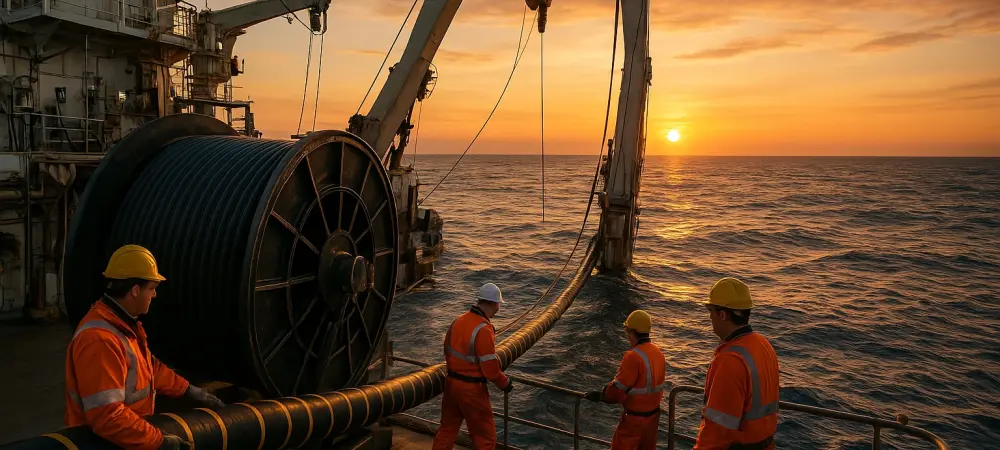
We are witnessing a “fast-build” cycle that feels more like an arms race, with EXA Infrastructure pushing a 6,552km cable between the US and the UK for a rapid launch in 2029. The shift toward buying entire fiber pairs among the 24 available—rather than just leasing wavelengths—signals that hyperscalers and large enterprises no longer trust third-party capacity to keep up with AI demands. They want the raw glass; they want to control the optics and the 500Tbps of potential capacity themselves to avoid being throttled by a provider’s middleman management. Compared to previous eras, the sheer volume of traffic is speculative and spiraling, forcing a pace of construction that is almost frantic. It is a return to foundational ownership where the winner is the one who actually owns the physical pipe under the Atlantic, rather than the one merely renting a lane on it.
Space42 and Viasat are utilizing a “tower company” model for their Equatys satellite platform to share ground and space infrastructure. How does this collaborative approach compete with vertically integrated models like SpaceX, and what are the operational risks of sharing space hardware while maintaining independent spectrum?
The Equatys platform, backed by a $1 billion investment, is a fascinating “team sport” approach that allows multiple operators to share a common satellite and ground infrastructure while keeping their own spectrum and customers. This stands in stark contrast to the SpaceX model, which is a vertically integrated powerhouse controlling everything from the rocket to the data center, hyper-scaling its own proprietary ecosystem. The “tower company” model competes by lowering the entry barrier for legacy telcos, but it carries significant operational risks, particularly in the coordination of high-capacity hardware between competing entities. If one partner’s traffic spikes or their independent spectrum suffers interference, the shared space hardware must be sophisticated enough to isolate those issues without crashing the entire platform. It’s a delicate balance of collaborative engineering and fierce commercial independence, designed to prevent a single player from monopolizing the orbital economy.
For satellite communications to transition from emergency SOS messaging to mainstream mobile data, massive constellations and dedicated spacecraft factories are being established. What are the specific manufacturing and launch milestones required to make direct-to-device satellite service a seamless experience for the average smartphone user?
To move beyond simple SOS pings, the industry needs a continuous stream of hardware, which is why the August 2026 merger of Lynk Global and Omnispace into Elveo Mobile is so critical. They are partnering with Apex to build a dedicated spacecraft factory, because you cannot achieve seamless Direct-to-Device (D2D) service with just a handful of satellites; you need a massive, replenished constellation. A key milestone was SES completing its 13-satellite O3b mPOWER MEO constellation, which provides the high-capacity backbone necessary for mainstream data. For the user, the experience only becomes “seamless” when the handoff between terrestrial towers and satellites is invisible, which requires thousands of low-orbit satellites and a launch cadence that keeps pace with hardware attrition. We are looking at a manufacturing scale that mirrors the automotive industry more than the traditional aerospace sector.
Operators like Reliance Jio and Viaero Wireless use a mix of fiber and Fixed Wireless Access (FWA) to solve connectivity challenges. When evaluating the economics of a specific region, what metrics determine if a carrier should commit to deep-sea fiber or low-orbit satellite backhaul instead of terrestrial towers?
The decision hinges on a brutal calculation of population density, terrain difficulty, and the speed at which revenue can be captured. For a carrier like Reliance Jio, the economics often favor fiber for its massive capacity, but in the rugged territories served by Viaero Wireless or Prairie Hills Wireless, the cost of trenching fiber through rock makes FWA or satellite backhaul far more attractive. Operators look at the “time to service” metric—if a low-orbit satellite can provide backhaul in weeks compared to the years it takes to permit and build terrestrial towers or subsea links, the satellite wins despite higher operational costs. They also weigh the spectrum strategy; if they have plenty of mid-band spectrum, FWA allows them to sweat those assets without the massive capital expenditure of a deep-sea cable. Ultimately, it’s a choice between the high upfront cost of permanent fiber and the flexible, rapid deployment of wireless and satellite technologies.
What is your forecast for the AI-driven physical network build-out?
My forecast is that the next few years will be defined by a “flight to the foundation,” where the most successful players are those who pivot from being service providers to being infrastructure owners. We will see a massive consolidation of edge-AI platforms, as the “puffery” of AI-native marketing fades and the reality of managing 500Tbps cables and 100% spectrum efficiency takes over. While the apps get the headlines, the real wealth will be captured by the entities that own the spacecraft factories, the subsea fiber pairs, and the Nvidia-backed RAN platforms that make the 6G era possible. Expect the “tower company” model to dominate the satellite sector as telcos realize they can’t beat the hyperscalers alone, leading to a more collaborative, yet physically intensive, global network.