

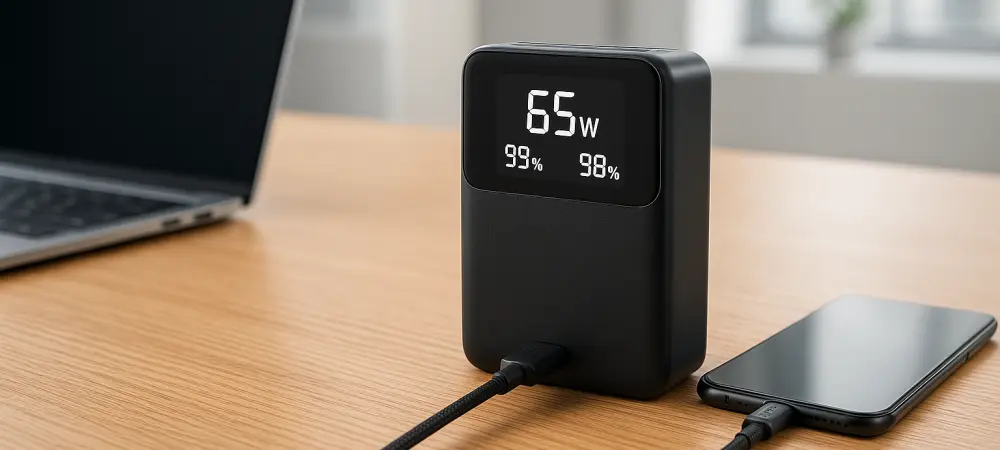
As modern mobile workstations demand more energy than ever, the traditional portable charger has transitioned from a smartphone accessory to an indispensable powerhouse for high-performance laptops. This shift reflects a trend where the boundary between stationary and mobile productivity continues to blur. The device serves as a benchmark for this new era, merging massive capacity with the kind of rapid charging once reserved for wall-bound bricks. It addresses the growing need for high-density energy solutions in a fast-paced professional landscape.
High-Output Charging: The Evolution of Portable Power
The move toward high-capacity power delivery responds to the energy-intensive hardware requirements of the current year. By utilizing high-density 20,000mAh battery cells, manufacturers have managed to increase the energy-to-volume ratio significantly.
Gallium Nitride (GaN) integrated circuitry allows these units to package 165W of output into a handheld form factor. This engineering bridges the gap for professionals who cannot afford downtime, turning any workspace into a high-powered energy station.
Engineering Excellence and Technical Features
Ultra-High Wattage and Dual-Device Power Distribution
Achieving a maximum 165W output allows a laptop to reach a functional charge in under thirty minutes. This level of performance is essential for power users who rely on resource-heavy applications while away from traditional outlets. The intelligent power-splitting mechanism allocates 120W to a primary device and 45W to a secondary one. This dual-track delivery ensures that neither a primary workstation nor a supporting mobile device suffers from a power deficit during simultaneous usage.
Integrated Hardware and Real-Time Diagnostics
An integrated braided USB Type-C cable addresses the common point-of-failure concerns found with external wires. This design choice emphasizes durability and convenience for users who move frequently between different working environments. The color digital display provides granular data on battery percentages, active wattage, and time-to-charge metrics. This allows for precise energy planning, moving away from the vague estimations provided by traditional LED indicators.
Versatile Compatibility and Multi-Protocol Support
Support for USB Power Delivery 3.0, PPS, and Qualcomm Quick Charge standards ensures that the unit functions as a universal adapter. This versatility is critical for maintaining a streamlined kit that works across various manufacturer ecosystems. A 12-layer safety protection system works alongside advanced temperature management to prevent thermal issues. These safeguards regulate heat during intensive 165W output cycles, protecting both the power bank and the connected hardware.
Emerging Trends in High-Performance Mobile Accessories
Consumer behavior now prioritizes “prosumer” gear that values charging speed over minimal weight. This transition suggests a willingness to carry slightly more bulk in exchange for the certainty of rapid energy replenishment during the day.
As chargers become more consolidated, the reliance on a single, high-wattage portable unit is becoming a standard expectation. This trend influences how accessory manufacturers design future compact energy storage solutions for a mobile-first workforce.
Real-World Applications and Use Cases
In professional environments, this technology empowers digital nomads to work in remote locations without tethering to a grid. It provides a reliable safety net for field professionals who require sustained performance from high-drain hardware. The 76Wh energy rating is strategically chosen to comply with international aviation regulations. This allows users to carry significant energy density onto aircraft, facilitating uninterrupted productivity during transcontinental travel and long flights.
Challenges and Technical Limitations
Heat dissipation remains a primary technical hurdle during peak output cycles. Operating at 165W generates significant thermal energy, necessitating sophisticated cooling solutions that can occasionally add to the physical footprint of the unit.
Regulatory and market obstacles also persist, such as the variance in charging standards across different hardware brands. While the device is highly versatile, it may not reach maximum speeds with every proprietary laptop on the market.
The Future of Portable Energy Technology
The industry focus is shifting toward solid-state battery technology to increase safety and energy density. From 2026 to 2028, these advancements will likely lead to even more compact power banks with even higher capacities.
Potential breakthroughs in AI-driven energy management will allow future devices to optimize charging curves autonomously. This evolution will further reduce global e-waste by standardizing universal USB-C ecosystems across all mobile electronics.
Final Assessment and Review Summary
The implementation of the high-output battery system established a new standard for mobile diagnostics and performance. It successfully moved the accessory market toward sophisticated power management solutions that mirrored the needs of modern computing.
For those seeking maximum efficiency, adopting this high-wattage infrastructure proved to be a necessary step in maintaining a competitive edge. The device stood out as a market leader, proving that portability no longer required a compromise in power.