

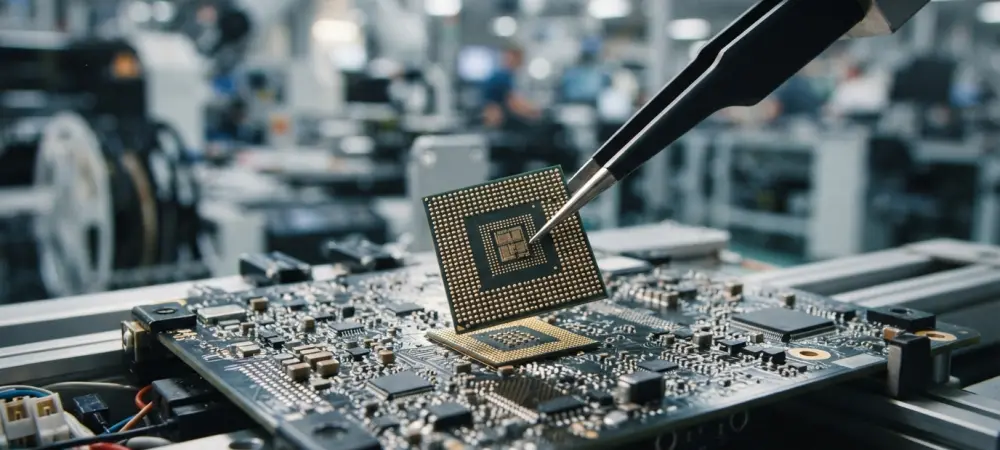
The expansion of Industry 4.0 is driving a consistent need for dependable microprocessors to manage complex industrial controls and automated machinery across global factories. In the current landscape of 2026, the global market for single-core microprocessors is experiencing a notable revival, moving beyond its traditional legacy role into specialized, high-stakes applications. While the broader tech industry often focuses on the high-speed multitasking of multi-core units, the single-core architecture has maintained its relevance through sheer reliability and energy efficiency. As of this year, the market valuation has reached $30.3 billion, and the trajectory toward reaching $41.38 billion by 2030 appears increasingly solid. This growth is not merely a byproduct of legacy support but a conscious choice by engineers who require deterministic performance for essential tasks. These processors offer a unique combination of low power consumption and high dependability, making them ideal for the massive influx of smart devices currently being integrated into the global digital infrastructure.
This shift in market dynamics highlights a broader trend in the semiconductor industry where specialized efficiency often trumps raw computational power. Many industrial and automotive applications do not require the parallel processing capabilities of high-end server chips; instead, they need hardware that can run indefinitely without overheating or requiring complex cooling systems. Consequently, the demand for single-core solutions is growing in sectors where cost-effectiveness and durability are the primary metrics of performance. As we progress through 2026, the focus has moved toward refining these single-thread architectures to better serve the needs of a connected world. The persistent demand for these chips across various sectors underscores their fundamental role in the modern economy, proving that simplicity remains a powerful asset in technological design. By prioritizing the specific needs of embedded systems, manufacturers are securing a profitable niche that continues to expand despite the dominance of more complex multi-core alternatives in the personal computing space.
Defining the Architecture and Market Utility
Understanding Core Functions and Embedded Systems
A single-core microprocessor is fundamentally defined by the integration of exactly one central processing unit onto a single integrated circuit. This architectural simplicity is its greatest strength, as it allows for the execution of a single instruction stream without the overhead required to manage communication between multiple processing units. In the context of 2026, where efficiency is paramount, this design enables the chip to handle essential arithmetic, logical, and system control functions with a high degree of precision. While the general computing world has largely moved toward multi-core designs for workstations and gaming systems, the single-core unit remains the undisputed king of the embedded hardware market. These systems require a processor that can perform a specific set of tasks predictably and repeatedly over long cycles.
By focusing on a single thread of execution, manufacturers can eliminate the heat generation and power consumption spikes associated with more complex chips, ensuring that devices remain stable during prolonged operation. The predictability of single-core performance is a critical factor for real-time applications where timing is everything. In industrial environments, a delay of even a few milliseconds in a control loop can lead to mechanical failure or safety hazards. Multi-core processors often struggle with execution time variability because the operating system must constantly balance tasks across different cores. In contrast, a single-core architecture provides a deterministic environment where the execution time of a specific instruction set is consistent and reliable, making them the primary choice for mission-critical systems.
Strategic Value in Industrial and Consumer Electronics
The strategic value of these processors extends far beyond their technical specifications, reaching into the economic realities of global manufacturing. One of the primary reasons the single-core market is projected to reach $41 billion is the sheer cost-efficiency of producing these units at scale. For consumer electronics that do not require high-end processing, such as smart thermostats or basic fitness trackers, the cost of a multi-core processor would be unjustified and would lead to inflated retail prices. By utilizing single-core microprocessors, manufacturers can maintain thin profit margins while still delivering the smart features that modern consumers expect. This affordability is especially vital in emerging markets where digital adoption is growing rapidly but price sensitivity remains a major barrier.
Moreover, the physical footprint of single-core microprocessors plays a decisive role in the trend toward miniaturization. As wearable technology and remote sensors become smaller and more discrete, the space available on a printed circuit board is at a premium. Single-core chips, by their very nature, require fewer transistors and less complex cooling solutions, allowing designers to cram more functionality into ever-shrinking enclosures. This compact nature does not just save space; it also directly impacts energy longevity. Many of these devices are expected to operate for years on a single battery or through energy harvesting methods. The low idle-power state of a single-core architecture is uniquely suited for these set-and-forget applications, ensuring that the technology remains viable for the long term.
Driving Factors and Sector-Specific Demand
Analyzing Growth Catalysts and Automotive Integration
Turning the focus toward specific industries, the automotive sector has emerged as a primary driver of single-core microprocessor demand in the current landscape. Modern vehicles are no longer just mechanical tools but have evolved into sophisticated mobile data centers that rely on dozens of electronic control units. Each of these units is responsible for a specific function, from monitoring tire pressure to managing cabin climate control. Most of these tasks are inherently linear and do not benefit from parallel processing. Therefore, the industry relies on the extreme reliability and thermal stability of single-core chips to ensure passenger safety and vehicle longevity. With the current push toward electrification, the number of these dedicated chips per car is increasing significantly.
This surge in automotive demand is backed by staggering financial commitments from global manufacturers. Recent data indicates that the European automotive sector alone has pushed its research and development spending toward the $100 billion mark to facilitate the transition to smarter transport. Single-core processors are the ideal choice for sensor interfaces and body electronics because they can be easily certified for safety-critical standards. Unlike complex multi-core systems, which can be difficult to validate due to their intricate internal communications, single-core chips offer a transparent and easily testable path to compliance. As we move from 2026 toward 2030, this safety-first engineering philosophy will likely secure a massive share of the market, as carmakers prioritize proven dependability over experimental designs.
Innovation Trends and Regional Market Dynamics
Innovation in the single-core space is currently defined by a philosophy of maximizing efficiency through architectural refinement rather than increasing clock speeds. Manufacturers are focusing on integrating more peripheral functions directly into the single-core silicon. This system-on-chip approach reduces the total component count on a device, which in turn lowers the risk of hardware failure and reduces assembly costs. These technical advancements ensure that the single-core microprocessor remains competitive against lower-end multi-core alternatives by offering a more streamlined solution for specific tasks. In the industrial sector, this manifests as high-reliability chips that are specifically hardened against radiation, extreme temperatures, and mechanical vibration.
From a geographic standpoint, the Asia-Pacific region continues to hold the reins of the global single-core microprocessor market. This dominance is a natural result of the region’s massive manufacturing infrastructure and its role as the primary supplier for global electronics and automotive brands. Countries like China and South Korea are not only manufacturing these chips but are also the largest consumers of them as they modernize their internal industrial bases. However, the demand is truly global, with North America and Europe remaining the leaders in high-value research and design, particularly for aerospace applications. This global synergy between Western design and Eastern manufacturing ensures that the market remains robust and resilient against regional economic fluctuations as we move deeper into the decade.
Future Pathways for Silicon Implementation
The strategic pivot toward single-core microprocessors proved to be a decisive move for industries that valued stability over pure performance. By the middle of the decade, it became clear that the integration of these reliable units into the automotive and industrial sectors was the most effective way to manage the complexities of modern digital infrastructure. To navigate the upcoming years, stakeholders should focus on deep integration and hardening of single-core architectures to meet the rising standards of safety-critical systems. The key takeaway for developers was the realization that more cores did not always equate to better solutions, especially in the context of power-constrained IoT environments. Organizations that prioritized the modularity and cost-efficiency of single-core designs successfully captured a significant portion of the global market. Moving forward, the industry must continue to innovate in low-power communication and silicon durability to ensure that these chips remain the bedrock of global automation. Implementing a strategy that emphasizes long-term lifecycle support and hardware-level security will be essential for maintaining this momentum through 2030.