

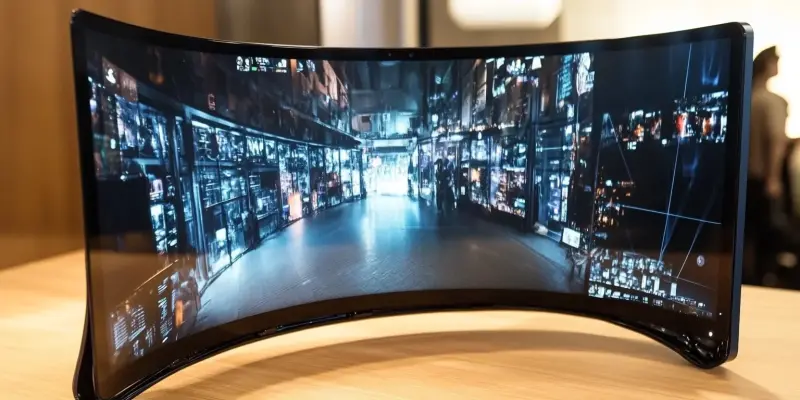
The recent announcement by LG Electronics promises to shake up the gaming monitor market with its new UltraGear GX9 series, featuring the world’s first high-end bendable OLED gaming monitors with a 5K2K resolution. This innovation marks another milestone in LG’s continuous effort to deliver cutting-edge display technology aimed at enhancing immersive gaming experiences. Scheduled for unveiling in January 2025 at CES, the GX9 series reaffirms LG’s commitment to maintaining its leadership position in the premium OLED gaming monitor segment. With superior display quality and advanced gaming technology, these monitors seek to revolutionize the way gamers experience their favorite titles, blending visual fidelity with ergonomic flexibility.
The UltraGear GX9 series comprises notable models such as the 45GX990A and 45GX950A, each featuring a 21:9 aspect ratio and the impressive 5K2K resolution (5,120 x 2,160). Compared to traditional 16:9 monitors, the 21:9 aspect ratio offers a significantly more immersive experience, wrapping the user in a broader and more expansive field of view that can make gameplay feel more enveloping and realistic. Additionally, these models are designed to maintain better content compatibility than 32:9 monitors, which sometimes face issues with certain games and media formats. This careful balance enhances gamers’ immersion while ensuring a wide range of content is optimally displayed.
Immersive Experience Through Advanced Technology
A key feature of the UltraGear GX9 series is LG’s use of WOLED technology, which guarantees high brightness, true blacks, and vivid color reproduction. This technological advancement is particularly crucial for gamers, as it significantly enhances the visual aspects of their gaming environment—whether it is the deep, dark corners of a horror game or the vibrant, dynamic landscapes of an open-world adventure. True blacks and high contrast ratios provided by WOLED technology add depth to images, making the gamer’s experience more lifelike and engaging. The level of detail and quality noticeable in these new monitors arguably surpasses that of most rival products currently available on the market.
Aside from the exceptional display quality, the GX9 series also features innovative aspects such as customizable aspect ratios and screen sizes via LG’s second-generation Dual-Mode feature. This flexibility allows gamers to optimize their monitor settings according to the genre of games they are playing, whether it be FPS, RPG, MOBA, or racing simulators. The ability to tailor the visual setup to specific game requirements ensures that the gaming experience is not only immersive but also highly personalized. Furthermore, certifications for low blue light emissions are included to reduce eye strain during prolonged gaming sessions. Coupled with an Anti-Glare & Low Reflection (AGLR) coating, these features aim to provide a more comfortable and enjoyable gaming session, even in brightly lit environments.
Unique Model Features and Cutting-Edge Connectivity
Each model within the UltraGear GX9 series boasts its own set of unique features. For instance, the LG UltraGear OLED Bendable Gaming Monitor (model 45GX990A) stands out as the world’s first 5K2K-resolution bendable OLED display. This model can effortlessly transition from a flat design to a 900R curvature within seconds, providing unparalleled flexibility for its users. The ultra-fast 0.03ms response time ensures smooth and responsive gameplay, thus significantly enhancing the user’s immersion, especially in fast-paced gaming scenarios. This model’s flexibility combined with its display quality makes it a pioneering product in the gaming monitor market, aimed at gamers who demand top-tier performance and adaptability from their equipment.
On the other hand, the 45GX950A model is designed with an 800R curvature and supports advanced connectivity options such as DisplayPort 2.1, HDMI 2.1, and USB-C with 90W power delivery. These connectivity features ensure compatibility with the latest graphics cards and a variety of devices, promoting seamless integration into existing gaming setups. The model’s 4-side Virtually Borderless design, complemented by slim bezels, enhances the immersion and aesthetics of the monitor, providing a more engaging and visually appealing gaming environment. Support for advanced gaming features such as variable refresh rate (VRR) also comes standard, and the certification by NVIDIA G-SYNC® and AMD FreeSync™ Premium Pro helps to reduce screen tearing and boosts overall responsiveness during intense gaming sessions.
Smart Gaming and Versatility
LG Electronics has made a significant announcement that is set to impact the gaming monitor market profoundly. They are introducing the new UltraGear GX9 series, which includes the world’s first high-end bendable OLED gaming monitors featuring an impressive 5K2K resolution. This launch represents another leap forward in LG’s quest to deliver state-of-the-art display technology designed to enhance immersive gaming experiences. Scheduled to debut in January 2025 at CES, the GX9 series highlights LG’s dedication to leading the premium OLED gaming monitor sector. These monitors aim to revolutionize the gaming experience by combining top-tier display quality with advanced gaming capabilities.
The UltraGear GX9 series includes standout models like the 45GX990A and 45GX950A, both boasting a 21:9 aspect ratio and the remarkable 5K2K resolution (5,120 x 2,160). Compared to conventional 16:9 monitors, the 21:9 aspect ratio offers a noticeably more immersive experience, providing a broader field of view that enhances the realism of gameplay. Additionally, these models are designed to offer superior content compatibility compared to 32:9 monitors, which can struggle with certain games and media formats. This ensures an optimal display for a wide array of content while enhancing gamers’ immersion.