

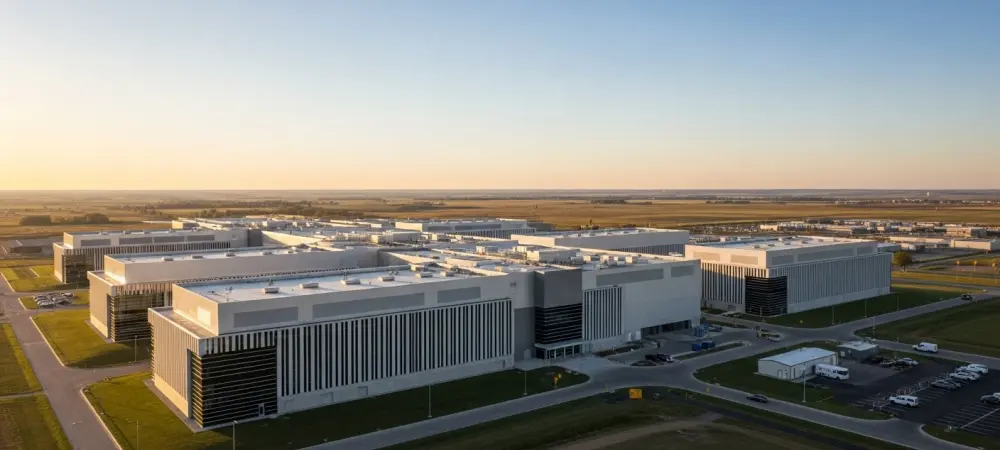
The silhouette of the American Midwest is undergoing a radical transformation as massive, windowless data fortresses replace traditional grain elevators across the vast landscape of the Heartland. This geographical pivot represents a monumental shift in how the digital world is built, moving away from historic tech corridors in Virginia and California toward the wide-open spaces of the interior.
The Great Migration of American Computing Power
The skyline of the American Heartland is no longer defined solely by grain silos and manufacturing plants; today, it is increasingly dominated by the sprawling, windowless monoliths of hyperscale data centers. While Silicon Valley and Northern Virginia have long been the undisputed titans of digital infrastructure, a massive shift is underway as 53 percent of all new hyperscale capacity moves toward the nation’s interior. This migration represents a fundamental rewriting of the American tech map, driven by an insatiable hunger for power that coastal grids can no longer satisfy.
This movement is not merely a matter of geography but a total reconfiguration of the digital backbone. As the demand for cloud services and massive storage grows, the limitations of traditional tech hubs have become impossible to ignore. Developers are now looking to the central United States as the only region capable of supporting the next generation of massive infrastructure projects required for a global economy.
Why the Infrastructure Crisis in Coastal Hubs Matters
For decades, proximity to major population centers and undersea cable landings made coastal hubs the logical choice for data storage. However, the explosion of artificial intelligence has pushed these legacy markets to a breaking point, characterized by dwindling land availability and multi-year wait times for power grid connections. As Northern Virginia and the Pacific Northwest struggle with infrastructure fatigue, the reliability of the digital services we use daily—from enterprise cloud platforms to generative AI—now depends on the industry’s ability to find “gigawatt-scale” locations where the lights can stay on without overwhelming local communities.
This bottleneck in coastal development has created a ripple effect throughout the entire technology sector. When the primary hubs reach capacity, the cost of operating within them skyrockets, forcing companies to reconsider their deployment strategies. The shift to the interior provides a necessary safety valve, ensuring that the expansion of the digital economy is not stifled by the physical constraints of a few saturated markets.
Analyzing the Shift from Silicon Valley to the American Plains
The transition to the Heartland is not a gradual trend but a rapid reallocation of billions in capital by titans like Amazon, Google, Meta, and Microsoft. Traditional data centers require significant power, but AI-focused facilities demand an entirely different order of magnitude, necessitating inland locations with vast, undeveloped acreage. Operational capacity in Texas and the Midwest reached 33 percent in 2026, with non-traditional markets like South Bend, Indiana, and Kansas City, Missouri, emerging as the new front lines of digital expansion.
While construction in primary coastal markets slowed, secondary markets saw a surge in development as operators prioritized speed-to-market over traditional tech corridor prestige. This change reflected a new reality where the physical distance from a user was less important than the ability to power thousands of high-density server racks. The move toward the plains allowed for the creation of massive campuses that would be physically and economically impossible to build in the densely populated coastal regions.
Industry Projections: Texas as the New Global Epicenter
Market analysts from JLL and CBRE highlight a strategic pivot where energy abundance has become the ultimate currency in site selection. Expert consensus suggests that the deregulated nature of the Texas electricity market, managed by ERCOT, provides a level of cost competition and flexibility that regulated coastal utilities cannot match. Because of these favorable conditions, JLL projects that Texas is on track to become the largest data center market in the world by 2030, effectively unseating long-time incumbents through a combination of lower operational expenses and a “power-first” development philosophy.
The unique energy landscape in Texas offered more than just low costs; it provided a level of autonomy that major tech firms craved. By operating in a deregulated environment, these companies negotiated directly for power and invested in their own renewable energy sources to fuel their operations. This autonomy positioned the state as the primary beneficiary of the migration, turning the Lone Star State into the central nervous system of the global cloud.
Strategies for Navigating the Heartland Data Surge
For developers and enterprise leaders who looked to capitalize on this inland migration, a specific framework became essential for modern site selection. Prioritizing grid maturity over latency was a key move, as the ability to secure massive power loads often outweighed the millisecond advantages of being physically close to end-users. Organizations that evaluated regional regulatory climates and sought out regions with flexible energy markets or aggressive renewable energy incentives found ways to offset the high carbon footprint of large-scale computing. Securing long-term land reserves also emerged as a critical tactic during this period. As the Heartland became more crowded, the early acquisition of “dark” sites with future utility commitments became the standard for maintaining a competitive edge in infrastructure capacity. This proactive approach allowed the industry to stabilize growth while preparing for the next generation of computational demands, ensuring that the heart of the country remained the engine of global innovation.