

Dominic Jainy brings a wealth of experience from the intersection of high-stakes real estate and the rapidly evolving world of artificial intelligence. As an IT professional with deep roots in machine learning and blockchain, he understands the physical requirements of the digital future better than most. This conversation explores the strategic partnership between Lincoln Property and Metrobloks, focusing on their massive $1.4 billion investment in Kansas City. We delve into the complexities of power procurement, the shift toward multi-story AI-ready designs, and why secondary markets are becoming the new front lines for global infrastructure development.
The discussion covers the strategic advantages of combining institutional capital with technical expertise and the logistical benefits of selecting pre-zoned sites. We also explore the unique design challenges posed by high-density AI workloads and the reasons behind the sudden surge of interest in the Missouri data center market.
How does a joint venture between a large-scale real estate firm and a specialized developer change the risk profile of a 150MW project? What specific operational advantages do you see when combining institutional capital management with AI-ready infrastructure expertise in the Kansas City market?
Combining Lincoln’s history of managing over $1.5 billion in data center investments with the specialized technical approach of a developer like Metrobloks significantly derisks a project of this scale. Lincoln brings a massive portfolio of 20 operational facilities totaling more than 2.1 million square feet, providing a foundation of stability and institutional trust. Meanwhile, the leadership at Metrobloks draws from high-level experience at tech giants like Meta and Amazon, ensuring the technical blueprint is actually optimized for the next generation of AI. This synergy allows us to bridge the gap between complex capital management and the agile, high-density engineering required for a 150MW campus. In a fast-moving market like Kansas City, having both the financial muscle and the technical pedigree ensures that we can deliver high-performance facilities in the near term without the usual growing pains of specialized construction.
Securing a 30-acre site that is already zoned and powered is becoming increasingly rare in the current utility landscape. How do these pre-existing conditions impact your development timeline, and what trade-offs are involved when opting for a two-story, 177,000 square foot facility design?
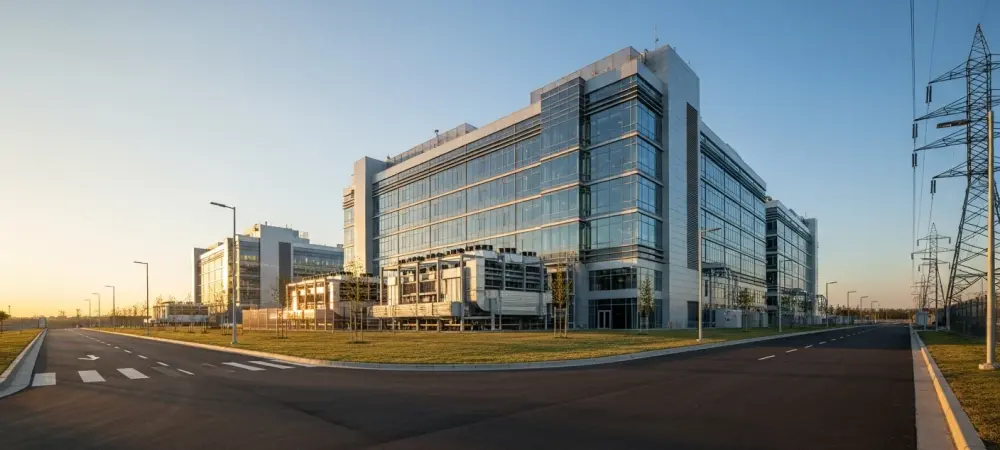
Having a 30-acre site that is already zoned and powered for data center use is an incredible competitive advantage that effectively eliminates the longest lead times in our industry. In many markets, waiting for utility upgrades or zoning approvals can stall a project for years, but here we can move immediately toward executing our $1.4 billion vision. The decision to build a two-story, 177,000 square foot facility as our first phase allows us to maximize the utility of the land while concentrating our power distribution more efficiently. While vertical builds require more sophisticated structural engineering and heavier floor loading to support high-density AI racks, they offer a more compact footprint that is easier to secure and manage. This approach ensures we can scale up to the full 568,000 square foot campus capacity while maintaining the speed-to-market that our customers demand.
Kansas City is rapidly emerging as a critical hub for high-density data centers. Why is this specific metro area attracting billion-dollar investments now, and how does the regional infrastructure support the massive power demands of a 568,000 square foot campus compared to traditional coastal markets?
Kansas City is gaining traction because it offers a rare combination of geographic centralism and robust power infrastructure that traditional coastal hubs are struggling to provide. Our $1.4 billion investment in Liberty reflects the fact that this region can actually support the massive 150MW power requirements of a campus this size without the grid congestion seen in older markets. The 568,000 square foot campus we are developing benefits from a utility landscape that is actively welcoming industrial growth, rather than pushing back against it. Furthermore, the cost of land and the availability of large, contiguous parcels allow for the kind of campus-style development that is becoming nearly impossible in land-constrained areas like Northern Virginia or Silicon Valley. This metro area is perfectly positioned to serve as a high-growth alternative for developers who need to scale quickly and reliably.
Designing facilities specifically for AI-ready workloads at the metro edge requires a different technical blueprint than standard colocation. What are the primary cooling and power distribution challenges for these high-density environments, and how do you ensure these sites remain scalable as processing demands evolve?
AI-ready facilities require a fundamental shift in how we think about heat rejection and power density, as these workloads often exceed the capabilities of traditional air-cooled environments. When dealing with high-density sites at the metro edge, the challenge is delivering massive amounts of power to a relatively small physical footprint without creating thermal bottlenecks. We address this by implementing modular power distribution and advanced cooling solutions that are designed to scale alongside the processing demands of our tenants. By building our 568,000 square foot campus with these high-performance specs from the ground up, we ensure the infrastructure remains flexible enough to adopt new cooling technologies as they emerge. This forward-looking design philosophy is what allows us to support the intense requirements of machine learning and large language models over the long term.
Managing a portfolio that spans diverse markets like Detroit, Miami, and Paris requires significant logistical coordination. What criteria do you use to determine if a secondary market is ready for a large-scale campus, and what are the first steps in aligning local community interests with industrial development?
Our expansion into markets like Detroit, Miami, and even Paris is driven by a strict set of criteria focused on power availability, fiber connectivity, and local government support. The first step in any of these markets is securing the trust of the local community, which we achieve through transparency and demonstrating the long-term economic value of a $1.4 billion investment. In Liberty, for example, obtaining planning permission for the first 177,000 square foot building was a collaborative process that aligned our industrial goals with local zoning priorities. We look for regions where we can be a “good neighbor” while also finding the 30-acre footprints necessary for significant 150MW deployments. This balanced approach ensures that our logistical coordination is backed by strong local partnerships, making the development process smoother for everyone involved.
What is your forecast for the Kansas City data center market?
I expect the Kansas City metro area to become one of the top five data center markets in the country within the next decade, fueled almost entirely by the surge in AI infrastructure demand. As traditional hubs reach their breaking point in terms of power and space, the 150MW campus we are building will serve as a catalyst for even more billion-dollar investments in the region. We will see a shift toward more multi-story, high-density designs across the metro area to make the most of the existing power grid. The region’s ability to offer development-ready sites will make it the preferred choice for hyperscalers and enterprise users who can no longer afford to wait years for capacity. Ultimately, Kansas City is no longer just a “flyover” market; it is becoming the digital heart of the country’s technological future.