

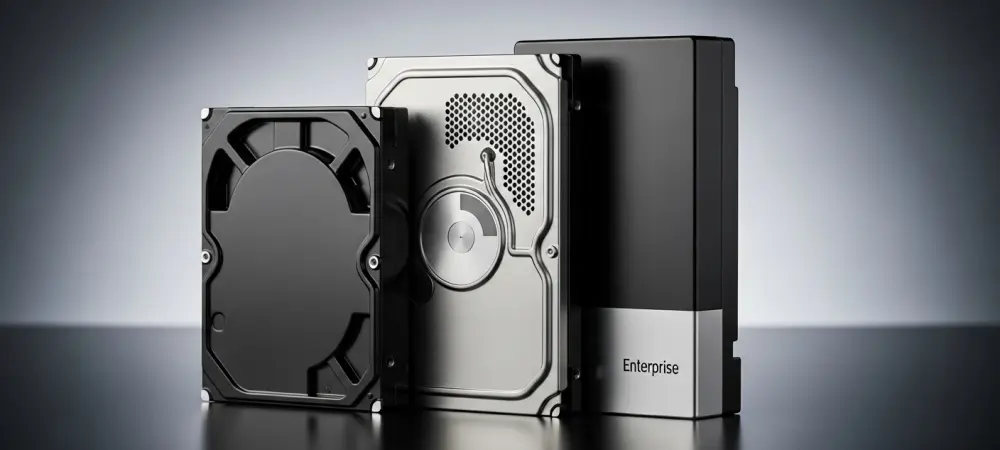
While modern computing is increasingly dominated by flash storage, the massive spinning platters of mechanical hard drives remain the silent architects of the global data infrastructure that powers everything from cloud archives to enterprise backup systems. These devices operate with a clockwork precision that seems almost archaic in a world of silent silicon, yet they provide the petabytes of capacity required for 2026’s data-driven economy. A curious observer might notice that hard drive speeds are almost always fixed at specific intervals like 5,400, 7,200, or 15,000 revolutions per minute rather than a spectrum of random values. This standardization is not a mere coincidence or a marketing gimmick; it is the result of a century of electrical history, aerodynamic engineering, and the unforgiving laws of thermodynamics. As storage needs expand, understanding the mechanical limitations of these rotating discs explains why the industry has converged on these specific figures while simultaneously pivoting toward new ways to increase throughput without simply spinning faster.
Historical and Electrical Foundations
The Legacy of the Power Grid
The foundational logic behind contemporary hard drive speeds can be traced directly back to the mid-twentieth century and the specific characteristics of the North American electrical grid. During the era of the IBM 305 RAMAC, the earliest hard drives utilized large alternating current induction motors that were physically synchronized to the 60 Hertz frequency of the utility power supply. A motor synchronized to a 60 Hertz signal naturally spins at 3,600 revolutions per minute or a fraction thereof, establishing a baseline that would define the industry for decades. This mechanical tethering simplified the design of timing circuits and ensured that data could be read at a consistent rate without the need for the complex, expensive electronic speed controllers that were unavailable or prohibitively expensive at the dawn of the computing age.
As the storage industry matured, engineers began looking for ways to increase performance without abandoning the established logic of existing controller designs. Doubling the standard 3,600 revolutions per minute rate to 7,200 allowed for a significant boost in data access speeds while maintaining a mathematical relationship that was easy for early hardware to process. This transition occurred during a period when most hard drives were moving from external AC power to internal direct current motors, which technically removed the physical requirement for 60 Hertz synchronization. However, the industry chose to stick with these established multiples to ensure that new drives remained compatible with the firmware and software protocols already in use. By the time global markets required drives for regions using 50 Hertz power, the 3,600 and 7,200 revolutions per minute standards were so deeply entrenched in the manufacturing ecosystem that they became the universal language of mechanical storage across the globe.
The Evolution of Rotational Standards
Maintaining these specific rotational speeds became a matter of economic necessity and logistical efficiency for manufacturers who were producing millions of units annually. When every manufacturer adheres to the same rotational benchmarks, it allows for a robust secondary market of standardized components, such as specialized spindle bearings and motor controllers, which drives down the total cost of production. If a company had decided to produce a drive spinning at 6,800 revolutions per minute, they would have faced significantly higher costs for custom-designed mechanical parts that offered no tangible benefit over the existing 7,200 revolutions per minute standard. This convergence created a stable environment where software developers could write operating system drivers with predictable expectations regarding data latency and throughput. Even in 2026, the legacy of these early electrical decisions continues to dictate the physical rhythm of the data centers that store the world’s vast repositories of digital information. The persistence of these numbers also facilitated the development of sophisticated error correction algorithms that rely on precise timing to identify specific data sectors on a spinning platter. Because the disc spins at a constant and predictable rate, the controller can calculate exactly where a bit of data should be based on the time elapsed since the last index pulse. If the rotational speed were to fluctuate or be set to a non-standard value, the complexity of these calculations would increase exponentially, requiring more processing power and increasing the risk of data corruption. By locking in these specific speeds, the industry ensured that mechanical drives could achieve the high levels of reliability required for long-term data retention. This stability allowed engineers to focus their efforts on other areas of innovation, such as increasing the density of the magnetic bits themselves, rather than constantly reinventing the fundamental mechanical architecture of the drive.
Physical and Engineering Limits
Aerodynamics and Thermal Management
Pushing a hard drive platter beyond its standard rotational speed introduces a host of aerodynamic challenges that threaten the integrity of the entire storage system. Within the sealed environment of a drive, the read-write heads do not physically touch the magnetic surface; instead, they hover on a microscopic cushion of air or helium that is only a few nanometers thick. As the rotational speed increases, the air moving across the surface of the platter becomes increasingly turbulent, creating unpredictable buffeting forces that can cause the actuator arm to vibrate. Even a microscopic oscillation at these speeds can lead to track misregistration, where the head is unable to align with the data tracks that are now narrower than a human hair. Engineers must mitigate these vibrations with sophisticated dampening materials and specialized gas mixtures, but there is a physical limit where the turbulence becomes too violent for the delicate heads to maintain their stable flight over the rapidly spinning surface.
Friction remains one of the most significant enemies of high-speed mechanical storage, as the air resistance against the spinning platters generates substantial thermal energy that must be managed. In high-performance enterprise drives spinning at 15,000 revolutions per minute, the internal temperature can rise rapidly, causing the metal components to expand at a microscopic level. This thermal expansion is particularly dangerous because it alters the distance between the read-write head and the magnetic media, significantly increasing the probability of a head crash which results in catastrophic data loss. To combat this, modern high-capacity drives are often filled with helium, which is less dense than air and significantly reduces both turbulence and heat-generating friction. However, even with helium, the energy required to overcome the air resistance at higher speeds increases exponentially, making faster drives less efficient and more prone to failure due to the constant thermal stress placed on the internal motor bearings.
Mechanical Stability and the RPM Ceiling
The immense physical forces exerted on a hard drive platter at high rotational speeds create a definitive ceiling that prevents the industry from pushing for even faster mechanical designs. At the enterprise standard of 15,000 revolutions per minute, the outer edge of a standard 3.5-inch platter is moving at speeds exceeding 150 miles per hour, creating massive centrifugal forces that test the structural integrity of the material. Any microscopic imperfection in the balance of the platter or a slight misalignment of the central spindle can lead to destructive resonances that would shatter the drive over time. Designing bearings that can survive years of continuous operation at these speeds requires expensive ceramic materials and fluid dynamic bearing technologies that add significantly to the cost of the unit. For most applications, the diminishing returns of increased rotational speed do not justify the massive engineering investment required to maintain mechanical stability while preventing the drive from vibrating itself into a failure.
Mechanical limitations also involve the latency associated with waiting for the platter to rotate so that the correct data block passes under the read-write head. The industry eventually recognized that chasing raw speed was becoming a losing battle against the laws of physics, leading to a stabilization of the market around the 15,000 revolutions per minute mark as the practical maximum. Instead of trying to spin a single platter at 30,000 revolutions per minute, which would likely cause the disc to disintegrate from the sheer tension, engineers shifted their focus toward increasing the density of the data stored on the disc. This pivot allowed for higher data transfer rates without the need for dangerous and power-hungry increases in physical rotation, marking the end of the “RPM race” in favor of more sustainable and reliable architectures.
Market Standardization and the Future of Storage
Balancing Performance Tiers
The categorization of hard drives into specific speed tiers allows manufacturers to target different market segments based on the specific trade-offs between speed, noise, and energy efficiency. The 5,400 revolutions per minute tier remains a staple for mass storage and eco-friendly consumer devices because it produces minimal heat and operates almost silently, making it ideal for external backup drives and home media servers. In contrast, the 7,200 revolutions per minute standard became the benchmark for high-performance desktop computing, providing a twenty percent reduction in latency compared to its slower counterparts. This tiering system is essential for original equipment manufacturers who must balance the power budget of a laptop or the cooling requirements of a dense server rack. By maintaining these specific speed standards, the industry ensures that system builders can predictably select the right hardware for their thermal and acoustic constraints without needing to test every individual drive model. A common misconception in the storage industry is that a higher rotational speed always translates to a faster overall data transfer rate, but this ignores the impact of areal density. Because the read-write head passes over more bits of data in a single rotation, the sequential throughput can increase even if the physical speed of the platter remains constant. This evolution has allowed the industry to focus on capacity and efficiency rather than raw mechanical velocity, which is far more beneficial for the current data landscape. In 2026, the focus for secondary storage has moved toward maximizing the volume of data stored per watt of power consumed, a metric where high-density, lower-speed drives excel compared to the power-hungry enterprise models of the previous decade.
Innovation Beyond Spin Speed
As the mechanical limits of rotational speed have been reached, engineers have introduced architectural innovations like dual-actuator technology to bypass the traditional bottlenecks of single-head designs. By placing two independent sets of read-write heads on a single spindle, a drive can effectively double its input and output performance by reading or writing to two different parts of the platter simultaneously. This approach provides the performance boost that users once expected from higher rotational speeds but without the associated increase in heat, noise, or mechanical wear. These multi-actuator drives are becoming essential for large-scale data centers that require massive capacity but cannot afford to let that data remain stranded behind the slow access times of a single actuator. This shift represents a fundamental change in how performance is measured, moving away from the physical velocity of the disc toward the intelligent management of the data access points themselves.
The industry adopted several sophisticated next steps to ensure that mechanical storage remained relevant in a landscape increasingly dominated by solid-state alternatives. Rather than continuing the futile attempt to increase rotational velocities, manufacturers focused on perfecting Heat-Assisted Magnetic Recording and Microwave-Assisted Magnetic Recording technologies. These methods allowed for a dramatic increase in storage capacity while maintaining the stable 7,200 revolutions per minute standard that provided the best balance of longevity and speed. Data center operators implemented tiered storage strategies that utilized high-speed flash for active workloads while reserving high-density mechanical drives for the massive archives that define the digital world of 2026. This strategic shift effectively solved the performance ceiling problem by recognizing that physical rotation was no longer the primary lever for progress. Engineers successfully pivoted toward architectural efficiency, ensuring that the legacy of the power grid finally gave way to a new era of innovation.