

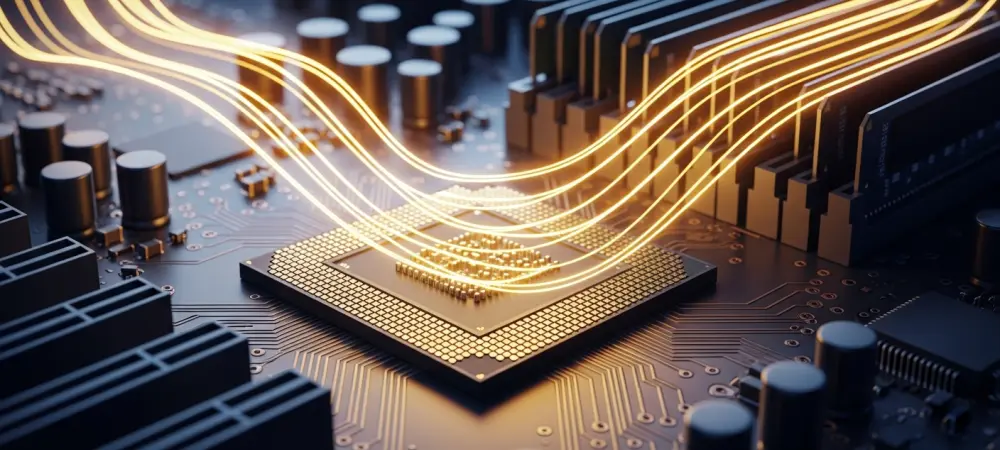
The global demand for computational throughput has reached a tipping point where traditional memory architectures can no longer sustain the velocity required by sophisticated Large Language Models. While Graphics Processing Units have seen exponential growth in speed, the ability to feed these processors with data has struggled to keep pace. Kioxia’s introduction of the GP1 Series marks a pivotal shift in addressing this imbalance. By positioning these enterprise SSDs as a high-performance memory extension tier, the goal is to provide the massive bandwidth necessary for modern AI workloads without the astronomical costs of traditional memory expansion. This analysis explores how the GP1 Series utilizes cutting-edge protocols and flash architecture to ensure that data storage is no longer the weakest link in the AI infrastructure.
Bridging the Gap: Storage Solutions for AI Computing Power
As generative AI continues to demand unprecedented levels of performance, the technology industry has hit a formidable bottleneck known as the “memory wall.” Graphics Processing Units struggle to access data fast enough to maintain efficiency, leading to idle cycles and increased costs. Kioxia’s GP1 Series addresses this by utilizing the PCIe 6.0 interface and NVMe 2.2 protocol. These drives act as a high-performance bridge, offering the throughput needed for Large Language Models while remaining more cost-effective than pure DRAM expansions.
The Evolution: Accelerating Enterprise Storage in the Modern Era
Historically, industry centers relied on a clear distinction between fast, expensive system memory and slower, high-capacity NAND flash. However, the rise of AI has blurred these lines. Modern accelerators rely on High Bandwidth Memory soldered directly onto the chip, which offers speed but is severely limited in capacity. As datasets grew into the petabyte range, it became clear that standard SSDs could not handle the throughput requirements of generative AI. This shift paved the way for storage-class memory solutions that offer near-memory speeds at storage-level capacities.
Decoding the Breakthroughs: Technical Advancements in the GP1 Series
High-Speed Architecture: Second-Generation XL-FLASH Technology
The heart of the GP1 Series is second-generation XL-FLASH technology. Unlike standard memory, it utilizes 512-byte block sizes to reach 10 million input/output operations per second. This allows GPUs to access massive datasets directly through PCIe interfaces, bypassing smaller on-chip memory constraints for fluid real-time processing.
Physical Durability: Robust Design and Industrial Reliability
Offered in E3.S and E1.S form factors, these drives support both air and liquid-cooling to manage thermal demands. An endurance rating of 50 drive writes per day ensures survival in hyperscale environments during intense AI training cycles, providing the reliability required for mission-critical research.
Competitive Landscape: Market Dynamics and Industry Competition
Kioxia differentiates itself by covering the entire storage spectrum, from high-speed GP1 drives to massive 245TB capacities. This broad strategy leverages high-end breakthroughs to eventually inform cost-effective enterprise solutions across the market, maintaining a competitive edge against other chipmakers.
Future Projections: The Path Toward 100 Million IOPS
The launch of the GP1 Series is just the beginning of a roadmap intended to keep up with the evolution of artificial intelligence. Kioxia signals that future generations will target 100 million IOPS as PCIe 7.0 emerges. This trend suggests a future where physical distance between data and the processor is virtually eliminated, leading to a memory-centric computing model where storage is vital to the calculation process itself.
Strategic Implementation: Optimizing Performance for Hyperscalers
Organizations looking to scale AI infrastructure should use these SSDs to create tiered memory architectures. Utilizing GP1 drives for active data subsets that exceed DRAM capacity allows hyperscalers to expand training sets without a linear increase in hardware costs. By integrating these drives into high-density server racks, professionals maximize efficiency while maintaining the endurance required for constant data churning.