

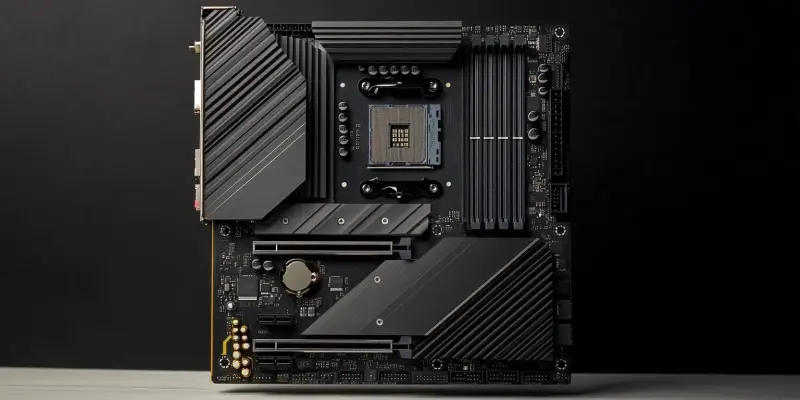
Nvidia’s recent announcement of the RTX 50 series GPUs at CES 2025 has created a significant buzz in the tech industry, with the RTX 5090 being the flagship model. The RTX 50 series, especially the RTX 5090, is currently the most powerful consumer GPU on the market, thanks to advancements in AI and neural rendering technologies. To harness the full potential of the RTX 5090, pairing it with the right motherboard is crucial. This article aims to guide users in selecting the best motherboard to ensure optimal performance and compatibility with the RTX 5090.
High-end GPUs like the RTX 5090 require top-tier components for support, not just in terms of raw power but also in terms of features and compatibility. A poorly chosen motherboard may bottleneck the GPU, preventing it from performing at its peak. Modern motherboards must accommodate the incredible demands of GPUs such as the RTX 5090, providing features like PCIe 5.0 support, ultra-high-speed memory compatibility, and robust power delivery. These features ensure that the entire system can handle the 5090 without any performance bottlenecks.
Key Features to Look for in a Motherboard
PCIe 5.0 Support
One of the most critical features to look for in a motherboard for the RTX 5090 is PCIe 5.0 support. PCIe 5.0 offers double the bandwidth of PCIe 4.0, which is essential for handling the high data throughput of the RTX 5090. This ensures that the GPU can communicate with the rest of the system without any bottlenecks, allowing for maximum performance. The increased bandwidth provided by PCIe 5.0 is particularly beneficial for gamers and professionals who engage in resource-intensive tasks, such as 4K gaming, 3D rendering, and video editing.
Motherboards with PCIe 5.0 support also future-proof your system, as upcoming components will likely adopt this standard. This means that investing in a PCIe 5.0 motherboard now will keep your system relevant for longer, saving you from frequent upgrades. The adoption of PCIe 5.0 by more manufacturers and peripheral makers will further enhance the longevity and relevance of your system, providing you with the best technology available for years to come.
High-Speed Memory Compatibility
Another crucial feature is high-speed memory compatibility. The RTX 5090 benefits significantly from fast memory, as it can handle more data at once, improving overall system performance. Look for motherboards that support DDR5 memory with high speeds, as this will complement the GPU’s capabilities. High-speed memory allows for faster data transfer rates between the CPU, GPU, and storage devices, leading to smoother and more efficient operation of your system.
Motherboards like the ASUS ROG Strix X870E-E Gaming WiFi and MSI MEG Z890 ACE offer memory speeds up to 8000 MT/s and 9200 MT/s, respectively. These high speeds ensure that the RTX 5090 can perform at its best, especially in memory-intensive tasks like gaming and rendering. Additionally, having a higher memory capacity, such as up to 256GB DDR5, provides more headroom for multitasking and running memory-heavy applications without experiencing lag or slowdowns.
Top Motherboard Picks for RTX 5090
Best Ryzen 9000 Series Motherboard: ASUS ROG Strix X870E-E Gaming WiFi
The ASUS ROG Strix X870E-E Gaming WiFi is an excellent choice for those using Ryzen 9000 series CPUs. This motherboard features the AM5 socket and X870E chipset, making it compatible with the latest AMD processors. Its ATX form factor ensures that it fits in most standard cases, providing flexibility in building your system. The combination of advanced features and robust design makes this motherboard a top contender for high-performance gaming and professional use.
This motherboard supports PCIe Gen 5, ensuring that the RTX 5090 can operate at its full potential. It also offers high-speed memory support, with speeds up to 8000 MT/s (OC) and a capacity of 192GB DDR5. These features make it an ideal choice for gamers and enthusiasts who demand top-tier performance. Moreover, the motherboard’s aesthetic appeal, with RGB lighting and a sleek design, adds to the overall build, making it a visually striking centerpiece for any gaming rig.
Best Intel Core Ultra Motherboard: MSI MEG Z890 ACE
For those using Intel’s Core Ultra series CPUs, the MSI MEG Z890 ACE is a top contender. This motherboard features the LGA 1851 socket and Intel Z890 chipset, ensuring compatibility with the latest Intel processors. Its ATX form factor provides ample space for components, making it suitable for high-performance builds. The robust construction and premium components used in this motherboard ensure that it can handle the intense demands of modern gaming and professional applications.
The MSI MEG Z890 ACE boasts a robust 24+2+1+1 power stage design, ensuring stable power delivery to the CPU and GPU. It supports PCIe Gen 5 and offers multiple M.2 slots for high-speed storage. With memory speeds up to 9200 MT/s and a capacity of 256GB DDR5, this motherboard is designed for both gaming and productivity workloads. The advanced cooling solutions, including heatsinks and VRM cooling, keep the system running efficiently, even under heavy loads, making it ideal for long gaming sessions and intense multitasking.
Best Intel 14th Gen Motherboard: ASUS ROG Maximus Z790 Hero
The ASUS ROG Maximus Z790 Hero is a highly capable motherboard designed for Intel’s 14th Gen CPUs. Featuring an ATX form factor and a 20+1 phase power design, this motherboard ensures stability even under heavy workloads. It offers extensive connectivity options such as 2.5Gb LAN, WiFi 6E, Bluetooth 5, USB4, USB-C, DisplayPort, and Thunderbolt 4, providing users with a versatile range of peripherals, networking, and data transfer options.
Supporting PCIe Gen 5 and DDR5 memory, the ASUS ROG Maximus Z790 Hero is ready to handle high-end components like the RTX 5090. The robust VRM cooling system keeps the motherboard stable during intense gaming sessions. Advanced features such as AI-based performance tuning and enhanced VRM designs make it an excellent choice for gamers and PC enthusiasts. The user-friendly BIOS and overclocking tools offer additional customization, enabling users to tailor their systems to precise specifications.
The RTX 5090’s standout performance is driven by Nvidia’s Blackwell platform, which uses AI and neural rendering to boost gaming and rendering capabilities. According to Nvidia’s benchmarks, the RTX 5090 is about twice as fast as the previous RTX 4090, thanks to technologies like DLSS 4 and Multi-Frame Generation. These AI-driven advancements allow the GPU to handle numerous rendering tasks more efficiently.
Pairing the RTX 5090 with a high-quality motherboard like the ASUS ROG Maximus Z790 Hero ensures the system meets the high data throughput and power needs of the GPU. Features like PCIe 5.0 bandwidth, high-speed memory support, and robust power delivery are crucial for maximizing the RTX 5090’s capabilities. This combination of Nvidia’s advanced GPU technology and a top-tier motherboard offers an exceptional computing experience, making it a valuable investment.