

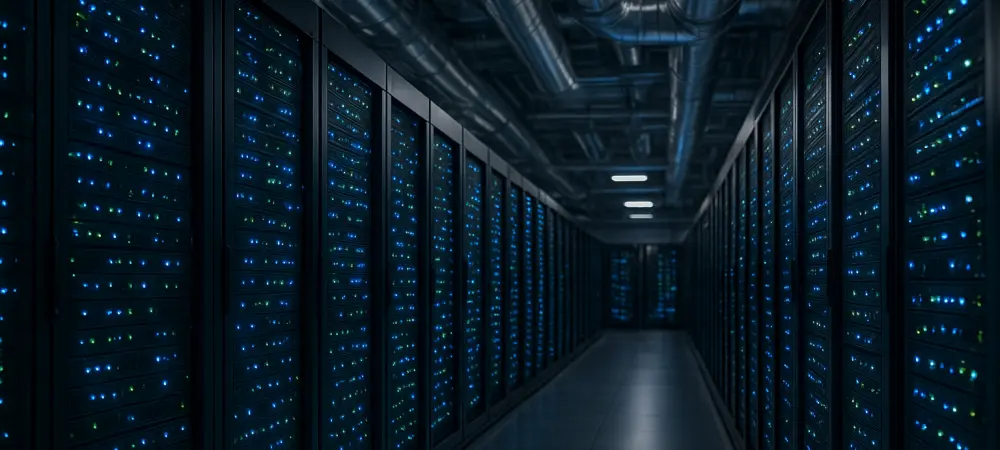
Deep within the concrete walls of windowless warehouses, millions of silicon processors hum with a mechanical intensity that consumes more water and power than most medium-sized cities. The digital “cloud” is often spoken of as if it were an ethereal, weightless entity, yet every prompt sent to an artificial intelligence and every byte processed depends on a massive physical foundation. While the user experience is seamless and instantaneous, the underlying reality is far more grounded: miles of fiber-optic cables and vast warehouses packed with high-performance servers that never sleep. This growing digital brain is not just a miracle of engineering; it is an industrial heavyweight that is beginning to reshape the physical world in ways we are only starting to quantify. The transition from simple search queries to generative models has fundamentally altered the scale of computation. Each interaction represents a tiny fraction of a massive resource drain, as the infrastructure required to support these models expands into the physical landscape.
The Invisible Industrial Reality Behind Your Screen
The sleek glass surface of a modern smartphone belies the massive industrial complex that breathes life into every intelligent response. Data centers are the physical manifestation of this intelligence, acting as centralized hubs where thousands of servers operate in unison. These facilities are often located far from the urban centers they serve, tucked away in rural industrial parks to minimize land costs and take advantage of proximity to power plants. This distance allows users to remain oblivious to the sheer scale of the machinery required to sustain a simple conversation with a chatbot. Modern AI models require specialized hardware, such as Graphics Processing Units, which are far more energy-intensive than traditional central processors. These units generate immense heat, requiring complex ventilation systems and massive cooling towers to prevent hardware failure. Consequently, the industrial footprint of the internet is no longer just a collection of hard drives; it is a high-density power environment that rivals the energy demands of heavy manufacturing plants. The “cloud” is not a vapor but a solid, hot, and noisy network of steel and silicon.
Why the Physical Footprint of Intelligence Matters Now
As Artificial Intelligence integrates into every sector of the global economy, its environmental demands are transitioning from a niche concern to a primary driver of resource scarcity. The rapid expansion of data centers is occurring at a pace that often outstrips the ability of local infrastructure to adapt. Understanding this cost is no longer just an academic exercise; it is essential because the AI boom is directly impacting electricity grids, local water supplies, and public health. This creates a complex tension between technological progress and global climate targets that requires immediate attention.
The competition for resources between tech giants and local communities is intensifying. In some regions, the construction of a single new data center can require as much power as tens of thousands of homes, forcing utility companies to prioritize industrial customers over residential needs. Furthermore, the land required for these facilities is often repurposed from agricultural or natural zones, leading to permanent changes in local geography. This expansion is happening during a period of global environmental sensitivity, making the resource-intensive nature of AI a critical factor in urban planning and policy.
The Triad of Resource Depletion: Energy, Water, and Land
If the data centers of the world were a single nation, they would already rank as the 11th largest electricity consumer on Earth. This energy hunger is accelerating rapidly, with projections suggesting that power usage will double by 2030 to reach 945 terawatt-hours, which is roughly the annual consumption of Japan. In major tech hubs like Frankfurt and Dublin, data centers now consume between 20% and 40% of the total city electricity. This massive consumption forced local authorities in some jurisdictions to pause new grid connections to prevent total system failure and ensure that residential areas remain powered. The “always-on” requirement of AI infrastructure is actively delaying the transition to green energy. Because wind and solar are intermittent, utilities increasingly rely on fossil fuels to maintain grid stability for these facilities. In the United States, this surge prompted the postponed decommissioning of 15 coal-fired power plants, which alone emitted 65 million tons of greenhouse gases in the past year. This creates a zero-sum game where renewable energy used by Big Tech is no longer available to decarbonize other critical sectors like transportation or agriculture, effectively slowing down global progress toward carbon neutrality.
Beyond electricity, high-performance servers generate intense heat, and evaporation remains the most efficient cooling method. A single large-scale facility can withdraw up to 5 million gallons of water daily, a volume comparable to a town of 50,000 residents. In northern Virginia, which serves as the premier hub for global data centers, nearly 300 facilities consumed 2 billion gallons of water in 2023. While 80% of this water is lost to evaporation, the remaining 20% is returned as wastewater that can overwhelm local treatment infrastructure and introduce chemical residues into the water table.
Localized Environmental and Health Impacts
Cooling a data center does not eliminate energy; it merely transfers heat from the servers to the external environment. In cities like Phoenix, Arizona, a single facility can raise nearby land surface temperatures by as much as 9 degrees Celsius. This “Heat Island Effect” increases the risk of heat stress for local residents and forces neighboring buildings to use more air conditioning, creating a feedback loop of rising energy demand and temperatures. The localized warming effect can persist long after the sun goes down, as the concrete structures of the data centers retain and radiate heat into the night air.
The reliance on coal and gas for grid power releases particulate matter linked to respiratory and cardiovascular diseases in nearby populations. Furthermore, data centers maintain massive on-site diesel generators for backup power, which emit 200 to 600 times more nitrogen oxides than standard power plants. In regions like Virginia, even limited use of these generators contributed to thousands of cases of asthma symptoms annually, placing a significant public health burden on surrounding communities. These emissions are often concentrated in industrial zones that border residential neighborhoods, leading to unequal health outcomes for those living in the shadow of the cloud.
The physical footprint of AI infrastructure also requires the massive conversion of natural and agricultural land into industrial zones. This rezoning disrupts local ecosystems and threatens biodiversity, as seen in recent land conversions in Hattersheim, Germany. Beyond the buildings themselves, the auxiliary infrastructure, such as new gas pipelines and high-voltage transmission lines, fragments habitats and leads to long-term soil erosion. These changes are often irreversible, as the soil is paved over or compacted to support the weight of heavy industrial equipment, permanently altering the drainage patterns of the landscape.
Strategies for a More Sustainable AI Ecosystem
The industry must move away from traditional evaporative cooling toward more sustainable alternatives to mitigate these impacts. Transitioning to immersion cooling, where servers are submerged in specialized non-conductive fluids, or closed-loop systems can reduce freshwater use by up to 70%. These technologies allow data centers to operate efficiently without placing an unsustainable burden on local municipal water supplies. While the initial investment for these systems is higher, the long-term reduction in resource consumption provides both environmental and financial benefits for operators.
Rather than venting heat into the atmosphere and contributing to the Heat Island Effect, data centers can be integrated into thermal energy networks. By piping waste heat into municipal heating systems, these facilities provide warmth to nearby homes and businesses, turning an environmental liability into a community resource. This circular approach to energy usage helps to offset the carbon footprint of the facility by reducing the need for separate heating systems in the surrounding area. In Scandinavia, such projects have already demonstrated that data centers can function as “digital radiators” for entire neighborhoods.
To avoid the zero-sum game of green energy consumption, AI providers focused on additionality, which is the practice of funding and building new renewable energy projects specifically to power their operations. This ensures that the growth of AI infrastructure adds more clean energy to the grid rather than siphoning off existing resources intended for public decarbonization. By investing directly in new solar and wind farms, tech companies can drive the expansion of the green energy market rather than just competing for the current limited supply of renewable power. The path toward a sustainable digital future required a fundamental shift in how societies valued the resources consumed by high-speed computation. Legislators and technology developers eventually recognized that the rapid advancement of artificial intelligence could not be sustained if it compromised the stability of the physical environment. Policy frameworks began to prioritize transparency in resource reporting, forcing companies to disclose the exact water and carbon costs of training large models. These regulatory shifts proved essential in moving the industry away from a growth-at-all-costs mindset and toward a model that respected the limits of local ecosystems.
Technological innovation also played a critical role in this transition as engineers successfully optimized algorithms to require less compute power. The adoption of small-scale, specialized models reduced the need for the massive, general-purpose clusters that characterized the early years of the AI boom. Furthermore, the integration of data centers into the circular economy through waste heat recovery became a standard requirement for new construction permits in many major cities. These combined efforts ensured that the digital brain could continue to evolve without exhausting the resources of the physical world it was designed to improve.