

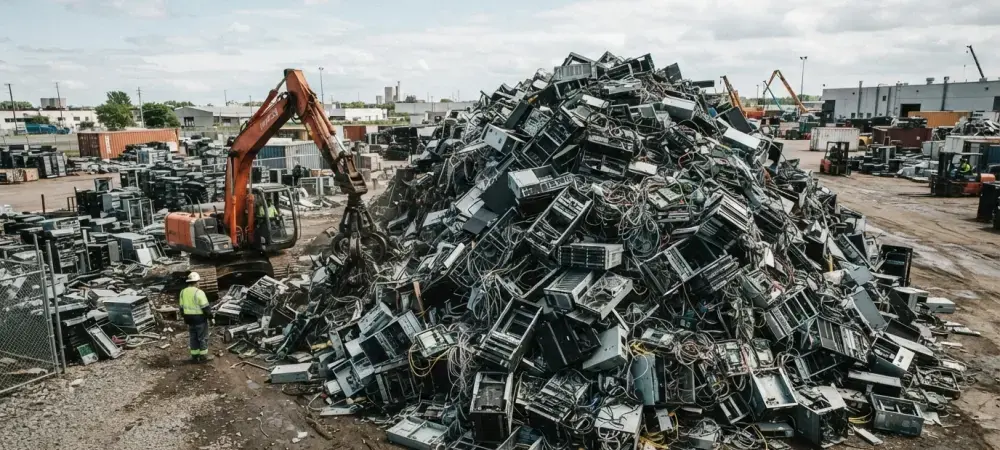
The sleek, ephemeral glow of a generative AI interface masks a brutal industrial reality involving massive excavations of rare minerals and the relentless churning of specialized silicon processors. Every time an algorithm generates an image or a block of complex code, it relies on a physical infrastructure that is expanding at a breakneck pace. This physical foundation is not permanent; it consists of high-performance components that degrade, become obsolete, and eventually transform into toxic waste. While carbon footprints and energy bills dominate the headlines, the mountain of discarded hardware is growing into a crisis that cannot be solved by simply switching to renewable power.
The environmental footprint of AI is often reduced to a digital measurement of kilowatt-hours, but this ignores the millions of tonnes of hardware that must be mined and manufactured. As global demand for machine intelligence grows, the industry must reckon with the material cost of the machines themselves. The real price of artificial intelligence is etched into the earth’s crust through the extraction of precious metals and the accumulation of discarded silicon.
The Physical Price of Virtual Intelligence
The invisible nature of the cloud has long fostered an illusion that digital advancement is decoupled from the physical world. However, the sophisticated neural networks powering today’s large language models are tethered to millions of servers packed with gold, copper, lithium, and rare earth elements. These materials are extracted through energy-intensive mining processes that often devastate local ecosystems and consume vast quantities of water before a single chip reaches the assembly line. The manufacturing phase alone accounts for a significant portion of a device’s total lifetime carbon footprint.
Every advancement in processing power requires a corresponding increase in the complexity and volume of the hardware involved. This physical expansion leads to a definitive end of life for millions of components every few years. As chips become more specialized for specific AI workloads, their utility in other general computing sectors diminishes, making them harder to repurpose. The result is a cycle where the pursuit of virtual intelligence leaves a permanent scar on the planet, represented by the massive tonnage of hardware that transitions from high-tech assets to environmental liabilities.
Beyond the Power Grid: Why Hardware Lifecycles Matter
Global discussions regarding data center sustainability typically focus on the “meter running”—the immediate electricity consumption and water usage required for cooling. According to the International Energy Agency, data center electricity demand is projected to reach over 945 terawatt-hours by 2030. While initiatives like Canada’s Responsible Data Centre Development Principles aim to address local energy impacts and water efficiency, they often overlook the debt created during hardware production. A server carries a heavy environmental price tag before it is ever powered on in a facility.
Ignoring the hardware lifecycle creates a massive blind spot in current environmental policies. Current frameworks prioritize operational efficiency, which encourages companies to replace older machines with newer, more energy-efficient models. While this reduces electricity consumption, it accelerates the rate of hardware disposal and the demand for virgin materials. Without a holistic approach that considers the total material throughput, the industry risks solving one problem by exacerbating another. True sustainability requires looking beyond the plug and analyzing the entire journey of a server.
The Burgeoning E-Waste Crisis and the Circularity Paradox
As generative AI continues its rapid ascent, the industry faces an unprecedented accumulation of electronic waste. Recent research indicates that from 2026 to 2030, the sector could generate up to five million tonnes of e-waste. This is a concerning figure, especially considering that the global recycling rate for such complex electronics remains stubbornly low. Transitioning to a circular economy—focused on modularity, refurbishment, and hardware reuse—is frequently cited as the solution. By designing servers with interchangeable parts, the industry could theoretically extend the life of these machines.
However, a technical paradox complicates this circular transition. Older, refurbished servers are often significantly less energy-efficient than the latest models. If a company chooses to keep a server in operation for an extra three years to save on material waste, it may consume twice as much electricity as a new unit would. This creates a difficult trade-off for data center operators who must choose between minimizing physical waste and maximizing energy efficiency. Balancing these competing environmental priorities is one of the most significant challenges facing the digital infrastructure sector today.
The Circular Rebound Effect and Systemic Realities
Environmental experts warn that even the most effective recycling and reuse programs can be undermined by the “circular rebound effect.” This phenomenon occurs when efficiency gains or cheaper refurbished components inadvertently fuel market growth, leading to an overall increase in resource consumption. If the availability of secondary hardware simply supplements the existing demand rather than replacing the purchase of new units, the total material footprint of the AI industry continues to climb. In such a scenario, the environmental benefits of circularity are swallowed by the scale of expansion. Meaningful sustainability in the AI sector must therefore be measured by the absolute reduction in raw resource extraction rather than just the percentage of materials recycled. Simply diverting hardware from landfills is insufficient if the rate of new manufacturing continues to accelerate toward unsustainable levels. Experts suggest that as long as the market for AI computing remains in an era of exponential growth, hardware longevity will struggle to keep pace with the demand for faster silicon. Addressing this reality requires a systemic shift in how the industry values hardware utility.
Strategies for a Sustainable Hardware Lifecycle
To mitigate the long-term impact of digital growth, the industry pursued a framework focused on radical transparency and mandated repairability. Organizations began to prioritize modular server architectures that allowed for component-level upgrades, effectively decoupling processing improvements from total system disposal. Policymakers introduced strict requirements for material recovery, ensuring that the precious metals inside every retired GPU were returned to the production loop. These steps were essential in slowing the tide of electronic debris that once threatened to overwhelm global waste management systems. The path toward a sustainable digital future required a departure from the traditional “take-make-waste” industrial model. Verified end-of-life protocols and robust secondary markets for older hardware helped extend the functional life of components that were still capable of performing less intensive tasks. By integrating hardware lifecycle management into national economic strategies, governments sought to ensure that the infrastructure of the intelligence revolution did not result in a degraded physical environment. The transition necessitated a fundamental realization that the most efficient server was not always the newest one.