

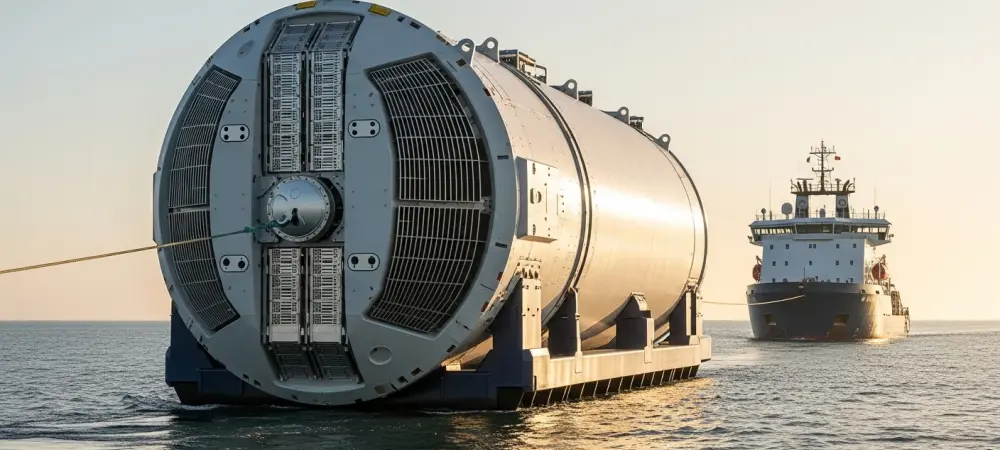
The massive energy hunger of artificial intelligence has pushed traditional land-based power grids to a breaking point, forcing a radical rethink of where and how we process data. As urban centers struggle with blackouts and regulatory hurdles, the ocean has emerged as the most viable frontier for high-density computing. Panthalassa, a trailblazing startup, is currently spearheading this transition by deploying autonomous, wave-powered nodes that operate entirely off-grid. This technology does not just move the problem elsewhere; it solves the fundamental bottleneck of energy transmission by co-locating power generation with computation in the deep sea.
The Convergence of Marine Energy and High-Density Computing
The core principle behind this maritime shift is localized power utilization, a strategy that eliminates the massive energy losses associated with transporting electricity over long distances. While terrestrial data centers are often tethered to aging utility infrastructures that cannot scale fast enough for neural network training, Panthalassa’s approach treats the ocean as a boundless, 24/7 battery. By harvesting the mechanical energy of waves at the source, these units bypass the political and physical constraints of land-based zoning.
This shift is particularly relevant now, as the industry faces a choice between stagnation or environmental radicalism. Unlike traditional green energy projects that require complex subsea cables to feed the grid, these nodes use the power immediately to fuel onboard processors. This creates a self-contained ecosystem where the density of the computing workload is limited only by the kinetic energy of the surrounding swell.
Technical Architecture of Offshore Autonomous Nodes
Closed-Loop Wave Energy Conversion
The internal mechanics of these nodes rely on a closed-loop turbine system designed to capture the constant bobbing motion of the sea. As the steel structure rises and falls with the waves, internal fluids or counterweights drive turbines that generate a steady stream of electricity. Because wave energy is far more consistent than wind or solar, the system maintains a stable voltage, which is critical for the delicate operations of high-end GPUs.
Sealed Modular Compute Stacks
Inside each vertical structure lies a pressurized, hermetically sealed capsule housing the server hardware. These capsules are engineered to withstand extreme pressures while maintaining a dry, stable environment for the silicon. To bridge the gap between deep-water isolation and global connectivity, data is beamed to land via low-earth orbit satellite constellations. This allows for near-real-time model inference and training updates without a single physical wire touching the shore.
Passive Liquid Cooling Systems
One of the most elegant features of this architecture is the reliance on the surrounding ocean as a massive heat sink. Traditional data centers spend nearly forty percent of their energy just on cooling; however, Panthalassa’s nodes use passive thermal exchange with the cold seawater. This constant, natural cooling stabilizes the hardware’s thermal profile, significantly reducing the risk of throttling and extending the operational lifespan of the components compared to their land-based counterparts.
Innovations in Maritime Engineering and Scalability
Modern engineering has moved away from the fragile, multi-jointed designs of the past. The current “hinge-less” steel architecture focuses on durability through simplicity, utilizing standard industrial materials that can be mass-produced in coastal shipyards. By eliminating external gearboxes and flaps that are prone to salt-water corrosion, the system ensures that the nodes can survive for years with minimal human intervention.
The deployment process itself has been streamlined through a horizontal-to-vertical technique. Nodes are manufactured as long tubes, towed behind standard vessels, and then ballasted to “flip” into their final upright position. This method allows for rapid fleet expansion, transforming the ocean into a modular, floating supercomputer that can be scaled up as easily as adding more units to a cluster.
Real-World Applications and Strategic Deployment
This technology is already finding its niche by offloading the most intensive “training” phases of large language models from stressed urban grids. By moving these heavy workloads to the Northern Pacific, companies can continue their R&D cycles without competing with local residents for electricity. The recent $140 million investment from heavyweights like Peter Thiel and Marc Benioff suggests that the market now views maritime compute as a strategic necessity rather than an experimental curiosity.
Technical Hurdles and Environmental Obstacles
Despite the promise, the maritime environment is notoriously hostile. Salt-water corrosion remains a constant threat to the structural integrity of the steel hulls, requiring advanced specialized coatings that must be reapplied or monitored by remote sensors. Additionally, while satellite links are improving, they still introduce a degree of latency that makes these nodes better suited for asynchronous training than for applications requiring millisecond response times.
Maintenance in deep water also presents a logistical puzzle. If a node suffers a hardware failure, the cost of sending a specialized vessel out for repairs can be prohibitive. Current development efforts are focused on improving autonomous diagnostics and hardening the internal electronics to ensure that the “mean time between failures” exceeds the five-year hardware replacement cycle typical of the tech industry.
The Future of Distributed Off-Grid Intelligence
As we look toward 2027, the trajectory points toward the full-scale commercialization of these maritime fleets. The next evolution will likely involve autonomous repair drones that can service nodes without human crews, further lowering operational costs. We are seeing the beginning of a world where “twice-concentrated sunlight”—the energy stored in waves—becomes the primary fuel for the global intelligence economy.
Final Assessment of Wave-Powered Infrastructure
The transition to wave-powered AI infrastructure was a necessary response to the physical limits of our terrestrial energy grid. By successfully decoupling high-density computing from the mainland, this technology proved that the ocean is not just a barrier but a resource for sustainable digital growth. The shift toward modular, autonomous maritime nodes established a new standard for environmentally conscious scaling, ensuring that the progress of artificial intelligence is no longer tethered to the fragility of land-based utilities. This evolution effectively transformed the maritime landscape into the backbone of a resilient, global decentralized compute network.