

Dominic Jainy stands at the forefront of mobile innovation, blending a deep technical background in artificial intelligence with a passion for how hardware evolves to meet professional creative demands. With years of experience tracking the intersection of high-resolution imaging and real-time processing, he offers a unique perspective on the engineering marvels currently reshaping the smartphone landscape. As mobile devices begin to rival dedicated DSLRs in stabilization and sensor density, Dominic provides a technical breakdown of how these advancements change the way we capture the world.
The following discussion explores the significant technological shifts in mobile photography, focusing on the integration of ultra-high-resolution sensors and advanced optical stabilization. We delve into the complexities of sensor modification for improved dynamic range, the mechanical hurdles of achieving industry-leading OIS, and how increased frame rates for motion tracking are redefining the success rate of action photography in the palm of your hand.
The main camera features a 1/1.12 inch 200-megapixel sensor paired with a 35mm lens. How does this specific focal length change the composition workflow for mobile photographers, and what technical hurdles must be overcome to maintain edge-to-edge sharpness on such a large, high-resolution sensor?
Transitioning to a 35mm focal length on a primary sensor represents a shift toward a more documentary-style perspective, moving away from the wider 24mm or 26mm lenses common in most phones. This focal length is beloved by street photographers because it mimics the natural field of view of the human eye, forcing the user to be more intentional with framing and subject isolation. However, maintaining edge-to-edge sharpness on a massive 1/1.12 inch sensor with 200 million pixels is a monumental engineering feat. At this resolution, even the slightest lens aberration or diffraction is magnified, requiring a complex Zeiss-engineered lens stack to ensure light hits every pixel at a perfectly perpendicular angle. To achieve professional-grade clarity across the entire frame, the optics must be precisely calibrated to prevent the softening of details that often occurs at the periphery of large-format mobile sensors.
The telephoto system utilizes a customized HP0 sensor designed to improve color fidelity and HDR performance. What specific engineering trade-offs occur when modifying a 200-megapixel sensor for zoom capabilities, and how do these adjustments specifically assist in managing light and shadow during high-contrast outdoor shoots?
When you modify a high-resolution sensor like the HP0 for telephoto use, you are essentially balancing pixel density against light sensitivity. The engineering trade-off often involves shrinking the individual pixel size to fit 200 megapixels into the telephoto module, which can traditionally lead to increased noise in the shadows. By customizing this sensor as a relative of the ISOCELL HPE, the focus shifts toward improving the dynamic range and color fidelity to ensure that zoomed-in shots don’t look flat or washed out. In high-contrast outdoor environments, these modifications allow the sensor to preserve details in bright highlights—like a sunlit sky—while simultaneously pulling textures out of deep shadows without losing color accuracy. It is a delicate dance between the sensor’s fifth-generation architecture and its ability to handle complex HDR algorithms in real-time.
Optical image stabilization has reached CIPA 7.0 levels with a 3-degree compensation range, nearly tripling standard industry specs. How does this hardware leap improve the feasibility of handheld shooting at extreme focal lengths like 1600mm, and what mechanical challenges arise when fitting such flexible optics into a smartphone?
Achieving CIPA 7.0 stabilization is a total game-changer for mobile users who want to ditch the tripod, especially when using the 4.7x extender to reach a staggering 1600mm equivalent focal length. At such extreme magnification, even the vibration of a heartbeat can cause significant blur, but a 3-degree compensation range—triple the 1-degree industry norm—effectively cancels out those micro-shakes. Mechanically, fitting this level of movement into a slim smartphone chassis is incredibly difficult because the lens elements need physical room to shift and tilt without hitting other internal components. Engineers have to design high-torque actuators that can move the glass with surgical precision while maintaining a footprint small enough to keep the device pocketable. This “flexible optics” system essentially creates a floating suspension for the lens that keeps the image rock-steady even when the user’s hands are not.
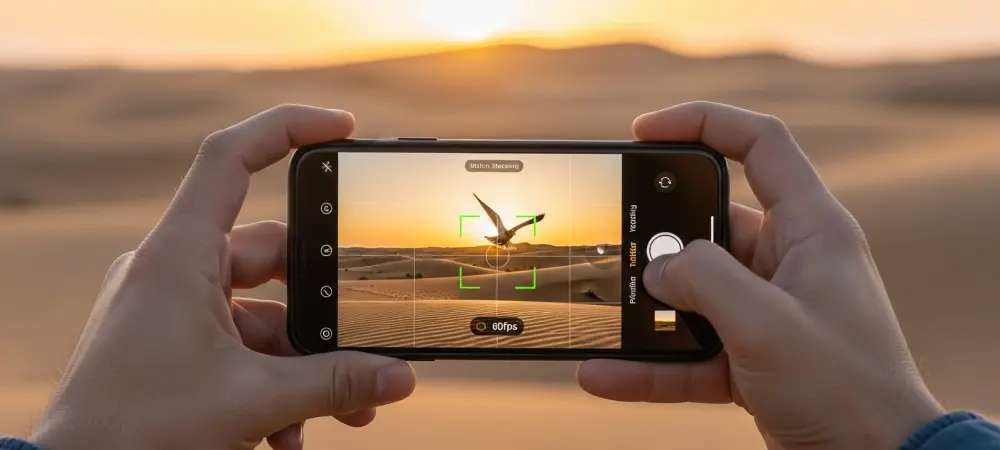
Motion tracking for subjects like wildlife has been increased to 60 fps to ensure smoother focus. In what ways does doubling the standard tracking frame rate impact the success rate of action shots, and what type of real-time processing is required to sustain this performance without draining the battery?
Doubling the motion tracking from the standard 30 fps to 60 fps provides a much higher “hit rate” because the autofocus system is sampling the subject’s position twice as often. For unpredictable subjects like wildlife or athletes, this means the camera can react to sudden movements in 16.6 milliseconds rather than 33.3 milliseconds, drastically reducing the chance of a missed focus. Sustaining this performance requires a massive amount of real-time computational power, as the image signal processor must analyze 60 frames every second to predict where the subject will move next. To prevent this from draining the battery, the hardware utilizes dedicated low-power AI cores that handle the tracking math independently of the main CPU. This specialized efficiency ensures that the phone remains cool and the battery lasts through an entire afternoon of shooting in the field.
What is your forecast for the future of professional-grade stabilization and ultra-high-resolution sensors in the mobile industry?
I believe we are entering an era where the hardware gap between smartphones and dedicated professional cameras will become virtually indistinguishable for 90% of use cases. In the next few years, we will likely see stabilization systems that exceed the CIPA 7.0 standard, perhaps incorporating even more degrees of freedom to mimic the performance of a physical gimbal. As 200-megapixel sensors become the baseline, the focus will shift from “more pixels” to “smarter pixels,” where each site on the sensor is optimized for extreme low-light performance through advanced stacking technologies. My forecast is that mobile devices will soon become the primary tool even for high-end wildlife and sports photography, driven by the marriage of incredible optical flexibility and AI-assisted focus that can track subjects faster than the human eye can follow. The “Ultra” category of phones is no longer just a marketing term; it is becoming a legitimate professional standard.