

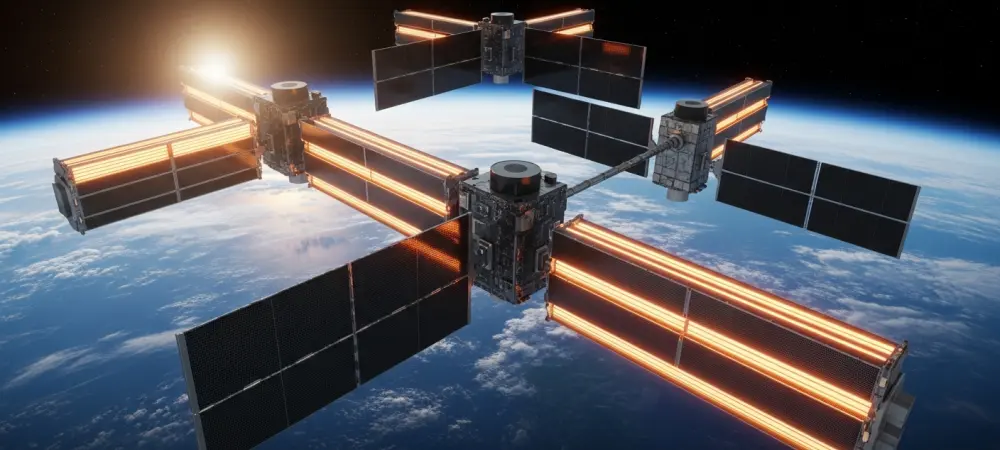
The exponential hunger for artificial intelligence processing is currently colliding with the hard physical limits of Earth’s electrical grids and cooling reservoirs, forcing a radical migration toward the silent vacuum of low Earth orbit. As traditional infrastructure struggles to keep pace with the power demands of massive neural networks, the tech industry has begun looking toward the stars to secure the next frontier of digital capacity. Orbital computing represents more than a speculative venture; it is a direct response to a “perfect storm” of energy shortages, water scarcity, and increasingly stringent terrestrial land-use regulations. This radical shift promises to decouple data processing from the ecological footprint of the planet, essentially turning the cold expanse of space into a functional heat sink and a source of limitless solar power.
This analysis examines the economic forces driving the relocation of data assets and the technical barriers that still define the feasibility of such missions. It evaluates the current costs of launch versus the long-term savings of energy efficiency, alongside expert perspectives on how latency will dictate the split between terrestrial and orbital workloads. Finally, the discussion outlines the looming risks of orbital congestion and the critical necessity for a new international framework to govern this extraterrestrial infrastructure.
Market Evolution and Global Adoption Trends
Data-Driven Growth: Economic Projections and Financial Constraints
The demand for artificial intelligence processing has entered a phase of sustained 20% annual growth, creating an unprecedented burden on terrestrial power grids. In many regions, the electrical consumption of a single large-scale facility now rivals that of a medium-sized city, leading to public resistance and utility rationing. This strain has accelerated the search for alternatives, with space-based data centers (SBDCs) emerging as the primary contender. While current operational costs for orbital facilities remain approximately three times higher than those on Earth, financial modeling suggests this gap will narrow to a factor of 1.5 toward 2030 as launch technology matures.
The primary financial bottleneck remains the high capital expenditure required for initial deployment. Launching one gigawatt of computing power currently carries a price tag of $30 billion, driven by launch costs hovering around $1,500 per kilogram. Despite these barriers, market analysts project that 15% of global AI workloads could reside in orbit by 2040. The transition is fueled by the realization that while the initial launch is expensive, the marginal cost of power in space is nearly zero, potentially offering a superior return on investment over a ten-year operational window.
Real-World Applications: Industry Pioneers and Specialized Use Cases
Google’s Project Suncatcher has established a template for success by utilizing dawn-dusk Sun-synchronous orbits to maximize energy capture. These orbits allow satellites to stay in continuous sunlight, achieving a solar efficiency level eight times higher than that of terrestrial panels. This constant energy stream eliminates the need for massive battery arrays, which are both heavy and prone to failure. Similarly, the “Space Cloud” initiative has seen a surge in participation, with regulatory bodies processing over one million satellite applications as nations race to secure their presence in the orbital digital economy.
The current market has segmented into specialized use cases where orbital computing offers a distinct structural advantage. SBDCs are increasingly used for sovereign workloads, where data must remain outside the physical jurisdiction of any single nation for security or privacy reasons. Furthermore, direct processing of Earth-observation data in orbit has reduced the need for massive downlink bandwidth, as satellites can now perform inference on-site and only transmit relevant results. This shift is particularly valuable for environmental monitoring and disaster response, where every second of latency in data transmission can have real-world consequences.
Expert Insights: Technical and Operational Hurdles
Thermal Management: The Hardware Challenge in a Vacuum
One of the most persistent engineering challenges in the orbital environment is the removal of heat from high-performance processors. Without an atmosphere to facilitate convection, SBDCs must rely entirely on passive radiative cooling, a process that requires massive surface areas to dissipate the thermal output of modern GPUs. Expert consensus suggests that a standard 100kW computing module requires a radiator of nearly 400 square meters. This technical requirement complicates satellite design, making the hardware both bulky and fragile during the high-vibration environment of a rocket launch.
Hardware durability also remains a significant concern, with experimental constellations reporting failure rates as high as 30% in the first year of operation. High-energy cosmic radiation can cause “bit flips” and permanent hardware degradation, necessitating expensive shielding or the use of specialized, radiation-hardened components. These factors contribute to a total cost of ownership where hardware replacement cycles account for 55% of the budget. Because standard GPUs are designed for the controlled environment of an Earth-based server room, their lifespan in the harsh vacuum of space is often limited to a mere five years.
The Latency Divide: Infrastructure Gaps and Lifecycle Problems
Network architects emphasize that the speed of light remains an unbreakable barrier for orbital computing, creating a clear divide in how AI tasks are distributed. Large language model training, which requires nanosecond-level synchronization between thousands of processors, is expected to remain terrestrial for the foreseeable future. In contrast, inference tasks—where a pre-trained model provides an answer to a user query—are moving to space because they can tolerate the slight delay introduced by the distance to low Earth orbit. This division allows Earth-based centers to focus on innovation while space-based centers handle the heavy lifting of global daily interactions.
To sustain this model, industry leaders point to a desperate need for in-orbit servicing and maintenance infrastructure. Currently, a single component failure can render a multi-million-dollar satellite useless, as there are no cost-effective methods for robotic repair or component replacement. The development of autonomous “service tugs” that can refuel satellites or swap out degraded processor modules is considered the “missing link” in the orbital economy. Without these capabilities, the financial risk of total hardware loss will continue to deter conservative institutional investors from entering the space computing market.
Future Outlook: Implications, Risks, and Opportunities
The Shift to Hybrid Infrastructure: Regulatory and Environmental Risks
The future of digital infrastructure is likely a hybrid ecosystem where terrestrial and orbital assets work in tandem. This multi-layered approach allows for redundancy and load balancing, ensuring that global AI services remain resilient even during localized power outages or geopolitical conflicts on Earth. However, this expansion brings the looming threat of Kessler Syndrome, a scenario where the density of objects in low Earth orbit leads to a cascade of collisions. With over 1.3 million pieces of debris already tracked, the addition of thousands of data center satellites significantly increases the probability of a catastrophic event that could render specific orbits unusable for generations.
Regulatory frameworks have not kept pace with the speed of orbital deployment, leaving significant gaps in international liability and data protection laws. As data centers move beyond national borders, the question of which laws apply to the information processed in the “no-man’s-land” of space remains unanswered. This legal ambiguity creates both an opportunity for data havens and a risk for organizations that require strict regulatory compliance. International cooperation will be essential to establish “rules of the road” that manage debris mitigation and ensure that the benefits of space-based computing are shared across the global community.
Data Sovereignty: Long-Term Evolutionary Paths
Over the long term, breakthroughs in orbital manufacturing and further reductions in launch costs could transform space from a niche solution into a primary pillar of global intelligence. If components can be manufactured or assembled in orbit using lunar or asteroidal materials, the $30 billion price tag for launch would plummet, making SBDCs the most cost-effective way to scale AI. This evolutionary path suggests a world where the most energy-intensive parts of our digital civilization are moved entirely off-planet, allowing Earth’s environment to recover from the industrial strain of the previous century.
The potential for space-based centers to bypass terrestrial censorship and national firewalls also presents a radical shift in how information is governed. The balance between the technical advantages of orbital sovereignty and the need for global security will likely be the defining debate of the next decade. Ultimately, the successful navigation of these risks will determine whether the orbital frontier becomes a sustainable extension of our digital world or a chaotic zone of technological waste.
Strategic Conclusion: Navigating the Orbital Frontier
The analysis of the transition from terrestrial to orbital data infrastructure demonstrated that the industry moved toward a hybrid model out of necessity rather than mere curiosity. Researchers found that the mounting pressures of energy consumption and land scarcity on Earth forced a reconsideration of the vacuum of space as a viable operational environment. The shift was supported by early pioneers who proved that solar efficiency in sun-synchronous orbits could offset the staggering initial costs of launch. It became clear that the decoupling of AI processing from the planetary biosphere offered the only sustainable path for the continued expansion of global digital intelligence.
The strategic focus shifted toward the development of robust robotic maintenance systems and more effective passive cooling technologies. Leaders recognized that the longevity of orbital assets was the primary driver of long-term profitability, leading to a surge in investment for in-orbit servicing. Furthermore, the necessity for international cooperation became a central theme as the risks of orbital debris and jurisdictional ambiguity grew. The industry concluded that establishing a comprehensive global framework for space traffic management was essential to prevent a catastrophic loss of infrastructure. These actions collectively ensured that the move to the stars remained a primary pillar of the global technological landscape.