

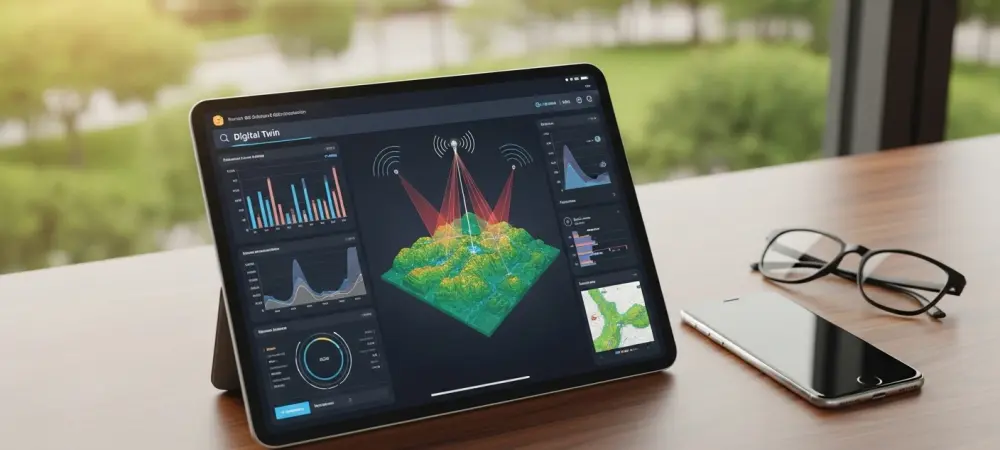
The traditional boundaries between physical hardware and virtual intelligence have effectively dissolved as the telecommunications sector moves aggressively toward a fully realized 6G landscape. This shift represents a departure from the incremental updates of the past, marking the rise of an “AI-native” architecture where intelligence is woven into the very fabric of the network. Central to this radical transformation is the Radio Access Network (RAN) Digital Twin, a high-fidelity virtual replica that serves as a vital bridge between laboratory theory and real-world deployment. As network complexity grows beyond human management, these digital twins have become the primary testing ground for the algorithms that will govern the next decade of wireless connectivity.
The Rise of Virtualized Network Modeling
Market Evolution and Data-Driven Adoption
Industry leaders are currently pivoting toward more sophisticated simulation models to combat the phenomenon known as “AI drift,” where models trained on static historical data lose their efficacy in the face of unpredictable, dynamic environments. This trend reflects a broader shift toward hybrid data strategies that prioritize high-fidelity synthetic data over fragmented, siloed historical logs. By creating a sandbox that mirrors the complexities of the physical world, operators can ensure that their machine learning models remain accurate even as traffic patterns and environmental conditions shift.
Furthermore, the expansion of the Open RAN ecosystem has intensified the demand for secure, simulated environments. Third-party developers now require a space to test innovative xApps and rApps without compromising sensitive live subscriber data or risking the stability of operational networks. This virtualization allows for a faster iteration cycle, enabling the industry to keep pace with the rapid standardization of 6G protocols. The result is a more resilient development pipeline that treats network optimization as a continuous, software-defined process rather than a series of hardware-centric updates.
Real-World Implementation and Industry Applications
The practical utility of these systems is already visible through high-profile collaborations, such as the work between NVIDIA and VIAVI on the Aerial Omniverse platform. By utilizing ray-tracing technology within a digital twin, these companies can model signal propagation and tower placement with centimeter-level precision, accounting for every building and topographical feature in a given area. This level of detail is essential for the high-frequency bands associated with 6G, where even minor physical obstructions can significantly disrupt signal integrity.
In a similar vein, DOCOMO has demonstrated the power of “self-aware networks” by using digital twins to predict and manage base station beam control. By offloading the computational burden of quality measurements to a virtual environment, they achieved a substantial 20% improvement in uplink throughput. Moreover, the integration of agentic AI within these twins has paved the way for autonomous energy optimization. These systems can now manage power consumption in real-time, shutting down or scaling back hardware during low-demand periods without causing a perceptible decline in the user’s quality of experience.
Industry Perspectives on AI-Native Architectures
Leading network architects increasingly describe the transition to 6G as the development of a “central nervous system” for the digital world. The consensus among professionals is that the safe evolution of such a system requires a virtual sandbox that can simulate extreme conditions. Industry experts point out that the volume of data is no longer the primary concern; instead, the focus has shifted to the “freshness” and relevance of the data. Digital twins provide the necessary forward-looking scenarios that historical data simply cannot capture, allowing for a proactive rather than reactive approach to network management.
Strategic discussions in the field have also identified the “App Validation Engine” as a critical safety mechanism for future deployments. This layer of the digital twin ensures that AI-driven decisions do not lead to unintended consequences, such as a localized coverage gap caused by an over-aggressive energy-saving algorithm. By providing a platform for constant validation, the industry is establishing a new standard for network reliability. This shift in perspective ensures that as AI takes a more prominent role in network operations, human operators maintain a high degree of oversight through sophisticated simulation and visualization tools.
The Future Landscape of 6G Digital Twins
The evolution of this technology is pointing toward a future defined by “closed-loop” systems where the digital twin and the physical network remain in constant, bidirectional communication. This synchronization ensures that any performance degradation in the real world is immediately reflected and solved in the virtual one before being pushed back to the live environment. Such a setup effectively de-risks the research and development process, allowing operators to stress-test their infrastructure against hypothetical cyberattacks and extreme environmental interference before they manifest as real-world problems.
Looking further ahead, the industry is preparing for a shift toward fully autonomous, self-healing networks. In this scenario, the digital twin functions as a diagnostic engine that can simulate potential hardware failures and implement software-based workarounds before a technician is even dispatched. While this transition offers unparalleled resilience and a faster time-to-market for new services, it also presents challenges regarding computational costs. The energy required to maintain real-time synchronization between the twin and the physical world is significant, prompting a new wave of innovation focused on making the simulations themselves more efficient and sustainable.
Strategic Conclusion for the 6G Era
The integration of RAN Digital Twins was a fundamental requirement for the successful structural overhaul of 6G architectures. By synthesizing physical ray-tracing data with synthetic traffic scenarios, operators moved past the traditional risks associated with AI drift and data privacy constraints. These virtual environments became the cornerstone of the AI-native future, providing a safe and scalable framework for the deployment of agentic AI. The shift from reactive maintenance to proactive simulation defined the competitive landscape, rewarding those who prioritized high-fidelity modeling early in their development cycles.
Stakeholders had to reconcile the high computational demands of digital twins with the long-term benefits of enhanced network stability and throughput. Moving forward, the industry should focus on standardizing the interfaces between different digital twin platforms to ensure interoperability across diverse vendor ecosystems. Developing more lightweight, edge-based versions of these twins could also reduce the latency in the closed-loop feedback system. Ultimately, the success of the 6G era depended on the ability to predict the unpredictable, a feat made possible only through the sophisticated synchronization of the physical and virtual worlds.