

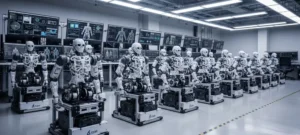
The sudden transition from massive, industrial-grade machinery to agile, modular humanoid systems marks a fundamental shift in how corporations approach the complex challenge of general-purpose robotics. While high-torque, human-scale robots often dominate the visual landscape of technological expositions, a more subtle and profound trend is taking root in the research laboratories of the world’s largest technology firms. This movement prioritizes the creation of “developer-first” ecosystems, treating the robot not as a finished appliance but as a versatile sandbox for rapid iteration. By focusing on safety and modularity, these platforms are effectively lowering the barrier to entry for artificial intelligence training, allowing for a much faster transition from theoretical code to physical movement in unstructured environments.
The Growth of Modular Humanoid Ecosystems
Market Trajectory: Investment Shifts and Accelerated Timelines
Recent industry data reveals a staggering 35% year-over-year increase in capital allocation specifically targeting developer-facing robotics infrastructure rather than consumer-ready products. This shift represents a pragmatic acknowledgment that the software required for true autonomy is not yet mature enough for the mass market. Consequently, the timeline from a conceptual design to a functional research platform has collapsed significantly, dropping from five years to under twenty-four months in the current development cycle. This acceleration is largely attributed to the widespread adoption of modular hardware stacks that allow researchers to swap out components without redesigning the entire skeletal structure.
Furthermore, the surge in investment is driving a diversification of the robotics supply chain. Instead of relying on a single manufacturer for a monolithic machine, developers are now sourcing specialized actuators, sensors, and limbs from a variety of vendors. This ecosystem approach ensures that no single point of failure in the supply chain can derail a project. As more companies enter the modular space, the cost of high-precision components is beginning to normalize, making it feasible for smaller laboratories to acquire and maintain humanoid platforms that were previously the exclusive domain of multi-billion-dollar corporations.
Shifting Scales: The Rise of Smaller Research Platforms
Statistics from prominent robotics research institutes indicate that 60% of current humanoid developers are pivoting toward smaller platforms, typically measuring under 1.1 meters in height. This strategic downsizing serves a dual purpose: it significantly reduces the kinetic energy and potential liability of the machine while simultaneously increasing the frequency of real-world testing. Developers can operate these smaller units in standard office environments without the heavy safety cages or overhead tethers required for larger, high-torque industrial humanoids. This proximity to human researchers fosters a more organic data-gathering process, as the robots can be tested in the very environments they are ultimately intended to inhabit.
Moreover, the smaller form factor facilitates more aggressive testing of bipedal locomotion. When a sub-meter robot falls, the risk of mechanical damage is substantially lower than that of a full-sized humanoid, allowing researchers to push the limits of balance and recovery algorithms. This lower risk profile encourages a culture of experimentation where “failing fast” is not just a slogan but a practical developmental strategy. By iterating on smaller models, companies are perfecting the fundamental balance and navigation logic that will eventually be scaled up to larger, more capable machines in the future.
Case Study: The Strategic Evolution of the Sprout Platform
The landscape of humanoid development was recently redefined by Amazon’s strategic acquisition of Fauna Robotics and its flagship platform, Sprout. This move signals a definitive departure from previous attempts to market “finished” home robots and instead focuses on the utility of robots as data-gathering vessels. The Sprout system exemplifies the new philosophy of building a robust “sandbox” where researchers can experiment with bipedal movement and object manipulation in controlled but complex settings. By utilizing this platform, developers can bridge the notorious “reality gap” by using high-fidelity teleoperation to train neural networks in real-world environments.
This acquisition also highlights the importance of the “platform-as-a-service” model in robotics. Amazon is not merely buying a robot; it is acquiring a pipeline that streamlines the collection of edge-case data. The Sprout platform allows for the rapid deployment of new behaviors, which can be tested and refined across a fleet of identical machines. This centralized approach to learning ensures that an improvement made on one unit can be instantly propagated to all others, creating a network effect that accelerates the overall intelligence of the system.
Expert Perspectives on Platform-Centric Development
Hardware Innovation: Prioritizing Safety and Tactile Feedback
Fauna’s design choices for the Sprout platform reflect a deep understanding of the needs of the modern developer, particularly regarding safety and physical interaction. The robot features backdrivable motors and a soft, compliant exterior that minimizes the risk of injury during human-adjacent development. These hardware guardrails allow for a “fail-fast” methodology, where physical errors do not lead to catastrophic mechanical failure or safety incidents. This design logic ensures that the focus remains on software optimization and data collection rather than constant hardware repair, streamlining the path toward functional integration.
Beyond safety, these hardware innovations provide crucial tactile feedback that is essential for complex manipulation tasks. Backdrivable motors allow the robot to “feel” resistance, enabling it to adjust its grip or stance based on physical feedback rather than just visual data. This multisensory approach is critical for operating in human environments where objects vary in weight, fragility, and texture. By integrating these physical sensations into the developmental platform, engineers are creating a more nuanced and capable form of robotic intelligence that can handle the unpredictability of everyday life.
Reframing Control: Failure Recovery and the Data Loop
Industry leaders are increasingly vocal about the limitations of the “black box” approach to artificial intelligence in the context of physical robotics. Many now advocate for a model of “constrained learned control,” where specific, discrete movements are isolated into individual policies to enhance reliability. This modular approach to software mirrors the modularity of the hardware, allowing developers to debug a walking gait or a grasping motion in isolation. By separating these low-level motor functions from high-level perception, engineers can prevent software glitches in the AI layer from causing unpredictable physical behavior in the robot. The true economic and technical value of modern humanoid platforms lies in the efficiency of the “data loop,” which describes the speed at which physical failures are converted into training data. Experts emphasize that the ability to intervene via virtual reality when a robot encounters an edge case is a transformative development for the industry. This seamless transition between autonomous exploration and human-led correction allows for the capture of high-quality, labeled data in the exact moment a mistake occurs. Consequently, the platform becomes a self-improving system that actively seeks out and learns from its own operational weaknesses, turning every stumble into a step toward greater autonomy.
The Future of Humanoid Developer Platforms
Navigational Efficiency: The Move Toward Localized Maplets
A significant hurdle for bipedal robots has always been the high compute cost of maintaining global maps in dynamic environments. To combat this, the industry is moving toward the use of “maplets” and localized navigation strategies that reduce the onboard processing load. By breaking down the environment into smaller, manageable submaps, robots can maintain high-precision local consistency without needing to calculate their exact position relative to a massive, static global coordinate system. This innovation makes bipedal robots significantly more efficient, allowing them to navigate cluttered spaces with less power and lower latency.
Furthermore, this localized approach allows for better handling of dynamic obstacles. When a human moves through a room, the robot only needs to update the specific “maplet” affected rather than recomputing the entire global environment. This efficiency is critical for maintaining real-time responsiveness, especially in fast-moving scenarios. As these localized mapping techniques become more refined, we can expect humanoid platforms to display a level of agility and spatial awareness that was previously impossible, moving through crowded spaces with a fluid grace that mimics biological movement.
Standardization: Universal Interfaces and the Rise of LLMs
The future of these platforms is being shaped by the proliferation of standardized software interfaces, such as ROS 2 and the Model Context Protocol. These frameworks allow humanoid robots to be easily controlled by external AI agents and Large Language Models (LLMs), effectively decoupling the “brain” from the “body.” As these interfaces become the industry standard, the ability to port intelligence from one hardware platform to another will become a reality. This interoperability ensures that the investments made in training data today will remain relevant even as hardware continues to evolve and improve. Moreover, the integration of LLMs allows for more natural human-robot interaction. Instead of writing complex scripts, developers can give high-level verbal instructions, which the robot then decomposes into a series of discrete physical actions. This democratization of robotic control means that subject-matter experts—such as warehouse managers or healthcare professionals—can participate in the training process without needing to be expert coders. This broadening of the developer pool will likely lead to a surge in specialized applications, as the barriers between human intent and robotic execution continue to dissolve.
The pivot toward modular humanoid developer platforms established a new benchmark for how the robotics industry approached the transition from laboratory prototypes to real-world utility. By prioritizing the creation of robust developmental sandboxes, the sector successfully moved away from the pursuit of immediate, “demo-ready” products that often lacked long-term reliability. This strategic shift ensured that future iterations of humanoid technology were built upon a foundation of high-quality data and deterministic safety protocols rather than speculative engineering. Ultimately, the focus on modularity and safety allowed developers to create more adaptable systems, which paved the way for the eventual integration of versatile robotic assistants into the complex fabric of daily human life. Success was found not in the sudden arrival of a perfect machine, but in the steady accumulation of small, verifiable improvements made across a shared, open ecosystem.