

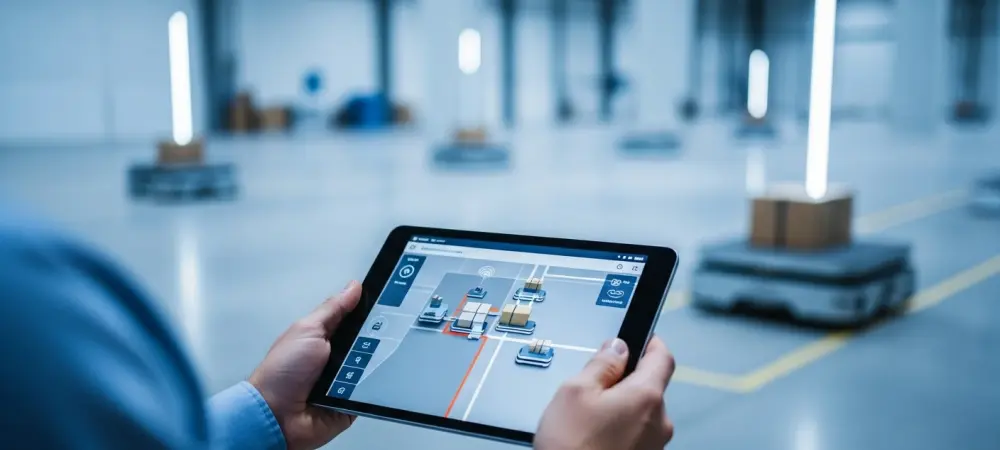
The days of warehouse floors being defined by rigid, yellow-striped lanes and robots that only follow pre-set scripts are rapidly coming to an end as the industry embraces cognitive autonomy. This fundamental shift marks the transition to “Automation 2.0,” a phase where machinery no longer requires constant babysitting through complex code but instead interprets the mission at hand. As supply chains grapple with more variability than ever before, the rise of intent-based robotics—often referred to as “Physical AI”—is transforming logistics hubs from collections of static machines into responsive, thinking organisms that can adapt to chaos in real-time.
The Evolution of Intelligent Autonomy in Modern Warehousing
Market Trajectory: The Rise of Goal-Oriented Systems
Traditional logistics relied heavily on Automated Guided Vehicles (AGVs) that acted much like trains, tethered to magnetic strips or fixed wires embedded in the floor. However, current market data reveals a massive shift toward high-payload Autonomous Mobile Robots (AMRs), such as the KMP 250P and the heavy-duty AMP 3000. These newer systems represent a departure from “hard footprint” automation, favoring flexible platforms that can carry thousands of pounds without requiring a single permanent modification to the building’s infrastructure.
By integrating 3D mapping and advanced vision technology, these robots have rendered physical isolation zones largely obsolete. Rather than being confined to cages for safety, modern AMRs use sophisticated sensor suites to navigate unstructured environments safely alongside human workers. This shift toward goal-oriented systems means that from 2026 to 2030, the primary metric for success will not be how fast a robot moves, but how effectively it interprets its surroundings to find the most efficient path to its objective.
Strategic Implementation: Breaking the Bottlenecks of Hand-Off Points
One of the most significant hurdles in logistics has always been the hand-off point where material moves from transport to processing. Leading firms are now solving this by synchronizing AMRs directly with fixed palletizing robots, creating a choreographed dance that eliminates the need for sprawling conveyor systems. This approach allows a facility to remain dynamic; as soon as a palletizing unit completes its stack, a mobile platform is already positioned to whisk the load away, ensuring that productivity never stalls at a transition point.
Moreover, removing forklift lanes and permanent conveyors frees up immense amounts of floor space, allowing warehouses to scale their operations upward rather than outward. The orchestration of these complex interactions is increasingly handled by centralized software platforms like the KUKA Automation Management Platform (AMP). By treating a fleet of diverse robots as a single entity, companies can manage material flow with surgical precision, ensuring that the right asset is always in the right place at the exact moment it is needed.
Expert Perspectives on the “Automation 2.0” Paradigm
Industry leaders are increasingly vocal about the transition from line-by-line programming to high-level system oversight. In the past, deploying a robot required a specialist to define every millimeter of movement, but the new paradigm allows operators to simply define the “intent”—such as “move this pallet to dock four.” This reduction in technical barriers is democratizing automation, allowing logistics providers to focus on operational strategy rather than the granular mechanics of motion.
However, professionals also highlight that this intelligence relies on a robust “nervous system” of data-sharing networks. For a facility to function as a unified organism, information must flow between the hardware and the central software with near-zero latency. While the hardware provides the “muscles,” the true value lies in the software’s ability to digest environmental data and make split-second decisions that prevent congestion and optimize throughput across the entire warehouse floor.
The Future Landscape of Physical AI and Global Supply Chains
Looking ahead, the long-term impact of robots that can autonomously determine the most efficient method for task completion will fundamentally redefine the Return on Investment (ROI) for automation. When robots can handle the inherent uncertainty of global commerce—such as damaged packaging or unexpected obstacles—the cost of downtime plummets. This evolution bridges the gap between current operational capacity and the surging demands of a market that expects instant fulfillment and total transparency.
The integration of “muscles, brains, and nervous systems” into a single ecosystem creates an agile framework capable of surviving shifts in consumer behavior. While maintaining such complex, integrated hardware-software environments presents a challenge for traditional IT departments, the benefits of a self-optimizing facility are too significant to ignore. As physical AI continues to mature, the distinction between a warehouse and a computer will continue to blur, resulting in a landscape where intelligence is embedded in every pallet and every motor.
Conclusion: Navigating the Next Frontier of Logistics
The transition toward intent-based robotics proved to be the decisive factor for companies seeking to thrive in an era of unpredictable global trade. By moving beyond repetitive scripts and embracing systems that understood the underlying goals of their tasks, logistics leaders successfully turned their facilities into competitive advantages. It became clear that the path to resilience lay in the synergy of heavy-duty hardware and sophisticated management software. Moving forward, the most successful operators did not just buy robots; they invested in flexible, AI-driven frameworks that could learn and grow alongside their business needs. To maintain this momentum, stakeholders had to prioritize the development of interoperable data networks that allowed these intelligent systems to communicate across every level of the supply chain.