

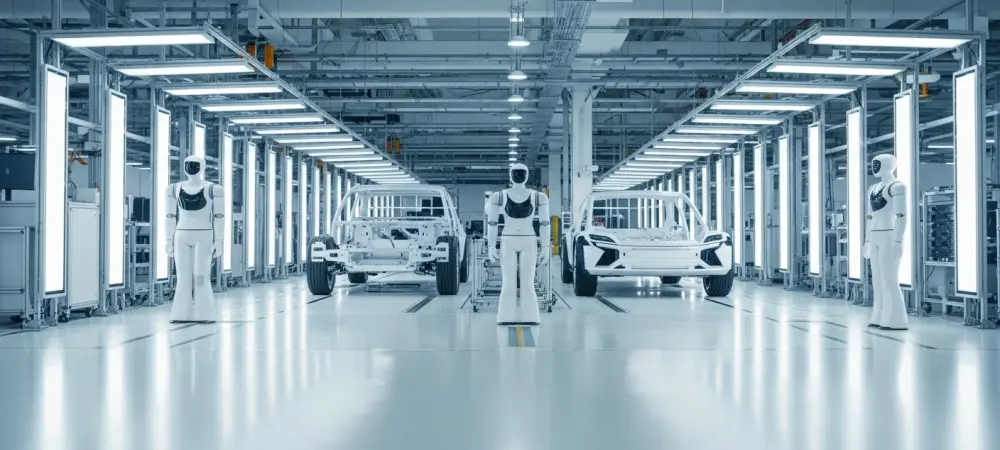
Modern vehicles are rapidly transforming from mere mechanical transport tools into intelligent nodes within a global digital network where humanoid robots build the machines and autonomous platforms handle the final steps of complex logistics. This shift marks a fundamental departure from the traditional assembly line model, as the automotive sector merges with advanced robotics and artificial intelligence. By integrating these disparate technologies, manufacturers are no longer just selling cars; they are building a sophisticated ecosystem designed to move goods and people with unprecedented efficiency.
As global vehicle markets experience significant fluctuations, the strategic integration of software-defined platforms represents the next multi-billion-dollar frontier for the mobility sector. The survival of traditional automakers now depends on their ability to pivot into high-value technology providers. This analysis explores the transition toward manufacturing automation, modular delivery solutions, and the robust software infrastructure that currently powers the future of transport.
Market Transformation and Strategic Implementation
Growth Statistics and Financial Commitments
Financial benchmarks indicate a massive capital injection of $33 billion planned through 2030, with a specific $14 billion carve-out reserved for robotics and autonomous software development. This aggressive spending underscores a broader industry pivot where hardware takes a backseat to digital intelligence. By prioritizing these investments, companies are betting that the long-term value of autonomous systems will far outweigh the initial costs of research and development.
Moreover, while global sales forecasts have seen recent adjustments, revenue targets are climbing toward a staggering $114 billion. This discrepancy signals a move toward high-value tech services rather than sheer production volume. The industry is currently moving toward a 2027 roadmap for Level 2+ “hands off” automation, with the phased rollout of humanoid workers in North American plants expected to begin by 2028.
Case Studies in Robotic Integration and Modular Mobility
The deployment of Boston Dynamics’ Atlas robot into 16 distinct manufacturing processes at the Hyundai Motor Group Metaplant is setting a new industrial standard. These humanoid machines are designed to navigate complex factory floors, performing tasks that were previously too intricate for stationary robotic arms. By using artificial intelligence to learn and adapt, these robots enhance safety and precision in high-stakes production environments.
In addition to factory automation, the Platform Beyond Vehicle initiative introduces modular electric solutions like the PV5, PV7, and PV9. These vehicles are engineered to transform into 40 different body types to meet diverse commercial needs, from mobile offices to delivery hubs. This modularity allows businesses to scale their fleets dynamically, ensuring that the vehicle architecture evolves alongside market demands.
The Last-Mile Synergy
Real-world applications of “Spot” and “Stretch” robots paired with autonomous vans are bridging the logistics gap in crowded urban environments. These mobile robots can exit a vehicle and navigate sidewalks or stairs to deliver packages directly to a customer’s door. This synergy solves the “last-mile” problem, which has historically been the most expensive and inefficient part of the supply chain.
Expert Insights on the Shift Toward Software-Defined Vehicles
Leadership Vision: Catalysts for Growth
Industry leaders, including CEO Ho Sung Song, view robotics and electrification as the primary catalysts for the most significant growth period in history. The vision involves a transition from hardware-centric manufacturing to a holistic mobility-as-a-service model. This evolution requires a complete rethink of how companies interact with their customers, moving from a single point of sale to a continuous service relationship.
The Data Flywheel Effect: Leveraging Partnerships
By strengthening partnerships with tech giants like Nvidia, automakers are utilizing data from millions of vehicles to refine end-to-end self-driving models. This “data flywheel” ensures that every mile driven contributes to the collective intelligence of the fleet. Consequently, the software becomes more capable over time, allowing for safer navigation in unpredictable environments through continuous machine learning.
The Future Roadmap of Autonomous Ecosystems
Evolving Autonomy and Global Implications
The progression toward fully software-defined vehicles allows for over-the-air updates that improve vehicle performance long after the initial purchase. While these advancements promise urban efficiency and reduced labor costs, they also present challenges regarding high R&D expenditures and evolving regulatory hurdles. Navigating these complexities will require a balance between rapid innovation and public safety requirements.
Industry Outcomes: Redefining Structures
The convergence of robotics and mobility will likely redefine labor structures and delivery speeds over the coming decade. As autonomous systems take over repetitive or dangerous tasks, the human workforce will shift toward oversight and system management. This transition represents a major step toward a fully automated logistics chain that operates around the clock without interruption.
The strategic shift toward artificial intelligence and modular hardware proved essential for the industry’s survival. Manufacturers successfully transitioned into tech-heavy organizations by mastering the entire ecosystem, from the factory floor to the customer’s front door. This integration of software and physical automation established a new benchmark for global mobility, ensuring that the line between a car company and a technology giant remained permanently blurred.