

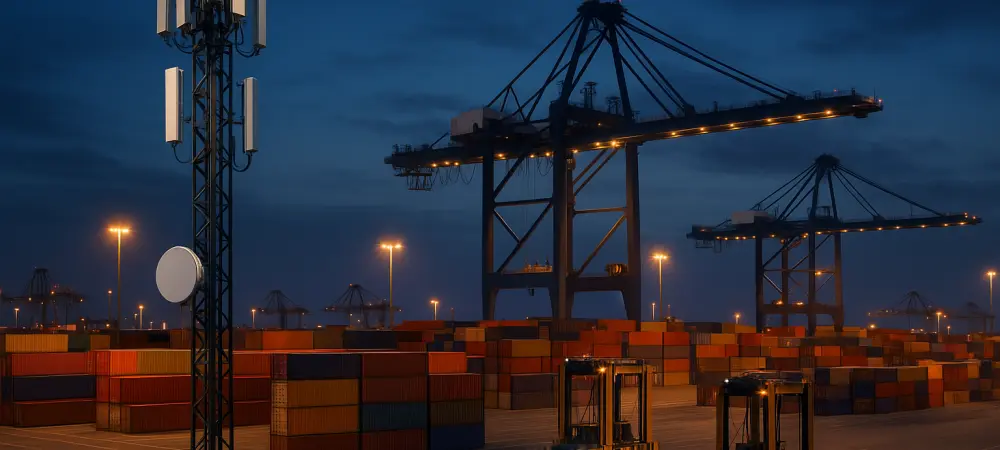
The massive steel cranes towering over the Port of Hamburg no longer rely solely on physical cables to orchestrate the complex ballet of global commerce, as invisible high-speed signals now dictate every move with millisecond precision. This transition marks a fundamental shift in how the world’s most critical logistics hubs operate, moving away from the limitations of tethered hardware toward a future defined by ubiquitous, low-latency wireless connectivity. As global trade volumes continue to fluctuate, the pressure on seaports to maximize efficiency and eliminate bottlenecks has never been higher. This demand has catalyzed the adoption of Industrial 5G, transforming it from a niche technological experiment into the primary nervous system of modern maritime infrastructure.
The logistical landscape is currently seeing a rapid departure from legacy systems as port authorities recognize that traditional Wi-Fi and 4G networks simply cannot support the density of devices required for full automation. By moving toward a standardized 5G framework, these hubs are addressing long-standing issues such as signal interference in high-density metal environments and the need for high-speed handovers between moving assets. The evolution witnessed at major global ports suggests that the maritime industry is no longer just moving cargo; it is managing a massive, real-time data stream that determines the speed and reliability of the entire global supply chain.
The Dawn of Hyper-Connected Seaports
Seaports have traditionally been environments defined by heavy machinery and rigid schedules, but the introduction of high-performance wireless networks is injecting a new level of agility into these operations. The move toward Industrial 5G is driven by the realization that physical infrastructure alone can no longer meet the throughput requirements of the modern era. As ports become more crowded, the ability to coordinate thousands of moving parts—from ships and trucks to individual containers—requires a connectivity layer that is both robust and flexible. This has led to the emergence of “smart ports” where every asset is a data point, contributing to a holistic view of the terminal’s operational health.
Furthermore, the integration of 5G serves as the foundation for broader digitalization efforts that were previously hindered by bandwidth constraints. By providing a reliable pipe for data transmission, port operators can now deploy high-resolution camera arrays and environmental sensors without fearing a network collapse. This shift is not merely about replacing wires with wireless signals; it is about creating an environment where information moves as fast as the cranes themselves. The result is a significant reduction in vessel turnaround times and a decrease in the energy consumption associated with idling machinery and inefficient traffic routing.
Market Evolution: The Rise of Private Campus Networks
The maritime 5G sector is currently navigating a significant transition from an experimental “slow-burn” phase to a period of permanent infrastructure establishment. This shift is clearly visible in the proliferation of dedicated testbeds and operational networks across Europe, particularly under the umbrella of Germany’s DigiTest program. This initiative has provided a structured environment for ports to explore the boundaries of cellular technology, moving past the initial skepticism that often accompanies industrial-scale digital overhauls. The market is now seeing a consolidation of lessons learned, leading to more standardized and repeatable deployment models.
Economic trends within this sector reveal an “infrastructure-first” strategy, where the high capital expenditure required for 5G deployment is often offset by strategic government subsidies. In many major European hubs, up to 80% of the funding for these digitalization projects has been provided through public grants, reflecting the perceived importance of port modernization to national economic security. This financial support has allowed port authorities to bypass the typical risk-aversion of the maritime industry, enabling them to invest in high-performance hardware that will serve as the backbone for operations from 2026 to 2030 and beyond. The architectural preferences of port operators have also evolved, moving away from public network slicing toward the sovereignty of private campus networks. While early trials in the 2019 era explored the feasibility of using public 5G slices, the current trend favors dedicated infrastructure utilizing the 3.7–3.8 GHz spectrum. This shift allows port authorities to maintain total control over their data and network performance, ensuring that critical logistics operations are never compromised by public network congestion. By owning the spectrum and the hardware, ports can tailor their network topology to the specific geographic and operational challenges of their terminals.
Real-World Implementation: The Hamburg Case Study
The Container Terminal Altenwerder (CTA) in Hamburg stands as a definitive model for the successful implementation of a private 5G core in a high-intensity environment. Covering approximately one square kilometer, the network at CTA provides the high-capacity link needed to manage one of the most automated terminals in Europe. This deployment proves that 5G is capable of handling the extreme environmental challenges of a seaport, where massive metal containers and moving cranes create a nightmare for traditional radio signals. The success of the CTA model has provided a blueprint for other terminals within the Port of Hamburg and across the global maritime network.
A diverse vendor ecosystem has emerged to support these complex installations, moving away from a monopolistic supplier landscape. While Tier-1 vendors like Ericsson continue to lead large-scale projects, there is an increasing presence of specialized integrators and Open RAN solutions. Companies such as COCUS and Airspan are providing tailored architectures for smaller or more specialized ports, allowing for a more modular approach to network design. This variety in the supplier market ensures that port operators can choose the technology that best fits their specific scale, whether they are managing a massive international hub or a smaller regional terminal.
Current applications at these terminals extend far beyond simple communication, encompassing a wide range of high-tech logistics tools. Autonomous straddle carriers now navigate the terminal grounds with precision, guided by real-time data transmitted over the 5G network. AI-driven camera systems are used for instantaneous container recognition and damage assessment, while ship-to-shore cranes are being fitted with low-latency remote control systems. These technologies collectively reduce the need for human presence in hazardous areas while simultaneously increasing the speed at which cargo can be processed and moved.
Expert Perspectives on the 5G Transition
Industry thought leaders are increasingly viewing 5G not as a standalone product but as the essential “connective tissue” for the modern industrial age. From this perspective, the value of the network lies in its ability to seamlessly integrate artificial intelligence, machine vision, and the Internet of Things into a single, unified IT fabric. Experts argue that without the high bandwidth and low latency of 5G, these advanced technologies remain isolated silos of information. By connecting them, port operators can achieve a level of predictive maintenance and operational foresight that was previously impossible.
Reliability is the most frequently cited mandate by professionals at organizations like HHLA and Deutsche Telekom. In an environment where a single minute of downtime can result in thousands of dollars in losses, the redundancy offered by Industrial 5G is a critical selling point. Experts emphasize that the network must be designed with “high availability” at its core, utilizing redundant cores and multiple radio access points to ensure that connectivity is never lost. This focus on resilience is what separates industrial-grade 5G from the consumer-grade services used by the general public, making it a professional-grade tool for mission-critical logistics.
Analysts also point out that the relatively long adoption curve for 5G in maritime logistics was a strategic necessity rather than a sign of failure. The “slow-burn” nature of the transition allowed ports to rigorously validate various economic and ownership models before committing to total digitalization. This cautious approach ensured that the technology was mature enough to handle the rigors of a saltwater environment and that the business cases for 5G were sound. Now that these models have been proven in hubs like Hamburg, the industry is prepared for a more rapid expansion of the technology across the global trade network.
Future Horizons: Implications and Challenges
Looking ahead, the concept of the “living lab” will likely become the standard for port development, where 5G enables constant experimentation and optimization. Future ports will utilize real-time data sharing to create a transparent supply chain where every stakeholder, from the shipping line to the end customer, has visibility into the movement of goods. This level of transparency will help to mitigate the impact of global disruptions by allowing for more dynamic rerouting and resource allocation. The port of the future will not just be a point of transit, but a data hub that drives the efficiency of the entire global economy.
Despite the clear benefits, several hurdles remain that could slow the widespread adoption of 5G in less-developed regions. The complexity of spectrum management continues to be a challenge, as different countries have different regulations regarding the use of the 3.7–3.8 GHz bands. Additionally, the high initial capital expenditure remains a barrier for ports that do not have access to the same levels of government subsidy seen in Europe. There is also a growing need for a specialized workforce capable of managing sophisticated telecommunications infrastructure alongside traditional maritime operations, necessitating a significant shift in labor training and recruitment.
The impact of maritime 5G will undoubtedly ripple out into other sectors, providing a blueprint for the digitalization of rail and mining industries. The lessons learned in the dense, high-interference environments of seaports are directly applicable to other heavy industries that struggle with the limitations of Wi-Fi. As these private networks become more common, the cost of the hardware and software is expected to decrease, making the technology more accessible to a wider range of industrial players. This cross-sector fertilization will accelerate the global transition toward a more connected and automated industrial landscape.
As the technology continues to mature through 2026 and into the latter half of the decade, the industry is moving closer to the reality of fully autonomous “dark” terminals. These facilities, capable of operating without human intervention under the guidance of 5G-connected AI, represent the ultimate goal of the current digital revolution. While a completely human-free terminal may still face regulatory and social challenges, the technical framework is being solidified today. The move toward Industrial 5G is the final piece of the puzzle, providing the reliable, high-speed heartbeat required to keep these autonomous systems synchronized in real-time.
Conclusion: A Blueprint for Global Trade
The deployment of Industrial 5G in maritime logistics marked a definitive shift from trial-based experimentation to the establishment of foundational infrastructure that redefined the standards of global trade. By synthesizing significant government support with expert engineering and pressing operational requirements, hubs like the Port of Hamburg proved that high-performance wireless connectivity was no longer a luxury but a necessity for economic survival. Port operators recognized that to remain competitive in an increasingly automated world, they had to view 5G as the critical framework for the next century of supply chain management.
This transition period highlighted the importance of moving beyond temporary testbeds toward permanent, private networks that offered total operational sovereignty. The industry successfully navigated the complexities of spectrum management and vendor selection, creating a diverse ecosystem that allowed both large and small ports to modernize their facilities. The integration of 5G into the maritime fabric provided the necessary resilience to handle the high-speed data demands of AI and autonomous machinery. Consequently, the lessons learned from these early deployments offered a clear roadmap for other industrial sectors seeking to overcome the limitations of legacy communication systems. Ultimately, the successful rollout of 5G across major logistical hubs solidified the technology’s role as the backbone of a more transparent and efficient global economy. The shift toward data-driven operations enabled a level of throughput and reliability that earlier generations of port technology could not achieve. By prioritizing infrastructure and embracing the “living lab” philosophy, the maritime sector ensured its readiness for the challenges of an automated future. This evolution was not merely a technical upgrade; it was a comprehensive reimagining of the port as a high-tech node in a hyper-connected world, ensuring that the lifeblood of trade continued to flow without interruption.