

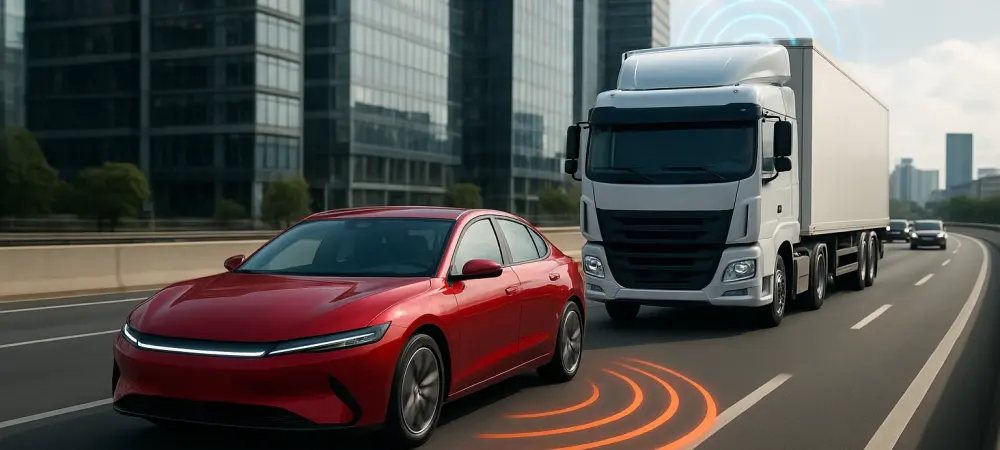
Variational Mode Decomposition allows systems to isolate slow-moving network trends from the high-frequency noise that typically obscures latency patterns. This advancement is particularly crucial in 2026, as the automotive sector rapidly shifts toward an ecosystem defined by autonomous driving and persistent, high-speed connectivity. In this modern landscape, Vehicle-to-Everything (V2X) communication has become the vital lifeline that enables cars to exchange vast amounts of telemetry and high-definition sensor data with surrounding infrastructure in real-time. The operational integrity of these systems is almost entirely dependent on network latency, where the margin for error is razor-thin; often, the difference between a successful emergency maneuver and a severe collision is measured in a mere handful of milliseconds. When a vehicle’s onboard computer is insufficient for processing intensive workloads—such as complex object detection or multi-lane trajectory planning—it must rely on offloading those tasks to external 5G edge infrastructure. A comprehensive study from the North China University of Technology has recently pinpointed a primary bottleneck in this process: the inability of current network models to accurately predict end-to-end propagation delay. Led by researcher Daqian Liu, the team discovered that volatile 5G environments make task offloading a high-risk gamble if the network’s behavior remains unpredictable. By introducing a framework that merges signal decomposition with statistical uncertainty quantification, these researchers have provided a viable roadmap for making 5G-enabled offloading reliable enough for mission-critical safety applications across the global automotive industry.
Overcoming Network Instability: The Wireless Challenge
The transition to fully autonomous transport requires a level of network reliability that traditional wireless systems have historically struggled to provide. The core issue lies in the fact that vehicular environments are fundamentally different from the static conditions found in residential or office-based 5G applications. As vehicles move at high speeds, they encounter a rapidly changing physical landscape that includes dense urban canyons, massive concrete overpasses, and long tunnels, all of which interfere with signal propagation. These factors lead to multi-path fading and frequent handovers between base stations, creating a high-variance environment where the available bandwidth and latency can shift within a fraction of a second. Furthermore, the 5G spectrum is a shared resource; a single base station might be managing the data demands of hundreds of individual users simultaneously, from pedestrians streaming high-bitrate video to industrial IoT sensors in nearby smart factories. This localized congestion adds another layer of unpredictability, making it nearly impossible for a vehicle to guarantee that its offloaded task will be returned within the necessary safety window. Without a way to anticipate these fluctuations, the potential for a “latency spike” remains a constant threat to the safety of autonomous maneuvers.
Addressing Stochastic Volatility in 5G
The researchers identified that the most significant hurdle in modeling these network conditions is the “stochastic volatility” or the random, high-frequency changes that characterize 5G latency. Unlike predictable systems where patterns repeat with high fidelity, 5G latency is influenced by a chaotic mix of environmental factors and user-driven network loads. High-speed mobility, often reaching 120 kilometers per hour on highways, means that a vehicle’s connection profile is in a constant state of flux. Traditional methods of forecasting often view this complexity as a single, messy data stream, which makes it incredibly difficult to extract meaningful predictions. By recognizing that the latency signal is actually composed of different underlying behaviors—some of which are slow-moving and stable, while others are fast and erratic—the team shifted the focus toward a multi-layered analysis. This perspective allows the system to treat the predictable aspects of the network separately from the sudden, sharp bursts of noise caused by temporary obstructions or sudden surges in local traffic. This nuanced understanding of volatility is essential for creating a model that can provide useful information to a vehicle’s decision-making engine before a safety-critical offloading event occurs.
The Failure of Conventional Point Predictions
In the current landscape of machine learning, many existing models rely on “point predictions,” which attempt to forecast a single, specific value for future delay based on historical data patterns. While these models can achieve high accuracy under stable conditions, they are notoriously “brittle” when faced with the unexpected fluctuations of a real-world 5G network. For safety-critical automotive applications, a prediction that is “correct on average” is fundamentally insufficient; even a single missed deadline for a remote processing task could lead to a catastrophic failure of the vehicle’s navigation system. If a model predicts a 10-millisecond delay and the actual delay turns out to be 15 milliseconds, the autonomous vehicle might not receive the necessary trajectory update in time to avoid an obstacle. These point-based estimates fail to account for the inherent “noise” and uncertainty of the wireless medium, often giving the vehicle a false sense of security. The research from North China University of Technology highlights that for 5G task offloading to be truly safe, the system must move beyond these simple guesses and instead provide a range of possibilities that allows the vehicle to plan for the worst-case scenario.
Innovative Two-Stage Methodology: Precision and Confidence
To address the inherent unpredictability of the 5G environment, the research team developed a sophisticated two-stage pipeline that draws inspiration from the forecasting techniques used in high-stakes energy grid management. This innovative approach recognizes that a single algorithmic pass is not enough to tame the complexity of modern network latency. The first stage of the methodology focuses on data refinement and simplification through Variational Mode Decomposition. By breaking the raw, noisy latency signal into multiple sub-components, the system can analyze the overarching trends and the periodic fluctuations without being distracted by the chaotic “jitter” that usually masks the underlying signal. This decomposition process effectively “cleans” the data, making it much easier for the subsequent predictive models to identify the trajectory of the network’s performance. It allows the model to see the signal through the noise, providing a much clearer picture of how the network is likely to behave in the coming milliseconds. This clarity is the foundation upon which the second stage of the process—quantifying the remaining uncertainty—is built, ensuring that the final output is not just a guess, but a mathematically grounded forecast.
Signal Decomposition via Variational Mode Decomposition
Variational Mode Decomposition serves as the critical first step in this new framework, acting as a high-tech filter that separates the latency data into its constituent parts. In a typical 5G environment, a latency signal is a combination of long-term trends, such as the gradual increase in congestion during peak commute hours, and short-term transients, such as the brief signal loss when passing behind a skyscraper. By applying this decomposition technique, the system isolates these “modes” so they can be modeled independently. The slow-moving trends represent the “signal,” providing a baseline of what the vehicle can expect from the network, while the fast-moving transients are treated as the “noise” that needs to be accounted for. This separation is vital because it prevents the high-frequency noise from overwhelming the predictive algorithm. Instead of trying to find a pattern in a chaotic mess of data points, the system focuses on the stable components of the network’s behavior. This process significantly improves the accuracy of the baseline prediction, ensuring that the vehicle has a reliable starting point for deciding whether or not to offload a specific task to the edge server.
Uncertainty Quantification with Kernel Density Estimation
The second pillar of the researchers’ methodology involves moving beyond the limitations of single-value estimates by implementing “interval predictions.” Using a statistical technique known as Kernel Density Estimation (KDE), the framework models the distribution of residual errors—essentially the “misses” that the primary prediction model might make. Instead of telling the vehicle that the delay will be exactly 12 milliseconds, the system provides a confidence interval, stating that there is a 95% probability the delay will fall between 10 and 14 milliseconds. This shift toward probabilistic forecasting is a game-changer for automotive safety. It allows the task-offloading algorithm to plan around the “worst-case scenario” within that confidence interval. If the upper limit of the predicted delay exceeds the time budget required for a safe maneuver, the vehicle can choose to process the task locally or adjust its speed to increase the safety margin. By quantifying the uncertainty of the network connection, the system provides the vehicle with a realistic assessment of the risks involved in offloading, turning an unpredictable wireless link into a manageable and quantifiable resource.
Integration with Global Standards: Architectural Realism
A defining characteristic of this research is its commitment to practical, real-world implementation by aligning with the established 3GPP Release 16 standards. The team proposed that their prediction framework be integrated directly into the Network Data Analytics Function (NWDAF), which is a centralized hub within the 5G core designed specifically for data processing and network optimization. By placing the “intelligence” of the prediction model within the core network rather than on individual vehicles, the system can leverage a much broader dataset. The NWDAF can aggregate latency information from thousands of vehicles and sensors across a wide geographic area, providing a holistic view of network performance that no single car could achieve on its own. This centralized approach ensures that the model is always working with the best possible data, reflecting the current state of the entire local infrastructure. This alignment with existing telecommunications standards makes the solution highly attractive to network operators and automotive manufacturers alike, as it can be deployed on the 5G infrastructure that is already being rolled out globally in 2026.
Centralized Intelligence via the NWDAF
Integrating the prediction framework into the Network Data Analytics Function represents a strategic move toward “network-aware” autonomous driving. In this configuration, the NWDAF acts as a centralized brain that monitors the health and performance of the 5G slices dedicated to V2X communication. When a vehicle needs to offload a task, it queries the NWDAF for a latency forecast. The NWDAF, having processed data from across the sector using the signal decomposition and uncertainty models, returns a high-precision interval prediction. This centralized model is far more efficient than having each vehicle attempt to build its own localized map of the network. Because the NWDAF has access to the internal telemetry of the base stations and the traffic patterns of the entire cell, it can anticipate congestion events before they even affect the vehicle. This “birds-eye view” of the network enables the system to provide much more reliable forecasts, especially during complex handover events where a vehicle is moving from one cell to another. This level of foresight is critical for maintaining the continuous, low-latency connection required for Level 4 and Level 5 autonomous driving systems.
Enhancing Efficiency and Hardware Compatibility
Beyond the benefits of centralized data, housing the prediction machinery within the NWDAF offers significant advantages for the vehicles themselves. Modern autonomous cars are already packed with heavy-duty hardware required for steering, braking, and local sensor fusion; adding the computational burden of complex signal decomposition and statistical modeling would further strain these resources. By offloading the “prediction of the offloading” to the 5G core, the vehicle preserves its onboard processing power for mission-critical safety functions. Furthermore, this architectural choice ensures that the solution is compatible with a wide range of hardware from different manufacturers. Since the heavy lifting is done by the network, vehicles only need to be able to receive and interpret the standardized forecast data sent by the NWDAF. This creates a scalable and cost-effective solution that can be implemented across entire fleets without requiring expensive hardware upgrades. By standardizing the way latency is predicted and communicated, the researchers have paved the way for a more unified and safer V2X ecosystem that benefits all road users.
Validation and Future Outlook: Toward Deterministic Performance
The research team conducted extensive validation of their model using high-fidelity simulations that accurately mirrored the complexities of 2026-era vehicular mobility and varying 5G network loads. These simulations were designed to test the model under extreme conditions, including high-speed highway travel and dense urban traffic where base station handovers are frequent and unpredictable. The results of these tests were remarkably consistent, demonstrating that the new framework could handle the inherent “noise” of the wireless environment with unprecedented precision. By comparing their results against industry-standard deep learning models, the researchers showed that their two-stage approach was not only more accurate but also more reliable in predicting the “tail end” of latency distributions—those rare but dangerous lag spikes that point-prediction models often miss. This rigorous validation process provides the necessary evidence for automotive manufacturers to begin considering edge-based offloading for a wider range of safety-critical tasks, moving the industry closer to a future where remote processing is as dependable as local hardware.
Proven Performance and Reliability Metrics
The empirical results generated during the simulation phase highlighted the significant technical leap achieved by this new model. The framework reached a Mean Absolute Percentage Error (MAPE) of just 1.721%, which represents an approximate 40% improvement over existing industry benchmarks for network delay forecasting. More importantly for safety applications, the team found that the actual network latency fell within the model’s predicted confidence interval nearly 95% of the time. This high level of “coverage” is the most critical metric for V2X safety, as it ensures that the vehicle’s “worst-case” planning is almost always grounded in reality. These statistics indicate that the model is exceptionally good at identifying not just the average delay, but the limits of how slow the network might become during a specific window. This reliability allows for much more aggressive and efficient use of edge computing resources, as the system no longer needs to maintain excessively large “safety buffers” that waste bandwidth. Instead, the vehicle can operate closer to the network’s true performance limits, knowing that the risk of an unpredicted delay spike has been mathematically minimized.
The Path to AI-Native 6G Networking
The research team successfully demonstrated that shifting the focus from simple averages to comprehensive interval-based forecasting was the key to unlocking the potential of 5G V2X offloading. They proved that by treating network latency as a statistical distribution rather than a fixed number, engineers could build safety buffers that were both efficient and effective. Looking forward, the immediate next step for the automotive industry involves migrating these models from simulated environments to live, large-scale urban pilot programs. This will require close collaboration between vehicle manufacturers and telecommunications providers to ensure that the prediction logic is deeply embedded within the edge hardware. Furthermore, as the industry begins to define the technical requirements for 6G, this study serves as a foundational blueprint for “AI-native” networks that prioritize deterministic performance. Stakeholders should prioritize the deployment of centralized analytics functions that can handle these complex decomposition algorithms in real-time. By turning the once-erratic nature of wireless communication into a quantifiable and manageable resource, the industry effectively secured the temporal map necessary for autonomous fleets to navigate the increasingly crowded and complex digital landscapes of the near future.