

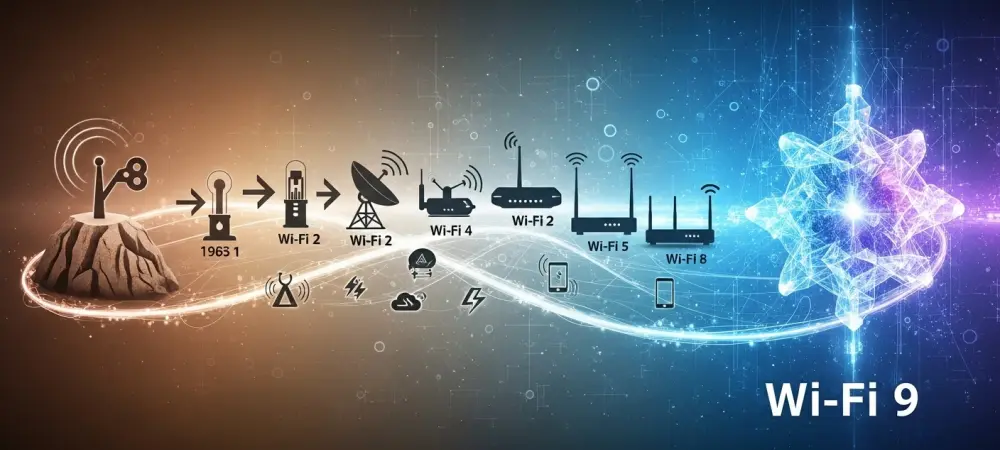
The seamless transition of a digital twin moving in perfect synchronization with its physical counterpart is no longer a laboratory dream but a looming technical requirement for the next decade of wireless connectivity. While the current global rollout of Wi-Fi 7 has provided a much-needed boost to throughput, the conversation among architectural visionaries and standardization bodies has already shifted toward the specialized requirements of 2030 and beyond. This evolution represents a departure from the historical obsession with “peak speeds” in favor of a new, more sophisticated metric: deterministic reliability. As the industry moves through the development of Wi-Fi 8 (802.11bn), the groundwork for Wi-Fi 9 is being laid to ensure that the “last hop” of the network is as dependable as a fiber-optic cable.
The Shift from Throughput to Predictable Performance
Market Drivers: The Demand for Deterministic Latency
The modern connectivity landscape is currently grappling with a significant structural bottleneck where ultra-high-speed fiber networks meet the limitations of local wireless distribution. With 10G and 25G PON deployments expanding rapidly between 2026 and 2029, the capacity coming into the building often dwarfs what the average wireless router can effectively distribute to multiple high-demand devices simultaneously. This gap necessitates a standard that moves beyond “best-effort” delivery, which often suffers from unpredictable jitter and packet loss.
Market data suggests that the sheer density of high-performance electronics in smart environments is reaching a critical mass, requiring a fundamental redesign of how spectrum is managed. In both residential and enterprise sectors, the focus is pivoting toward low-latency necessity rather than just raw bandwidth. This transition is fueled by the realization that for a network to be truly modern, it must provide a guaranteed level of service that can support a dozen concurrent multi-gigabit streams without a single millisecond of unmanaged delay.
Real-World Applications: From XR to Autonomous Systems
The shift toward Wi-Fi 9 is most visible when examining the rise of Extended Reality (XR) and haptic feedback systems, which require “motion-to-photon” latency of less than 5ms to maintain immersion and prevent user discomfort. Current standards, while fast, often struggle to maintain this level of precision under heavy load. In contrast, the next generation of networking is designed to function as a wireless nervous system, providing the instantaneous feedback loop necessary for professional 3D collaboration and the “Internet of Senses” where touch and physical sensation are transmitted digitally.
Industrial environments are also acting as a primary catalyst for these advancements, particularly in the deployment of autonomous mobile robots (AMRs) and complex industrial robotics. These machines require a level of network predictability that allows them to navigate crowded warehouse floors or medical facilities with absolute safety. By ensuring that every command and sensor reading is transmitted with guaranteed responsiveness, Wi-Fi 9 principles enable a level of automation that was previously only possible with cumbersome physical tethering.
Expert Perspectives on the Wi-Fi 9 Vision
The consensus among working groups at the IEEE and leading infrastructure providers like Nokia emphasizes a transition toward “predictability” as the defining characteristic of future connectivity. Experts argue that the industry has reached a point of diminishing returns regarding theoretical maximum speeds; instead, the value now lies in “responsiveness.” This vision positions Wi-Fi 9 as a refined, intelligent partner to 6G wide-area networks, creating a unified ecosystem where the transition between indoor Wi-Fi and outdoor cellular is completely invisible to the user and the application.
Efficiency is also taking center stage in expert discussions, as the power demands of multi-gigabit networking must be balanced against the limited battery life of wearables and mobile sensors. Engineers are focusing on sophisticated sleep-and-wake cycles and more efficient signal processing to ensure that higher performance does not result in shorter device longevity. This holistic approach ensures that the leap in capability is sustainable for the billions of battery-operated IoT devices expected to join the global network in the coming years.
Future Outlook: Navigating the Immersive Digital Era
The trajectory toward the 2030s suggests that artificial intelligence will move from the cloud to the very edge of the network, with Wi-Fi 9 access points autonomously managing spectrum in real-time. By analyzing user behavior and environmental interference, these systems will preemptively allocate resources to the most critical tasks, such as a remote surgical procedure or a high-stakes financial transaction. This move toward AI-driven network management represents the end of manual configuration and the beginning of truly self-healing wireless infrastructure.
However, the path forward is not without significant hurdles, particularly regarding global spectrum allocation and the prevention of hardware fragmentation. International standardization remains the greatest challenge, as different regions must align on frequency usage to ensure that a device manufactured in one part of the world remains fully functional in another. Successfully navigating these regulatory waters will be essential for the socio-economic impact of the standard, as it seeks to bridge the gap between physical reality and digital utility on a global scale.
Sustainability is emerging as the final, critical pillar of this evolution, where efficiency is not just a technical goal but a green initiative. The future of connectivity must account for the energy footprint of massive data centers and millions of local access points. By optimizing data transmission protocols to use less energy per bit, the industry aims to provide the infrastructure for a hyper-connected world without compromising global climate targets, ensuring that the immersive era is as responsible as it is advanced.
The evolution toward Wi-Fi 9 represented a fundamental maturation of wireless technology, shifting the focus from how much data can be sent to how reliably it can be delivered. Industry leaders recognized that the next generation of digital services—from autonomous robotics to tactile haptic interfaces—depended on a network that could guarantee performance under pressure. Stakeholders began prioritizing early alignment on spectrum and AI integration to avoid the fragmentation that hindered previous transitions. This strategic foresight ensured that the infrastructure was prepared for the high-density, low-latency demands of an AI-integrated society. The focus shifted to developing hardware that balanced extreme performance with environmental sustainability, cementing Wi-Fi 9’s role as the indispensable link in the modern digital chain.