

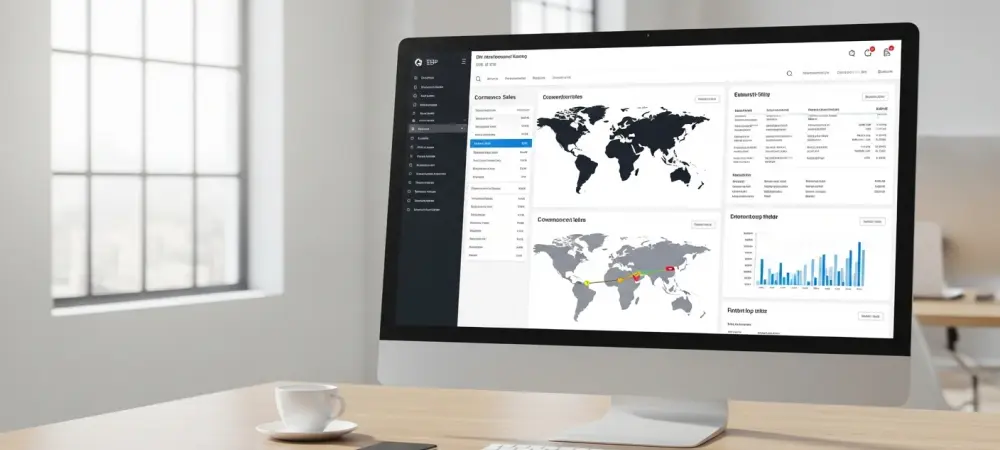
The standard architecture of digital commerce is undergoing a foundational realignment as organizations move away from the fragmented “best-of-breed” approach toward systems where the Enterprise Resource Planning (ERP) core dictates every online interaction. This shift is not merely a technical preference but a strategic response to the increasing complexity of global supply chains and the need for absolute data synchronization. By centering operations within a single environment, businesses are finally closing the gap between the warehouse floor and the digital storefront.
The Rise of ERP-Centric Digital Commerce
Market Adoption and the Shift Toward Integrated Ecosystems
Current market data indicates a decisive trend where mid-market and enterprise-level organizations are abandoning standalone webstores in favor of ERP-governed models. Recent adoption statistics suggest that over 65% of new digital commerce deployments within the Microsoft Dynamics 365 Business Central and NAV ecosystem now prioritize “native” integration over traditional middleware. This movement is driven by a growing realization that the cost of maintaining separate data silos often outweighs the initial convenience of a quick-launch web platform.
As we look at the trajectory from 2026 to 2030, the demand for a “single source of truth” has transitioned from a competitive advantage to a baseline requirement for survival. Companies operating in both B2B and B2C sectors are reporting that customer expectations for real-time accuracy are at an all-time high. This has forced a migration toward architectures where the ERP serves as the heart of the commerce engine, ensuring that every inventory update or price change is reflected globally in milliseconds rather than hours.
Real-World Applications: From Operational Drift to Unified Logic
The concept of “operational drift”—where the online store and the back-office ERP gradually stop speaking the same language—is being systematically dismantled by ERP-governed technologies. In practical application, this means that instead of having a website that tries to mimic the ERP’s rules, the website is actually a window into the ERP itself. Specialized solutions like Nav-to-Net™ have pioneered this space by building commerce functionality directly inside the Dynamics environment, allowing businesses to manage their entire web presence without ever leaving their familiar ERP interface.
Industries characterized by high-volume transactions and complex pricing structures, such as industrial manufacturing or wholesale distribution, are the primary beneficiaries of this shift. For instance, a distributor with thousands of SKUs and unique contract pricing for every client can no longer afford the manual labor required to sync data between a web platform and Business Central. By utilizing a native approach, these companies ensure that a customer sees their specific, negotiated price the moment they log in, directly pulled from the ERP’s internal logic tables without the risk of synchronization lag.
Industry Perspectives on Strategic Alignment
Technology consultants and industry experts increasingly view eCommerce as a core operational strategy rather than a secondary marketing project. The consensus among digital transformation leaders is that the era of “bolt-on” solutions is reaching its natural conclusion. Experts warn that the hidden maintenance costs—often referred to as “technical debt”—associated with keeping disparate systems connected can eventually cripple a company’s ability to pivot in a fast-moving market. When the bridge between the store and the ERP breaks, the resulting manual reconciliation burden often requires additional headcount that negates the profitability of the online channel.
From a leadership perspective, the focus has shifted toward maximizing the Return on Investment (ROI) of existing infrastructure. Executive teams are no longer satisfied with a beautiful website if it does not contribute to margin protection and operational leaness. By consolidating the technical stack, leadership ensures that business logic remains centralized, making it easier to implement company-wide changes. This consolidation allows for a more aggressive pursuit of profitability, as it removes the friction and errors inherent in manual data entry, providing a clearer path to sustainable growth.
The Future Landscape of ERP-Governed Commerce
The trajectory of ERP-native technologies suggests a future defined by AI-driven automation and hyper-granular business intelligence. As data becomes more unified within the ERP, predictive analytics will likely move beyond simple sales forecasting toward autonomous supply chain adjustments. In this evolving landscape, the ERP could theoretically anticipate a surge in demand for a specific region and automatically adjust webstore promotions or inventory allocations in real-time. This level of responsiveness is only possible when there is no latency between the sales channel and the inventory management system.
While the positive outcomes include unprecedented scalability and agility, the path forward is not without its hurdles. The move toward leaner, more integrated software stacks requires a high degree of specialized technical expertise during the initial deployment phase. Organizations must move away from generalist web developers and toward consultants who understand the deep architectural nuances of Microsoft Dynamics. However, those who navigate this transition successfully will find themselves with a significantly more agile business model, capable of expanding into new global markets with minimal technical overhead and a much smaller footprint of middleware.
Strategic Summary and the Path to Scalability
The shift from simply “selling online” to a comprehensive model of “operating digitally” has redefined the relationship between technology and commerce. For years, the ERP was viewed as a back-office utility, but it has now emerged as the cornerstone of digital transformation. This transition ensures that the rules governing a business are applied consistently across every touchpoint, protecting the integrity of the brand and the health of the bottom line. The movement toward ERP-governed strategies represents a maturation of the digital marketplace, where efficiency and control are valued as much as customer acquisition.
Executives who evaluated their digital strategies in the past found that prioritizing operational control over superficial features led to more resilient organizations. The decision to build outward from the ERP core proved to be the most effective way to eliminate the friction of modern commerce. Looking ahead, the focus will remain on refining these integrated ecosystems to support even more complex global trade requirements. Businesses that embraced this unified approach secured a foundation that not only supported their current volume but also provided the necessary infrastructure to scale into the next decade without the traditional growing pains of disconnected software.