

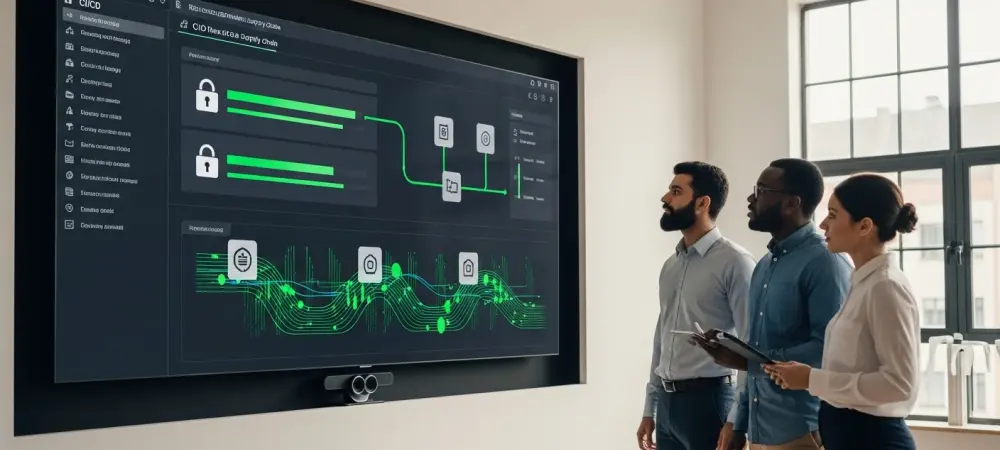
The digital architecture of a modern enterprise is only as resilient as the automated factory that produces its code, yet this very machinery is becoming the most exploited weakness in the global tech stack. As software delivery cycles have compressed from months to minutes, the Continuous Integration and Continuous Deployment (CI/CD) pipeline has evolved into a sprawling, interconnected nervous system. While this shift toward cloud-native efficiency has unlocked unprecedented innovation, it has also inadvertently created a massive, opaque attack surface. Adversaries are no longer just looking for a way into the data center; they are looking for a way into the build process, realizing that a single injection at the source can compromise thousands of downstream environments simultaneously. This shift from network-level infiltration to supply chain poisoning represents the most significant security paradigm change of the current decade.
The Growth of the Software Supply Chain Threat Landscape
Adoption Statistics and Market Evolution
The statistical reality of the current threat landscape is stark, as industry data reveals that software supply chain attacks have surged by nearly 300% since the mid-2020s. This explosion in incident rates is not merely a byproduct of more software being written, but a direct result of attackers identifying the CI/CD pipeline as the path of least resistance. Security teams have historically focused on hardening the perimeter, but the perimeter is irrelevant when the malicious code is delivered through a legitimate, signed update. Consequently, global investment in DevSecOps tools is accelerating rapidly, with spending projected to grow at a compound annual growth rate of over 20% through the end of the decade. This financial commitment reflects a desperate need to secure the automated build environments and containerized workloads that define modern production.
Despite the widespread adoption of “shifting left”—the practice of integrating security earlier in the development lifecycle—the maturity of these implementations remains inconsistent. While more than 70% of enterprise organizations now incorporate basic vulnerability scanning into their workflows, these tools often fail to catch sophisticated workflow injection attacks. Many organizations are still relying on legacy scanning technologies that look for known CVEs in static code but remain blind to the dynamic threats within the pipeline configuration itself. This gap between basic automation and advanced integrity protection has left a window of opportunity for attackers to exploit the very tools meant to accelerate business value.
Real-World Applications and High-Profile Breaches
The legacy of the SolarWinds incident continues to cast a long shadow over the industry, serving as the definitive case study for how compromised pipeline integrity can dwarf the impact of a traditional data breach. By infiltrating the build system rather than the source code directly, the attackers ensured that the resulting binary was cryptographically signed and distributed as a trusted update. This proved that the software factory is the ultimate prize for state-sponsored actors. More recently, the GhostAction campaign underscored the fragility of automated trust within popular platforms like GitHub. By leveraging malicious pull requests to exfiltrate thousands of secrets, attackers demonstrated that even the most widely used DevOps ecosystems are susceptible to “poisoning the well” if the trust relationships between repositories and build runners are not strictly audited. In response to these escalating threats, the industry is moving toward a more structured verification framework, specifically the Supply-chain Levels for Software Artifacts (SLSA). This standard provides a checklist of requirements to ensure that artifacts are not tampered with during the build process. Leading technology firms are now mandating these verifiable provenance records, forcing a shift away from “blind trust” in build outputs toward a model of continuous, cryptographic proof. This transition is not just about adopting new tools but about fundamentally changing how the software industry defines a “secure” release, prioritizing the history of the artifact as much as the code it contains.
Expert Perspectives on Modern Pipeline Vulnerabilities
The Fallacy of Automated Trust
Security architects increasingly argue that the greatest strength of DevOps—its frictionless, automated nature—is simultaneously its most dangerous vulnerability. The philosophy of “everything as code” means that the configurations governing the pipeline are often treated with less scrutiny than the application code they manage. Experts emphasize that every internal integration, from a simple webhook to a cloud provider service connection, must be treated as a potential path for lateral movement. When a pipeline is granted broad permissions to modify infrastructure, any compromise of that pipeline effectively hands the keys to the entire cloud environment to the attacker. This realization is forcing a move away from static trust models toward more dynamic, context-aware security layers. The ownership gap remains a critical cultural hurdle that many organizations have yet to clear. CI/CD infrastructure frequently falls into a “grey zone” of responsibility, sitting uncomfortably between development teams focused on speed and security operations teams focused on risk. This lack of clear stewardship often results in build servers that go unpatched for months and API keys that remain active long after their intended use. Thought leaders in the space suggest that until the software factory is managed with the same operational rigor as a production database, it will remain an easy target. Bridging this silo is not a technical challenge but a management one, requiring a cultural shift where the integrity of the delivery path is seen as a core business metric.
Secrets Proliferation and Credential Sprawl
The explosion of cloud-native microservices has led to an unsustainable proliferation of secrets, creating what experts call “secret sprawl.” Every automated step in a modern pipeline requires an identity, a token, or a key to interact with other services. When these credentials are static and long-lived, they become “ticking time bombs” waiting to be discovered in a misconfigured log or an exposed environment variable. The transition from these static keys to dynamic, short-lived credentials is no longer a luxury for high-security environments but a baseline requirement for any organization operating in the cloud.
Security veterans warn that the sheer volume of integrations in a typical DevOps stack makes traditional credential management impossible. Modern strategies now focus on “identity-based” security, where build runners are issued temporary tokens that expire within minutes or even seconds. This approach significantly limits the window of opportunity for an attacker even if they manage to intercept a secret. Moreover, the move toward “secretless” architectures, which rely on workload identity rather than shared strings, is gaining momentum as the most effective way to eliminate the risks associated with manual credential handling and storage.
The Future of CI/CD Security: Trends and Implications
Autonomous Remediation and AI-Driven Defense
The next frontier of pipeline protection is shifting toward autonomous remediation, where security is no longer just a passive observer but an active participant in the workflow. We are seeing the rise of AI-driven security agents that do more than flag a vulnerability; they analyze the context of a pull request and automatically generate a patch or a configuration fix. This trend aims to solve the “alert fatigue” that has long plagued DevSecOps teams by reducing the time between detection and resolution to nearly zero. By embedding these intelligent agents directly into the developer’s existing tools, organizations can maintain high deployment velocity without sacrificing security standards.
However, this level of automation is a double-edged sword. While it can accelerate defensive measures, it also provides adversaries with the ability to scale their attacks with terrifying speed. An attacker who successfully injects a malicious dependency into a widely used library can see that code propagate across thousands of downstream consumers in a matter of minutes. This reality makes the speed of detection and the ability to “quarantine” a pipeline the most critical metrics for future security operations. The arms race is no longer just about who has the better code, but who has the faster, more intelligent automation.
Zero-Trust Pipelines and Cryptographic Identity
The concept of “Zero-Trust,” which has revolutionized network security, is now being applied to the build process itself. Future developments are moving toward a model where build runners are treated as untrusted entities by default. In this scenario, every step in a pipeline—from the initial code check-in to the final container push—must cryptographically prove its identity and the integrity of its environment before it can access sensitive secrets or production systems. This move toward “attestation-based” security ensures that even if a build server is compromised, the attacker cannot impersonate a legitimate process because they lack the necessary hardware-backed or ephemeral proofs of identity.
Regulatory pressure is also becoming a significant driver of change. Governments around the world are increasingly mandating the use of Software Bill of Materials (SBOMs) for any software used in critical infrastructure or government contracts. This regulatory shift is forcing organizations to achieve total transparency in their dependency trees, making it impossible to hide “shadow” dependencies or unpatched components. This move toward transparency will likely result in a “clean-up” of the open-source ecosystem, as maintainers and enterprises alike are held accountable for the security of the libraries they provide and consume. Compliance is moving from a checkbox exercise to a continuous, automated validation of the entire supply chain.
Summary and Strategic Outlook
Securing the cloud-native pipeline was once considered a specialized concern for high-security firms, but it has now become the fundamental challenge of modern enterprise IT. The transition from traditional perimeter defense to a focus on artifact integrity and identity-based security reflects the reality that the “nervous system” of the business is under constant threat. Organizations that successfully navigated this transition did so by adopting a multi-layered defense strategy that prioritized secret management, mandatory code signing, and the elimination of automated trust. They recognized that in a world of rapid deployment, the speed of the pipeline must be matched by the rigor of its security controls.
The strategic outlook for the coming years emphasized that the integrity of the CI/CD process was synonymous with the integrity of the business itself. As global adversaries focused their efforts on the software factory, the most resilient organizations were those that treated their build infrastructure with the same level of care as their most sensitive production data. The primary takeaway from this period was that security could no longer be an afterthought or a “gate” at the end of a project; it had to be woven into the very fabric of the automation. By hardening the pipeline through dynamic secrets and zero-trust principles, the industry established a new baseline for digital trust that protected both the developer and the end-user. To stay resilient in this environment of automated threats, organizations prioritized the implementation of hardened pipelines and foster a culture of shared responsibility. Leaders moved toward adopting mandatory attestation for every build step and ensured that all third-party integrations followed the principle of least privilege. They also invested heavily in the technical training of their development teams, turning them into the first line of defense against supply chain poisoning. Ultimately, the successful strategy was not about stopping all attacks but about building a system that was structurally resistant to compromise and capable of rapid, autonomous recovery when breaches occurred.