

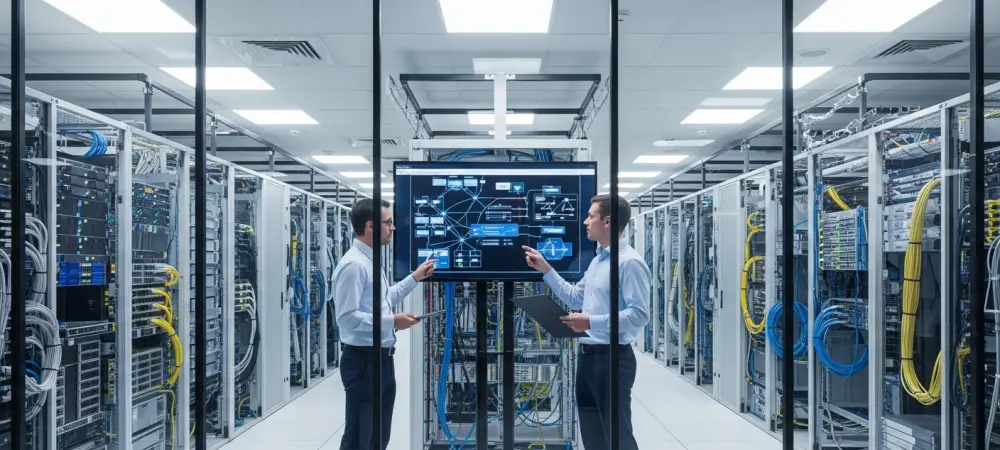
The sudden realization that the physical infrastructure required for generative artificial intelligence is fundamentally different from traditional software-as-a-service workloads has sent ripples through the global tech industry. For over a decade, the migration toward a cloud-first strategy seemed like an inevitable path for every modern enterprise, promising infinite scalability without the burden of maintaining heavy hardware. However, as the computational intensity of large language models grows, the hidden costs of electricity, cooling, and specialized networking are becoming impossible to ignore in the annual budget reports. Major tech giants are currently pouring hundreds of billions of dollars into data center expansions, yet the centralized model of the public cloud is beginning to show cracks under the pressure of such unprecedented demand. Businesses are now pivoting toward a more nuanced approach, one that balances the rapid innovation of public platforms with the cost-effectiveness and control of local or specialized systems.
The Role of Public Clouds in Early Development
Speed and Accessibility for Initial AI Projects
Public cloud providers have established themselves as the indispensable starting line for any serious artificial intelligence project because they offer immediate access to the latest GPU clusters and pre-configured development environments. When an organization decides to explore the potential of a new generative model, the speed at which they can provision high-performance instances determines their ability to stay competitive in a market that moves at breakneck speeds. This level of accessibility removes the traditional barriers to entry, such as the multi-month lead times for hardware delivery or the specialized labor required to wire high-speed InfiniBand networks. By leveraging these existing environments, engineering teams can focus entirely on fine-tuning algorithms and validating business use cases. The initial phase of AI development is characterized by high uncertainty, and the ability to spin up thousands of cores for training remains a powerful advantage that on-premises hardware cannot match.
In these early stages, the convenience of a managed environment is usually more important than the cost of the service, providing a flexible space where companies can launch pilot programs with very little risk. If a project fails to yield the expected results, the organization can simply terminate the resources, making the public cloud an essential incubator for innovation in a fast-moving market. This operational agility allows for a fail-fast culture that is vital for discovering the most valuable applications of AI technology without committing to long-term capital expenditures. Furthermore, the global availability of cloud regions ensures that developers can collaborate across borders, sharing massive datasets and model checkpoints with minimal latency. While the long-term economics might eventually favor private systems, the speed of the cloud is the only way to capitalize on immediate market opportunities. This initial reliance sets the stage for a more complex transition as the models move from the lab into the hands of users.
Leveraging Ecosystems for Rapid Prototyping
The value of the public cloud extends beyond raw compute power into the rich ecosystem of integrated software tools and managed services that streamline the entire machine learning lifecycle. Modern cloud-native platforms provide automated pipelines for data labeling, model versioning, and endpoint deployment, which significantly reduces the operational overhead for medium-sized enterprises. During the experimentation phase, the convenience of having integrated security protocols and identity management systems allows developers to iterate quickly without compromising the integrity of corporate data sets. Moreover, these platforms offer pre-trained foundation models that can be customized via fine-tuning, allowing businesses to skip the most expensive part of the process. This model democratizes access to sophisticated technology, enabling even non-technical companies to integrate natural language processing and computer vision into their existing products with relatively minimal effort or specialized talent. By utilizing managed databases and serverless functions alongside AI workloads, organizations create a seamless flow of data that is difficult to replicate in a fragmented on-premises environment. The ability to automatically scale resources in response to user traffic ensures that the user experience remains consistent even during unexpected surges in popularity. This level of automation is particularly beneficial for startups that do not have the resources to maintain a dedicated infrastructure team. Additionally, the availability of specialized APIs for tasks like sentiment analysis, translation, and image generation allows teams to build complex applications by simply connecting existing building blocks. As these services mature, they become deeply embedded in the software architecture, providing a level of reliability that would be costly and time-consuming to build independently. However, this deep integration also creates a form of technical dependency that can make future migrations more difficult if the costs of these services begin to escalate.
Addressing the High Costs of Scaling AI
Navigating the Move from Pilot to Production
The financial reality of AI changes quickly once a project moves from a small trial to full-scale production where the consistency of usage patterns reveals the premium pricing of public cloud services. Running massive AI workloads around the clock can lead to unpredictable and extremely high bills, especially as the number of inference requests scales into the millions. As usage becomes more consistent, the premium prices charged by major cloud providers often become a burden, forcing companies to look for more sustainable alternatives. This realization is leading many enterprises to adopt a strategy of workload repatriation, where they move established tasks back to their own hardware or specialized servers. By identifying which workloads are steady rather than temporary, businesses can choose environments that offer better price performance. The goal is to avoid the high costs of data movement and managed services that can eat into the profits of a successful AI product, ensuring that the technology remains a viable business asset. Achieving cost-efficiency in this transition requires a granular understanding of how different workloads interact with specific hardware architectures and networking configurations. Enterprises are now employing dedicated FinOps teams to monitor spending in real-time and identify which tasks are better suited for specialized, lower-cost environments. For example, a company might use the public cloud for the initial training of a foundation model but move the daily fine-tuning and inference tasks to a colocation facility equipped with liquid-cooled racks. This hybrid strategy allows businesses to capitalize on the massive research and development of cloud giants while insulating themselves from the price fluctuations of spot instances. By carefully decoupling data storage from compute resources, technical architects can move workloads more fluidly between environments based on current market rates for power and processing. This level of strategic maneuvering is becoming a core competency for technology leaders who must balance cutting-edge capabilities with sustainable margins.
Utilizing Specialized Providers and Private Systems
To keep costs under control, many organizations are now exploring neoclouds and private data centers that are specifically designed for the high-density requirements of artificial intelligence tasks. These specialized providers often offer more transparent pricing and denser computing power than general-purpose cloud giants, as their entire stack is optimized for GPUs. For companies with sensitive data or very specific hardware needs, owning their own infrastructure provides both better security and more predictable long-term spending. The most successful businesses will be those that stay flexible and avoid becoming too dependent on a single provider’s technology. By building systems that can move between different environments, companies take advantage of the cloud’s speed while still being able to switch to cheaper options as they grow. This hybrid approach ensures that AI initiatives remain financially viable as the market continues to evolve, allowing for a balanced distribution of resources that leverages unique strengths. Forward-thinking organizations successfully navigated the infrastructure crisis by adopting a diversified approach that prioritized architectural flexibility and data sovereignty. They implemented hardware-agnostic software layers, such as containerized environments and standardized model formats, which allowed workloads to migrate seamlessly between disparate physical systems. Decision-makers established clear metrics for determining when a workload had reached the level of maturity required for repatriation, preventing unnecessary spending on managed services. These teams invested in internal expertise for managing high-performance networks and cooling systems, which turned their private infrastructure into a true competitive advantage. By treating compute power as a strategic commodity rather than a fixed utility, these businesses protected their margins while maintaining the ability to innovate at pace. This transition ultimately proved that a hybrid foundation was necessary for the long-term sustainability of the AI industry, as it offered the best balance of agility, cost control, and security.