

The global smartphone market has finally reached a saturation point where mere iterative updates no longer suffice to drive consumer excitement or brand loyalty. As Apple prepares to deploy its long-anticipated “iPhone Ultra,” the company is signaling a shift that transcends the simple pursuit of a flexible display. While first-generation foldable pioneers focused on the novelty of a screen that bends, this new engineering philosophy prioritizes a repair-first architecture. This strategic pivot suggests that the next decade of mobile technology will not be defined by who was first to market, but by who can maintain a device’s longevity in an increasingly regulated and environmentally conscious landscape.
Market Evolution and Technical Implementation
Data Trends in the Foldable Sector: The Push for Serviceability
Market data from 2026 reveals a maturing foldable segment where the initial fascination with folding glass has been replaced by pragmatic concerns regarding durability. Statistical insights indicate that a significant portion of potential premium buyers has hesitated to switch to foldables due to the high failure rates and astronomical repair costs associated with internal displays. Furthermore, the “Right to Repair” movement has moved from the fringes of activist circles into the heart of legislative halls, particularly within the European Union. These regulatory frameworks are forcing manufacturers to abandon adhesive-heavy internal designs in favor of structures that are accessible to third-party technicians.
The growth projections for the high-end “Ultra” segment reflect a consumer base that views a smartphone as a primary computing platform rather than just a communication tool. As users demand tablet-grade productivity in a pocketable form factor, the engineering requirements have shifted toward supporting intensive multitasking and long-term hardware reliability. This trend has created a vacuum for a device that offers the benefits of a foldable screen without the “disposable” nature of early prototypes. Apple’s entry into this space is timed to capitalize on these shifting sentiments by offering a product that feels like a long-term investment rather than a fragile experiment.
Real-World Engineering Applications: The iPhone Ultra
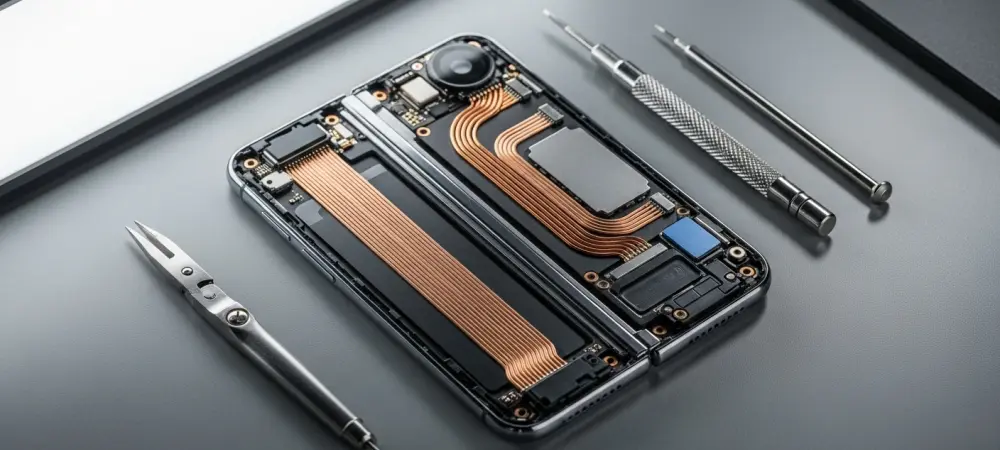
The most notable engineering departure in the iPhone Ultra is the implementation of linear cable routing. In contrast to the tangled ribbon cables found in rival devices, which often loop through high-stress hinge points, Apple has designed a more direct internal pathing system. This choice effectively reduces the mechanical wear and tear that leads to the “black line of death” on folding screens. By optimizing how power and data move across the central fold, the architecture minimizes the risk of friction-induced failures that have historically plagued the category. The internal layout has been completely reimagined to include a dedicated “service corridor” for technicians. By relocating the motherboard to the right chassis and shifting primary control buttons toward the top edge, the design avoids the complex overlaps that usually require hours of labor to disassemble. This modularity allows for the replacement of specific components, such as the volume rocker or charging port, without disturbing the delicate OLED panel or the primary battery. Moreover, the use of a stacked hardware structure enables the inclusion of a high-density 5,400mAh battery while keeping the unfolded profile at a record-thin 4.5mm.
Industry Perspectives on Apple’s Engineering Shift
Technical analysts and repair advocates have observed that this design represents a clean break from the “maze-like” structures seen in previous flagship devices. For years, the industry standard for thin electronics involved permanent bonding and proprietary screws, but the iPhone Ultra’s logical layout suggests that internal organization is now a major branding asset. Experts argue that by making the device easier to fix, Apple is essentially lowering the lifetime cost of ownership, which could prove more persuasive to consumers than a slightly better camera or a faster processor.
There remains, however, a tension between physical modularity and software-based constraints. While the hardware might be easier to pull apart, the practice of “part serialization”—where a specific screen is digitally married to a motherboard—continues to spark debate. Some industry insiders suggest that Apple may use this foldable launch to pilot a more open software validation system, potentially allowing verified third-party parts to function without loss of features like FaceID. This would be a significant concession to global regulators and a major step toward a truly sustainable hardware ecosystem.
Future Implications and Evolutionary Paths
The ripple effects of this “repair-first” engineering will likely force competitors to overhaul their own assembly lines. If the market rewards Apple’s focus on durability, manufacturers who rely on glued-in batteries and fragile display connections will find themselves at a disadvantage. This could lead to a new industry standard where the “repairability score” of a device becomes as vital a metric as its benchmark performance. Consequently, the mobile industry might transition from a cycle of rapid replacement toward a model of long-term software and hardware maintenance.
On the software front, the integration of iPadOS multitasking features into the foldable form factor is expected to redefine the software ecosystem. The ability to run three or four simultaneous apps on a 7.8-inch internal screen effectively bridges the gap between the iPhone and the iPad. This evolution suggests that the future of mobile computing lies in “dynamic displays” that change their interface based on the physical state of the hinge. The challenge for Apple will be maintaining the premium price point in a market where consumers are becoming increasingly sensitive to the initial cost of entry.
Summary of Key Findings and Strategic Outlook
The analysis of Apple’s foldable engineering revealed that the company prioritized a streamlined internal architecture over being the first to enter the market. The implementation of linear cable routing and a dedicated service corridor demonstrated a commitment to reducing mechanical failure points. This logic suggested that the iPhone Ultra was built to endure the rigors of daily use for several years, rather than just the duration of a standard contract. The hardware stacking techniques allowed for an unprecedented battery capacity, proving that serviceability did not have to come at the expense of extreme miniaturization.
Industry leaders recognized that this shift toward modularity responded directly to global regulatory pressure and changing consumer demands. The strategic outlook for the foldable category moved toward a more sustainable and user-centric design philosophy. Ultimately, the engineering choices found in the iPhone Ultra provided a clear blueprint for the next generation of high-end consumer electronics. By focusing on the internal logic of the device, the manufacturer successfully positioned the foldable as a reliable tool for professional productivity rather than a fragile novelty.