

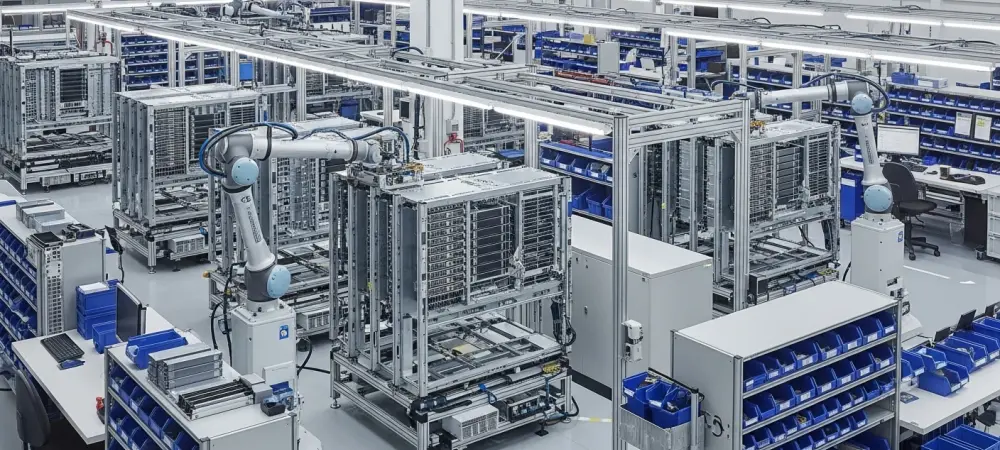
The global electronics landscape has undergone a profound metamorphosis, evolving from a market dominated by pocket-sized consumer gadgets to one anchored by the massive, humming monoliths of high-performance computing centers. This shift represents more than just a change in product catalogs; it is a structural pivot in how the world’s most powerful corporations allocate their capital and how manufacturing giants define their survival. As the digital economy pivots toward intelligence-first operations, the traditional assembly lines that once churned out smartphones are being dismantled to make way for complex, liquid-cooled server racks that serve as the fundamental “bricks” of the generative intelligence era.
The Surge of the AI Server Market
Market Dynamics and Record-Breaking Growth Statistics
Recent fiscal reports from the manufacturing sector reveal a staggering departure from historical revenue patterns, with industry titans reporting year-over-year gains exceeding 24% during what used to be their slowest seasonal windows. This financial explosion is the direct result of a trillion-dollar transition where the world is moving away from general-purpose central processing units toward accelerated computing architectures. The sheer scale of this investment is almost difficult to visualize, as the physical manifestation of these funds takes the form of sprawling data centers that require constant hardware refreshing to keep pace with algorithmic advancements. Capital expenditure forecasts for the current fiscal cycle suggest that the collective spending of “hyperscalers”—a group led by Microsoft, Alphabet, and Meta—is poised to climb well beyond the $200 billion mark. A massive portion of this treasury is being channeled into server rack infrastructure, creating a gold rush for those with the logistical capacity to build them. This investment represents a high-stakes gamble on the future of digital services, ensuring that the manufacturing demand for AI hardware remains insulated from the fluctuations that typically plague the consumer electronics market.
Real-World Integration and the Hyperscale Arms Race
The introduction and deployment of Nvidia’s Blackwell architecture has established a new gold standard for data center operations, necessitating a radical redesign of manufacturing workflows. These high-density systems generate heat levels that traditional air-cooling methods can no longer handle, forcing a move toward specialized liquid-cooled integration. Consequently, the manufacturing process has evolved from simple component snapping to complex thermal engineering, where every millimeter of a server rack is optimized for heat dissipation and energy efficiency.
Organizations like Foxconn, once synonymous with the high-volume assembly of consumer handsets, have successfully rebranded themselves as the primary integrators for these massive computing clusters. Today, the most successful players are delivering fully integrated, high-power computing environments that are essentially “plug-and-play” at a massive scale. This ability to provide a complete infrastructure solution has turned the manufacturing floor into a high-tech laboratory where the physical limits of power and cooling are constantly being tested.
Expert Perspectives on the Manufacturing Pivot
From Build-to-Order to Co-Engineering Partnerships
Industry analysts are observing a fundamental shift in the relationship between designers and builders, characterized by a transition from traditional “build-to-order” models to deep “co-engineering” partnerships. In this new paradigm, manufacturers do not simply wait for a blueprint; they work alongside chip designers from the earliest stages of development to solve the physical constraints of power management. This collaborative approach ensures that the hardware can actually survive the intense workloads demanded by modern neural networks, making the manufacturer a vital contributor to the product’s functional success.
Thought leaders in the field often point to the increasing “stickiness” of the AI supply chain as a primary differentiator from previous technological cycles. The technical complexity involved in constructing an AI-ready server creates a formidable barrier to entry, meaning that the established players who have mastered liquid cooling and high-speed interconnects are unlikely to be displaced by low-cost competitors. This complexity acts as a protective moat, providing a level of long-term stability for the manufacturers who have invested early in these specialized skills.
The Margin Dilemma and Intellectual Property
Despite the record-breaking volumes, experts often highlight the “margin dilemma” that continues to haunt the physical assembly side of the industry. While the revenue figures are at an all-time high, the lion’s share of the profit surplus remains concentrated in the hands of intellectual property owners and chip designers. The manufacturers, while indispensable, are still operating in a competitive environment where operational efficiency is the only way to protect their bottom line. This tension forces companies to look for ways to move “up-stack” by developing their own proprietary cooling technologies or power management systems.
Furthermore, there is a constant pressure to innovate at a pace that matches the software world. If a manufacturer falls behind on the latest interconnect standards or fails to master a new cooling technique, they risk being sidelined in the next wave of data center buildouts. This reality creates a high-pressure environment where constant capital reinvestment is not just a strategy but a necessity for survival. The successful manufacturers of this era are those who can balance the need for massive volume with the technical precision of a specialized engineering firm.
Future Projections and Evolving Implications
Geographic Diversification and Geopolitical Resilience
The next phase of the infrastructure buildout will likely be defined by a significant push for geographic diversification. To mitigate the risks associated with geopolitical friction, production hubs are increasingly being established or expanded in regions like Mexico, Vietnam, and India. This shift is not merely about finding cheaper labor; it is about creating a resilient, globalized supply chain that can withstand regional disruptions. By spreading the physical manufacturing footprint, companies are ensuring that the flow of AI hardware remains steady even if trade relations in one part of the world sour.
Potential headwinds are also appearing on the horizon, specifically regarding the efficiency of AI model training. Innovations like the “DeepSeek” phenomenon suggest that software breakthroughs might eventually reduce the sheer volume of raw hardware required to achieve high-level intelligence. If researchers can train more powerful models with fewer chips, the insatiable demand for physical server racks might eventually find a plateau. However, the current backlog for high-end systems remains deep, suggesting that any moderation in demand is likely several years away.
Energy Integration and the Taiwan-Centric Model
Looking ahead, a convergence of energy infrastructure and server manufacturing is inevitable. The massive power requirements of modern data centers mean that future facilities will likely be designed with integrated renewable energy solutions built directly into the site. Manufacturers may find themselves moving into the energy sector, providing not just the computing power but the modular nuclear or solar systems needed to sustain it. This holistic approach to infrastructure would represent the final evolution of the server manufacturer into a complete utility provider for the digital age.
The “Taiwan-centric” nature of the current hardware stack will continue to be both a source of incredible innovation and a point of extreme vulnerability. As long as the most advanced chips and the most complex assembly processes remain concentrated in a single geographic area, the global tech ecosystem remains tethered to regional stability. This concentration has turned the hardware supply chain into a critical component of international diplomacy, where the ability to build and ship an AI server is as much a matter of national security as it is of corporate profit.
Conclusion: The Physical Backbone of the AI Revolution
The transition toward a global economy anchored by AI infrastructure necessitated a total reimagining of what it means to be a technology manufacturer. While the initial waves of the artificial intelligence boom were focused on software capabilities, the long-term sustainability of these systems relied entirely on the physical capacity of those who could assemble the hardware. Organizations that embraced the technical challenges of liquid cooling and high-density integration successfully distanced themselves from the commoditized world of consumer electronics. They proved that in a digital-first world, the physical “shovels” of the gold rush remained the most reliable source of structural growth.
Strategic decision-makers began to look beyond the immediate revenue spikes, focusing instead on how to integrate renewable energy and localized production to solve the power and political constraints of the future. This led to the development of modular data centers that could be deployed near energy sources, bypassing the limitations of aging power grids. The move toward a more diversified manufacturing footprint also provided a blueprint for navigating a world where trade barriers became as common as technological breakthroughs. By securing their place as the indispensable architects of the digital landscape, these manufacturers insured themselves against the volatility of software trends, ensuring their role remained vital regardless of which specific AI model eventually dominated the market. Through this evolution, the industry demonstrated that the true power of intelligence would always depend on the strength of its physical foundation.